Swimming in the Danube Is a Thing in Budapest — And It’s About to Get Even Better
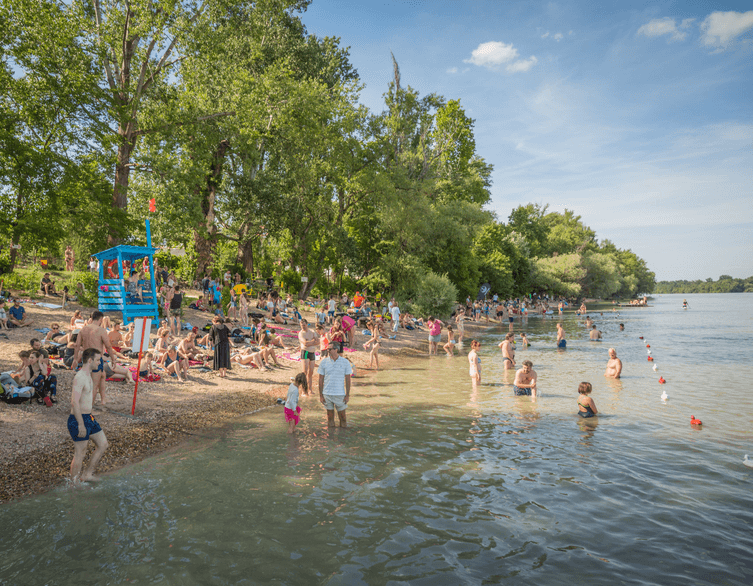
When most people think of Budapest, they picture grand thermal baths, steaming pools, and tourists in fluffy robes looking deeply content with their life choices. What far fewer people know is that you can also swim in the actual Danube river — for free — right in the middle of one of Europe’s most beautiful capital cities. And in 2026, there are not one but two places where you can do exactly that.
A River Reborn
The Danube has not always been the clean, swimmable waterway it is today. For decades, industrial pollution turned it into something you admired from a bridge rather than jumped into. The designated swimming spots along the Római-part (Roman Bank) — historically one of Buda’s most beloved riverside hangouts — were shut down back in 1973 due to deteriorating water quality. That’s right, swimming in the Danube was off the table for nearly half a century.
The comeback began slowly. The Valyo — Város és Folyó Egyesület (City and River Association), a passionate civil organization dedicated to reconnecting Budapest with its river, started pushing for a proper riverside beach as far back as 2013. Eight years of advocacy later, the Római-parti Plázs (Roman Bank Beach) finally reopened in the summer of 2021, becoming the first free riverside beach Budapest had seen in almost 50 years.
Római-parti Plázs: Budapest’s Classic Free Beach
The Római-parti Plázs is back for 2026, open from July through August 20th, and it remains the gold standard of Budapest’s free outdoor swimming scene. Located in the third district on the Buda side, it’s the kind of place where you can stretch out on a sun lounger — provided free of charge by the local council — and feel vaguely smug about the fact that you’re not paying a single forint to be there.
The beach doesn’t just throw you into the river and wish you luck. Water quality is tested rigorously before the season opens and monitored continuously throughout, with authorities required by law to close the beach immediately if any readings exceed safe bathing standards. Swimming is only permitted within a designated zone marked by buoys at a maximum depth of 120 centimeters, between the hours of 10am and 7pm, with lifeguards from the Hungarian Red Cross Danube First Aid Service on duty the entire time. Free drinking water, showers, toilets, baby changing facilities, and even free bicycle storage are all part of the package — Budapest really went all in on making this work.
Árasztó-part: The New Kid on the Riverbank
If the Római-parti Plázs is the experienced veteran, the Árasztó-part (Floodplain Bank) in the 11th district is the exciting newcomer. It debuted in August 2025 as Budapest’s second official free riverside beach, and it’s expected to open again in 2026 — this time earlier and bigger than ever. The Valyo has announced that the Árasztó-part beach is planned to open on June 20th, a full ten days before the Római-part kicks off, and will run through August 20th.
This year’s version promises some welcome upgrades. The swimming section will be longer than in 2025, a new set of steps is being built to make river access easier, and the volleyball court is getting a fresh makeover. Compost toilets, picnic tables, and sun loungers are all coming back in May, and a wildflower meadow is replacing last year’s oleanders — which apparently cost a frankly unreasonable amount to rent. A leafy pergola-style shade structure is also in the works, because Budapest knows how brutal a July afternoon by the river can get.
Best deals of Budapest










How Clean Is the Danube, Really?
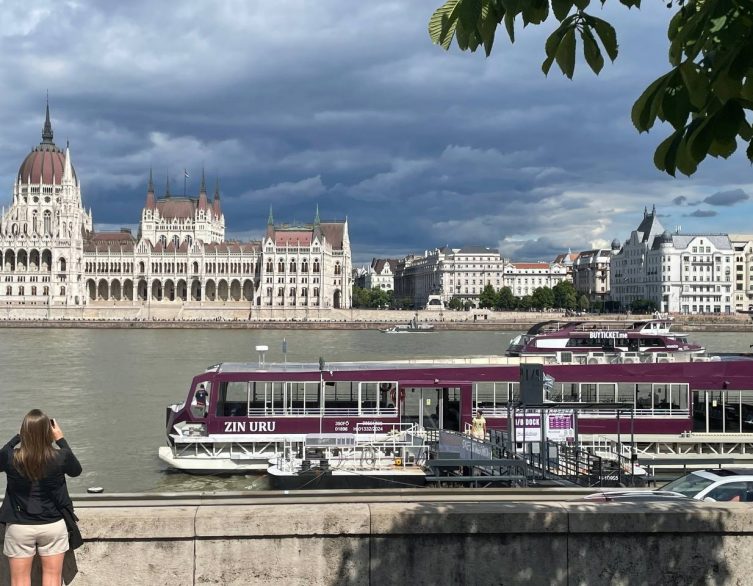
This is the question every sensible person asks before willingly jumping into a major European river. The honest answer is: cleaner than you might think. Budapest Gyógyfürdői és Hévizei Zrt. — the company that manages the city’s famous thermal baths — has been conducting accredited water quality tests at multiple points along the Danube since spring 2025. The results have been consistently encouraging, meeting EU and Hungarian thresholds for safe bathing at all designated locations.
That said, heavy rainfall can temporarily change things — upstream agricultural runoff and combined sewer overflows are real factors — which is exactly why the monitoring doesn’t stop once the season starts. If readings spike after a big storm, the beach closes. No exceptions, no arguments. It reopens only when the numbers say it’s safe again. You have to respect a city that takes its river seriously.
What’s Coming Next: 49 Potential Spots and Floating Baths
Budapest is not stopping at two beaches. The Valyo has mapped out an ambitious 49 potential swimming locations along Budapest’s stretch of the Danube, with a detailed public presentation of those sites already underway. Several spots are under active investigation, including areas around Margaret Island, the Jane Haining Embankment in the city center, Óbuda Island, and various northern stretches of the river.
Even more exciting — at least for history buffs and anyone who’s seen old photographs of prewar Budapest — is the plan to bring back floating river baths, known as fauszodák in Hungarian. These wooden bathing structures were once a beloved fixture of Budapest life before disappearing decades ago, and the city is now commissioning feasibility studies to explore where and how they could return. Locations being considered include the stretch near the Parliament building and the Várkert Bazár (Castle Garden Bazaar) — which, if it ever happens, would be one of the most spectacular urban swimming experiences in all of Europe.
Practical Tips for Visiting the Beaches
Both beaches are completely free to enter, which is a genuinely rare and delightful thing in a European city center. The Római-parti Plázs in the third district is most easily reached by the number 34 bus from the city center. The Árasztó-part in the 11th district is accessible by public transport and on foot from several tram stops along the Buda embankment.
Bear in mind that the Árasztó-part is a wilder, more nature-oriented experience — there are no food vendors on site, so pack your own snacks and drinks, and plan to take your rubbish home with you, as the waste infrastructure is still being set up at the start of the season. Both beaches operate under strict safety rules: designated swimming zones only, lifeguards on duty during opening hours, and immediate closure if water quality dips. This is not the sort of place where you take an unsanctioned midnight swim — the Danube’s currents are no joke.
Budapest’s Long Game with Its River
What’s really happening here is something bigger than a couple of free beaches. Budapest is slowly and deliberately reclaiming its relationship with the Danube — a river that flows through the heart of one of Europe’s most spectacular cities and has, for too long, been treated more as a backdrop than a place to actually be. The fact that you can now swim in the same river that frames the Parliament building, the Chain Bridge, and the Castle Hill skyline is, frankly, remarkable.
Whether you’re a serious swimmer after an unusual urban dip, a budget traveler making the most of a sunny afternoon, or simply someone who finds the idea of swimming in a UNESCO World Heritage-listed river irresistible — Budapest in the summer of 2026 has something for you. Just maybe check the water quality board before you jump in.
Related news
Budapest Is Finally Becoming a Bathing City on the Danube — Here’s Where to Swim
Ask a first-time visitor to Budapest what the Danube is for, and they’ll probably say “photos.” Bridges, boat cruises, the Parliament...
Budapest’s Beloved Thermal Baths Are Getting a Makeover — Here’s Everything You Need to Know
If there is one thing Budapest does better than almost anywhere else on Earth, it is the art of doing absolutely nothing in hot water while surrounded...

Budapest Beach Season 2026: When to Hit the Outdoor Pools
The May sunshine is out, the temperatures are flirting with something almost summery, and you’re standing in Budapest wondering: can I finally...
Palatinus Bath on Margaret Island Is Now an Even Better Deal — Here’s Why
If you’re visiting Budapest and looking for an authentic thermal bathing experience that won’t break the bank, Palatinus Bath just became...

Budapest’s Danube Bathing Revolution: 49 Potential Spots Revealed
Budapest is set to transform its iconic Danube into a network of urban swimming spots, with 49 potential bathing sites now mapped out for tourists...
Related events