Budapest’s Saddest Statue Just Got Vandalized Into Oblivion — And That’s Kind of the Point
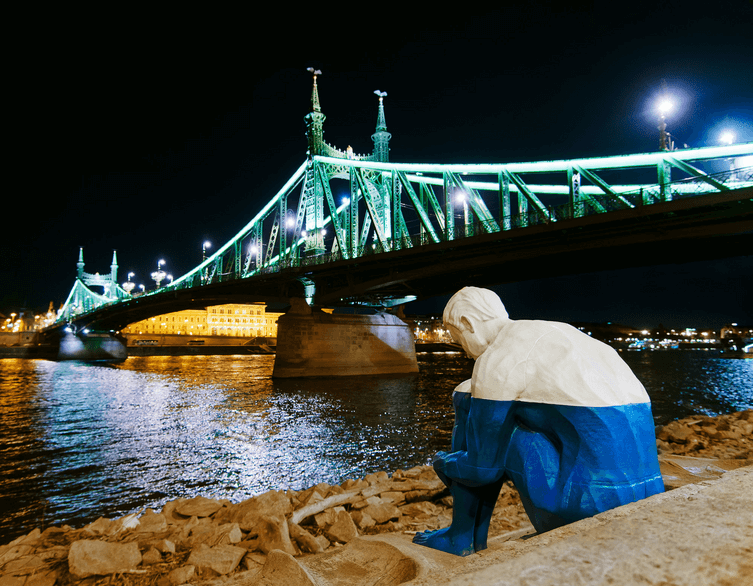
Budapest is full of statues. Heroic generals, brooding poets, the occasional quirky tourist trap (yes, we mean the Little Princess on the Chain Bridge railing). But tucked at the foot of the Liberty Bridge, there used to be one that was a little different — quieter, stranger, and surprisingly poignant. It was called Suppressed Tears, and if you’re visiting Budapest hoping to see it, we’ve got some bad news.
A Statue Born from a Bold Idea
Suppressed Tears (Elfojtott könnyek in Hungarian) was installed on the Danube embankment in April 2025 as part of a public awareness campaign focused on men’s mental health. The sculpture depicted a sorrowful male figure seated by the river — half painted white, half painted blue. That blue wasn’t decorative. It represented the accumulated tears that men suppress daily, the kind that, if they overflow, can swallow a person whole — just like the Danube.
The campaign behind the statue had a clear and sobering message: society still largely expects men to be strong, stoic, and emotionally bulletproof. Showing pain or vulnerability? That’s weakness — or so the outdated script goes. The numbers back up why this matters: nearly 80% of men suppress feelings of anxiety rather than processing them, and men cry over 92% less than women on average. Bottling all of that up leads somewhere dark — stress, anxiety, depression, and in extreme cases, suicide.
The statue was owned and maintained by LESZ (Magyar Lelki Elsősegély Telefonszolgálatok Szövetsége), Hungary’s Association of Mental Health First Aid Phone Services, a nonprofit running emotional support hotlines across the country.
The First Attack
Here’s where the story takes a turn that’s either deeply ironic or deeply tragic, depending on your mood. Within just weeks of being installed, the statue was vandalized for the first time. By June 2025, someone had snapped off its head and walked away with it. The headless torso sat by the river for a while before LESZ managed to restore it — though not quite in its original form.
When the head came back, so did more blue paint. The water level crept higher up the figure’s body. LESZ president Erika Dudás explained the symbolism: “With the raised water level, we want to draw attention to the fact that the problem may be even more serious than we originally thought. Not only suppressed sadness, but suppressed rage too can lead to harmful patterns and impulsive actions.”
It was a bold artistic response to an act of destruction. Unfortunately, it wasn’t the last one.
Gone Before Its First Birthday
This winter, the vandals came back — and this time, they were thorough. The male figure was almost entirely destroyed, damaged nearly down to the legs. What had been a sitting, sorrowful man by the Danube was reduced to a stub. LESZ told Hungarian news outlet Telex that they simply cannot afford to restore the statue again. The remains are expected to be removed from the embankment soon.
A statue installed in April 2025 will likely not survive to see its first birthday. And in a deeply uncomfortable way, that’s almost a perfect metaphor for the very thing it was trying to say.
Best deals of Budapest








Why Men’s Mental Health Is a Crisis Worth Talking About
It might be tempting to read this story and move on, but the issue the statue represented deserves more than a passing glance. Men’s mental health is one of the most quietly devastating public health challenges of our time — and it’s hiding in plain sight.
The core problem is cultural. From a young age, boys in most societies are taught that emotional expression is a sign of weakness. “Man up.” “Don’t cry.” “Be strong.” These messages get absorbed so deeply that by adulthood, many men genuinely struggle to identify, name, or share what they’re feeling. That emotional illiteracy doesn’t make the feelings disappear — it just forces them underground, where they fester.
The consequences are serious. Suppressed emotions are strongly linked to chronic stress, anxiety disorders, depression, substance abuse, and relationship breakdowns. Men are significantly less likely than women to seek professional help, less likely to talk to friends about their struggles, and more likely to reach a crisis point before anyone — including themselves — realizes something is wrong. Globally, men die by suicide at roughly three to four times the rate of women, a grim statistic that researchers largely attribute to this culture of silence.
What makes this particularly tricky is that suppression can look a lot like strength on the outside. The man who never complains, never cries, always seems fine — he might be the one who needs help the most. Crying, as it turns out, is not weakness. Science has shown that shedding tears actually reduces stress hormones in the body and triggers the release of endorphins. In other words, having a good cry is, quite literally, good for you. The statue understood this. Society is still catching up.
A Budapest Story Through and Through
If you’re walking along the Danube embankment near Liberty Bridge — one of Budapest’s most scenic and photogenic spots — you may notice the empty space where the statue once sat. It’s worth pausing there for a moment, not just for the gorgeous view of the bridge, but to think about what briefly existed in that spot and why.
Budapest is a city that has always worn its emotions on its sleeve — in its melancholic music, its turbulent history, its coffee house culture built for brooding. The story of Suppressed Tears fits right into that tradition, even if the statue itself is gone.
The Organization Behind the Statue
Even without their statue, LESZ continues its work running free emotional support phone lines in Hungary. If you’re traveling with someone who might need a listening ear and speaks Hungarian, the service is available around the clock. Mental health support, much like a good Budapest ruin bar, is always open.
An Empty Pedestal Worth Remembering
The story of Suppressed Tears is, in the end, a story about what happens when we don’t take things seriously enough — and what happens when we do. LESZ created something vulnerable and visible, placed it by one of Budapest’s most beloved bridges, and watched it get torn down. Twice. And yet, paradoxically, the destruction may have done more to spread the message than the statue ever could have on its own. Here you are, reading about it.
Budapest will keep drawing visitors with its thermal baths, its stunning Parliament building, its legendary nightlife and unforgettable skyline. But next time you find yourself standing on the Liberty Bridge, watching the Danube roll beneath you, spare a thought for the little blue statue that tried to sit there and start a conversation. It didn’t survive — but the conversation it started very much has.
Related news