Budapest’s Most Fascinating Bridge Just Turned 150 — and It Has Quite the Story to Tell
There are bridges, and then there is Margaret Bridge. Stretching over 600 metres across the Danube, with its distinctive angled kink at the centre and its cheerful yellow ironwork catching the sun, this is one of those landmarks that tourists walk across, photograph, and admire — without necessarily realising that the structure beneath their feet has survived wars, floods, politics, a wartime explosion, and more than a few spirited debates about whether it should even exist in the first place. On April 30, 2026, Margaret Bridge turned 150 years old. Here’s why that’s worth celebrating.
A Bridge Born Out of Big Ambitions
The story of Margaret Bridge really begins not with engineers or architects, but with a political vision. In the early 1870s, Budapest as we know it didn’t yet exist — Pest and Buda were still separate cities, connected by a single permanent crossing: the Chain Bridge, which was groaning under the weight of all that traffic. The question of where to build a second bridge had been debated since the 1860s, but progress was slow. The Chain Bridge’s operators held an exclusive revenue monopoly until 1930, and that legally blocked any new crossings from being built nearby. The city had to buy out that monopoly right before the new project could move forward at all.
When the government finally got the green light, they made a bold choice. Instead of building the obvious crossing — a practical, southward link between the two city centres — Prime Minister Gyula Andrássy pushed for a bridge further north, connecting what were then largely industrial areas on both banks. His critics thought he was out of his mind. Contemporary commentators openly questioned why on earth anyone would build an elegant public bridge in the middle of a factory district. The poet János Arany even wrote a poem for the opening ceremony. Andrássy, however, wasn’t building for the Budapest of 1876. He was building for the Budapest he intended to create — a world-class capital to rival Vienna itself.
A French Genius and a Very Flexible Design
In 1871, an international competition was launched, attracting 46 entries from across Europe. The winner was French engineer Ernest Goüin and his firm, the Société de Construction des Batignolles — a company with an impressive track record of building railways and bridges across France. His design was elegant, technically sound, and, crucially, he was willing to negotiate. That last quality turned out to be essential.
Mid-project, the plans for regulating the Danube around Margaret Island changed significantly, requiring Goüin to redesign his original five-span bridge into a six-span one. He agreed without much fuss, which must have been a relief for everyone involved. There was also a lengthy debate — held, somewhat absurdly, while construction was already underway — about exactly how wide the bridge should be. The wider option, at 16.8 metres, was 270,000 forints more expensive, but would accommodate horse-drawn tram lines. After years of wrangling with the tram companies over who would foot the extra bill, the government went with the wider bridge anyway.
Best deals of Budapest










Not everything was imported from France, either. While the six main spans were fabricated in French workshops and shipped to Hungary by rail, the approach spans on either bank were designed and manufactured by Hungarian engineers and craftsmen — making them the first large-scale riveted steel bridge elements ever produced in Hungary.
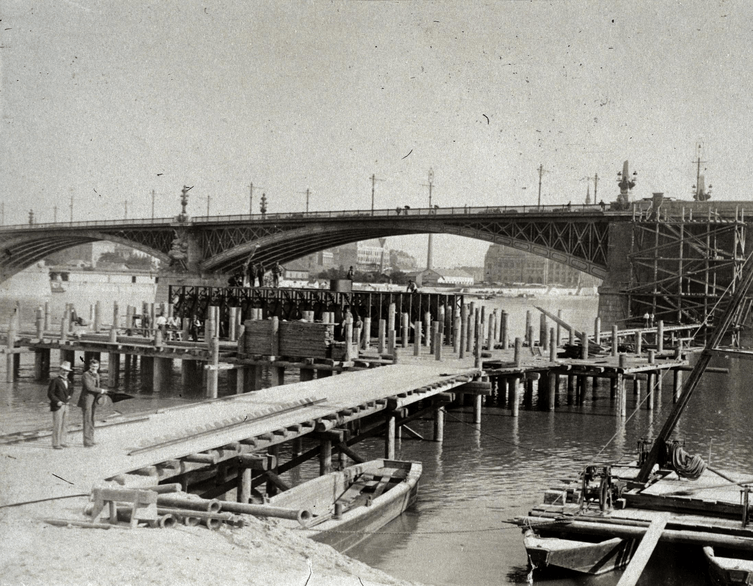
Construction began in the summer of 1872 and took nearly four years, delayed by high Danube water levels, a flood in the winter of 1875–76, slow material deliveries, and the rather unusual requirement — requested by the Ministry of War — that pre-built demolition points be incorporated into the structure so the bridge could be rapidly destroyed in the event of an enemy siege. This was, apparently, completely standard practice at the time. The irony of that particular precaution would only reveal itself some seven decades later.
The Famous Kink — and Why It Has Nothing to Do with the Island
On April 30, 1876, the bridge officially opened. Government officials, military representatives, and Archduke József (standing in for the king) all turned out for the ceremony, after which the assembled dignitaries and public walked from Pest to Buda together, marking the opening in the most straightforward way possible.
The finished bridge was originally painted blue, stretched over 607 metres, and featured something genuinely unique in bridge design: its central axis broke at an angle of roughly 30 degrees at the reinforced middle pier. This quirk has puzzled visitors ever since, and the popular explanation — that the kink was designed to create a spur towards Margaret Island — is a myth. The real reason was hydraulic engineering: the bridge’s piers needed to align with the direction of the Danube’s current to minimise water resistance. The fact that this also happened to create a perfect attachment point for a future branch bridge to the island was, as one Hungarian engineer cheerfully noted, simply a bonus.
The ornate ironwork adorning the bridge, including the allegorical figures on the piers depicting strength and victory, was crafted by French sculptor Adolphe Thabard, while the architectural decoration was designed by Wilbrod Chabrol, architect of the French Palais Royal. For a bridge built over an industrial district that most of the city was skeptical about, it turned out rather beautifully.
Trams, Tolls, and a Slow Start
Despite all the grand ambitions behind it, Margaret Bridge got off to a rather underwhelming start. In 1877, the Chain Bridge’s toll revenue was five times higher than Margaret Bridge’s. In 1885, the newer bridge still hadn’t reached even a third of its older rival’s income. The roads leading to the bridge on both sides of the Danube simply weren’t ready yet, and most of the city’s population and commerce remained clustered further south. It took the completion of the Grand Boulevard (today’s Nagykörút) and an adjustment to toll pricing in 1885 — which made the Chain Bridge more expensive for freight wagons — to finally start redirecting meaningful traffic northward.
The horse-drawn tram arrived on the bridge in 1879, which was no small feat: the gradient at the bridge’s midpoint was steep enough that a third horse had to be harnessed just to haul the tram car up to the central pier. In 1894, Margaret Bridge became the first bridge in Budapest to carry electric trams, and the extra-horse problem was permanently solved.
The branch bridge to Margaret Island, meanwhile, took another 24 years after the main bridge’s opening to arrive. The island was private property belonging to Archduke József, and the question of who should pay to build a bridge to someone’s private park was not easily resolved. The spur was finally completed in 1900, with the archduke contributing to the costs — and to the great joy of Budapest’s residents, who had long coveted the island as a peaceful escape from city life. Until that point, the only way to reach the island had been by boat.
War, Destruction, and Rebirth
The bridge was widened and structurally upgraded between 1935 and 1937, gaining extra load-bearing capacity and repositioned tram tracks. Then came the Second World War — and Margaret Bridge’s darkest chapter.
On November 4, 1944, while the bridge was full of civilian traffic during the afternoon rush, German-planted explosives detonated prematurely — reportedly triggered by a spark from a passing tram that ignited the fuse while the charges were still being primed. Several spans collapsed into the Danube, taking trams, vehicles, and an estimated 600 or more people with them, among them civilians, German soldiers, and Jewish forced labourers. Olympic champion fencer Endre Kabos was among those killed. It remains one of the worst civilian disasters in Budapest’s wartime history. The remaining bridges of Budapest were then deliberately blown up by German forces in January 1945 during the Siege of Budapest.
After the war, rebuilding was complicated by the fact that Hungary’s steel production was largely committed to Soviet reparations, and there were proposals to replace the bridge with a concrete structure. Fortunately, enough steel was secured to rebuild it in iron, closely following the original design but with slightly higher arches. Much of the original steel was actually recovered from the riverbed and incorporated into the rebuilt structure. A small temporary bridge nicknamed “Manci” kept pedestrians crossing in the meantime, and the reconstructed Margaret Bridge reopened in 1948. It was painted grey. It only turned its now-iconic yellow in 1979, during a later renovation.
A major reconstruction project between 2009 and 2011 — partially funded by the EU — finally brought the bridge back to something close to its original splendour, restoring period-style lamp posts, ornamental ironwork, widening the footpaths, and adding a dedicated cycling lane.
Why You Should Walk Across It Today
Margaret Bridge is one of those rare urban landmarks that rewards you simply for using it as intended. Walking across it, you get sweeping views of the Danube in both directions — the Hungarian Parliament Building glowing to the north, the Chain Bridge and Castle Hill visible to the south. Halfway across, the branch bridge dips down towards Margaret Island, Budapest’s beloved green oasis in the middle of the river: 5 kilometres of car-free parkland, thermal baths, medieval ruins, a musical fountain, and a popular running track, all reachable on foot from the bridge’s central pier.
The bridge is also a living piece of European engineering history. Designed by a French firm, partly manufactured in France, partly built by Hungarian craftsmen using the first large-scale riveted steel elements ever produced in Hungary, it is named — via the island it connects — after Saint Margaret of Hungary, a 13th-century princess who took holy vows on that very island after her father, King Béla IV, pledged her to a convent in exchange for divine protection against the Mongol invasion.
One hundred and fifty years later, it carries trams, buses, cyclists, and pedestrians around the clock. It has been blue, grey, and yellow. It has been blown up and rebuilt. It has watched Budapest grow from an ambitious mid-sized city into one of Europe’s great capitals. Not bad for a bridge that half of 19th-century Budapest thought was in entirely the wrong place.