Budapest Just Made History — and It Was Absolutely Wild

Something extraordinary happened in Budapest on May 9, 2026, and if you weren’t there, you genuinely missed one of the most unforgettable days this city has seen in decades. Kossuth Square — the grand plaza stretching in front of the Hungarian Parliament — turned into the epicenter of Hungarian history, as Péter Magyar was sworn in as the country’s new Prime Minister, ending 16 years of Viktor Orbán’s rule. What followed was a street party so joyful, so gloriously chaotic, and so packed with internet-breaking moments that it’s hard to know where to even begin. But let’s try.
A Day 16 Years in the Making
To understand just how electric the atmosphere was, you need a tiny bit of context. For over a decade and a half, Hungary had been governed by Viktor Orbán’s Fidesz party — a tenure that frequently put Budapest at odds with the European Union and dominated headlines worldwide. Then came April 2026, when the opposition Tisza Party pulled off a landslide election victory that sent shockwaves across Europe. On May 9 — fittingly, Europe Day — the new parliament held its inaugural session, and Péter Magyar took the oath of office as Prime Minister. The people of Budapest were not about to let this moment pass quietly.
The Party at Kossuth Square
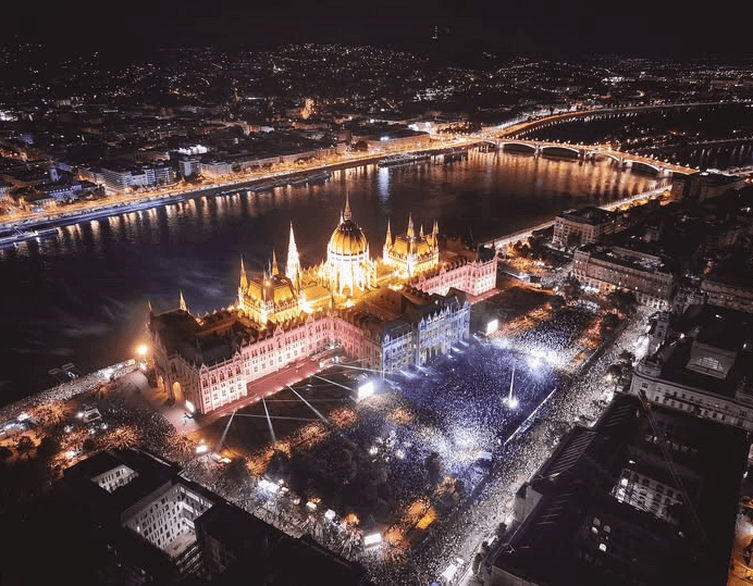
The Rendszerváltó Népünnepély — which translates, beautifully, to the “System Change People’s Celebration” — was a free, all-day outdoor festival stretching from Kossuth Square all the way down to the Danube embankment. It ran from morning until nearly midnight, drawing enormous crowds of Hungarians who wanted to be part of what many were already calling a once-in-a-generation moment. There was music, dancing, speeches, and enough national pride to fill the Danube twice over.
Magyar himself took to the DJ decks at one point — yes, the Prime Minister DJed his own inauguration party, which is objectively brilliant — while singer Oláh Ibolya performed the patriotic anthem Magyarország in front of a massive, tearful, flag-waving crowd. But the night still had a couple of extraordinary surprises up its sleeve.
Best deals of Budapest








Enter: The Dancing Health Minister
If there’s one person who has become the unlikely global celebrity of Hungary’s political transformation, it is Dr. Zsolt Hegedűs — orthopaedic surgeon, Member of Parliament, and quite possibly the most enthusiastic dancer ever to hold a cabinet post.
It all started back on election night, April 12, when Hegedűs — tipped to become Hungary’s new Minister of Health — took to the stage at Batthyány Square and absolutely let loose. Air guitar. Freestyle moves. Pure, unfiltered joy. The footage went viral almost instantly, racking up millions of views worldwide. He had previously suggested it was a one-off moment, but clearly his feet had other plans.
At the May 9 inaugural celebration on Kossuth Square, Hegedűs danced again — and this time, he had live musical accompaniment. British singer Jalja performed her song live on stage, and Hegedűs danced to it so enthusiastically that the entire Tisza parliamentary faction eventually joined him. The video once again made international headlines and laps around the world’s news feeds.
Jalja herself was visibly moved by the whole experience. On her Instagram, she wrote: “It’s hard to find the right words to summarise all the emotions that the events of recent weeks have stirred in me.” She called it a “true privilege to play a small role in a historic moment made even more memorable by their health minister’s unforgettable dance moves” — adding, with a perfectly straight face, that Hegedűs is clearly a role model for fitness and health, given that he danced all night long. She signed off with: “I will remember this day for the rest of my life. It was beautiful, it was energising, it was a revolution. I love you all.”
The dance world also took notice. The Rudolf Laban Award — a prestigious Hungarian prize for contemporary dance, established in 2006 by MU Theatre and Trafó — announced a special Alternative Rudolf Laban Award for Hegedűs, honouring his “outstanding contribution to popularising dance.” The official ceremony is scheduled for May 28. You genuinely cannot make this stuff up.
A Meme Icon Walks Among Us
Now, for perhaps the most delightful subplot of the entire evening. Among the tens of thousands of revelers on Kossuth Square, cameras spotted a face known to virtually every corner of the internet: András Arató, better known worldwide as Hide the Pain Harold.
If you’ve spent any time online in the last decade, you know this face. Arató, a retired Hungarian electrical engineer, became one of the world’s most recognisable meme figures after a series of stock photos — featuring his trademark expression of thinly-veiled, polite discomfort — went spectacularly viral. He’s been photoshopped into every awkward situation imaginable, and his gentle, stoic face has provided comic relief to millions across the globe.
But on May 9, the 80-year-old wasn’t just a meme — he was a witness to history. German broadcaster Deutsche Welle spotted him in the crowd and asked him about the day. His answer was quiet, considered, and genuinely moving: “I was here back when the Hungarian People’s Republic became a republic. I felt I had to come out today too. I’m expecting a change of at least the same magnitude.” He was referring, of course, to 1989 — Hungary’s original democratic transition, when the communist system collapsed and a new era began. For Arató, standing in that same square nearly four decades later, the parallels were impossible to ignore.

The story was picked up everywhere from Deutsche Welle to Swedish state television, because the universe occasionally has a sense of humour — and having Hide the Pain Harold show up to compare your country’s political revolution to 1989 is exactly the kind of detail that belongs in a history book.
The Night the Parliament Glowed
As if the day hadn’t already delivered enough spectacle, the evening brought something else entirely. After darkness fell over Kossuth Square, the Hungarian Parliament Building became the canvas for a breathtaking light projection show. A massive Hungarian tricolour flag was projected across the entire facade, flooding the neo-Gothic stonework in red, white, and green. Traditional Hungarian folk floral motifs — the kind of intricate, colourful patterns found in Matyó embroidery and Kalocsa textiles — danced across the ancient walls. And at the centre of it all, a vivid, rotating image of the Holy Crown of Hungary glowed against the stone.
The Parliament Building is already one of the most spectacular sights in all of Europe at any time of day, but bathed in national colours and centuries-old folk art on the night of May 9, it became something genuinely transcendent.
A Square That Holds History
On the night of May 9, 2026, Kossuth Square was the beating heart of a nation rediscovering its joy. A prime minister took an oath, a doctor danced to a British pop song and was rewarded with a contemporary dance prize for it, a retired engineer compared it all to the fall of communism, and the Parliament itself lit up in the colours of Hungary’s soul. Whether you were in the crowd or watching from ten countries away, one thing was clear: Budapest had just written another chapter in its extraordinary story — and it did so with dancing, memes, and a very good light show.
Related news
Budapest Just Threw the Most Historically Significant Party You’ve Never Heard Of
If you happened to find yourself wandering along the banks of the Danube in Budapest on May 9th, 2026, you might have stumbled upon something rather...

A Nation Reborn: Budapest Throws Its Biggest Party to Welcome a New Political Era
There are days when a city simply buzzes with something bigger than itself, when the streets fill up not because of a festival or a football match,...
Budapest Erupts in Joy: Hungary’s Historic Election Ends Orban Era
If you happened to be in Budapest last night — or if you’re arriving in the city today — you may have noticed something extraordinary in...