Budapest’s Danube Riverbank Has a Secret, and His Name Is Tamás Kánya
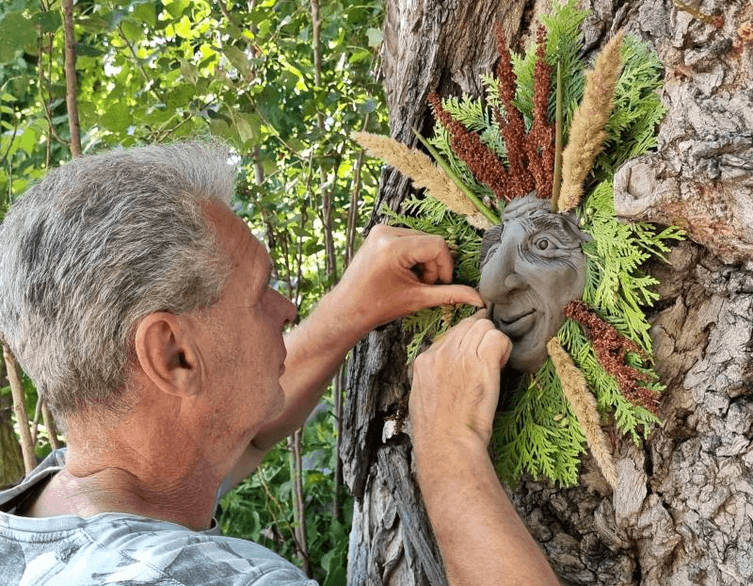
Budapest has no shortage of things to see — grand parliament buildings, thermal baths, ruin bars the size of city blocks. But if you wander a little further north along the Danube, past the tourist crowds and the Instagram-famous bridges, you’ll stumble into something far more intimate, far more surprising, and absolutely free. Nestled along the Roman Bank (Római-part) and the floodplain forests of Budakalász, a one-man creative force has been quietly turning the riverbank into an open-air wonderland for over thirteen years. No museum. No ticket booth. No artist statement pinned to the wall. Just bark, mud, acorns, and an imagination that simply refuses to clock off.
The Accidental Artist of the Danube
Tamás Kánya is not a professional artist. He’ll be the first to tell you that. For over a decade, he has been heading out to the Roman Bank almost daily, picking up whatever the forest and the river happen to offer — bark, river mud, pine cones, snail shells, feathers, driftwood — and then turning it into something extraordinary, purely because he enjoys it. He started with Indian masks pressed into tree trunks. Then came balanced stone cairns. Then elaborate mandalas spread across the sandy riverbank. Each one made alone, often for hours at a stretch, and each one destined to be reclaimed by the weather, the river, or simply the passing of time.
What makes Kánya’s story genuinely charming is that he stumbled into the world of land art without knowing it existed as a discipline. “I had no idea that what I was doing was a separate art form,” he has said. That accidental authenticity is precisely what makes his work so affecting. There is no gallery strategy here, no grant application, no artist’s CV. Just a man, a forest, a pocket full of hazelnuts for the squirrels, and a compulsion to make beautiful things out of whatever is lying around.
Best deals of Budapest






A Forest Full of Faces
Walk slowly through the floodplain forest along the Roman Bank and you will start to notice them: faces peering out from tree trunks. A grinning goblin decorated with hornbeam berries and tuja branches, still smiling after surviving floods, storms, and several Hungarian winters without so much as cracking. A pipe-smoking forest man wearing a tinder-fungus hat, his hair made of hazel catkins, his pipe carved from driftwood. A long-haired forest creature whose flowing locks are made entirely from poplar catkins, adorned with acorns, plane tree balls, and pheasant feathers.
Kánya sculpts these directly onto living trees using river mud gathered from the bank below, then decorates them with whatever nature has left lying around that week. The mud dries, hardens, and bonds to the bark with surprising permanence — some of his tree masks have been standing for two years or more, surviving everything the Danube weather can throw at them, still visible to every cyclist and jogger who passes by. Finding one unexpectedly while walking through the trees is, honestly, a bit like discovering that the forest has been watching you the whole time.
Mandalas That Belong to the River
Down on the sandy riverbank itself, Kánya creates intricate circular mandalas using the seasonal offerings of the forest floor — and the results are astonishing given that his only materials are things he finds within arm’s reach. A red mandala assembled in October uses rowan berries for colour, arranged around a star shape built from dark alder cones and decorated with crab apples, snail shells, acorns, pine cones, river mussels, and kauri shells. A yellow one blooms with dandelions and various cones. A third is built on sifted riverbank sand, using plane tree balls, snail shells, and seed pods arranged with the patience of someone who genuinely has nowhere else they would rather be.
These mandalas are temporary by design — a wave from a passing tourist boat can erase one before it’s even finished, as Kánya has cheerfully documented. That impermanence is the whole point. The work isn’t trying to last forever; it’s trying to be extraordinary right now, in this particular moment of autumn light on the Danube. In January 2017, he took the same philosophy to its logical extreme and built two-metre-tall ice sculptures on the frozen bank — stacking Danube ice slabs bare-handed in -7°C temperatures, watching them fuse together in the cold, then melt away three days later when the weather warmed. He said he hadn’t even noticed the cold. The seagulls that gathered made the photos spectacular.
Yes, the Goblin Village Got Destroyed. He Kept Going Anyway.
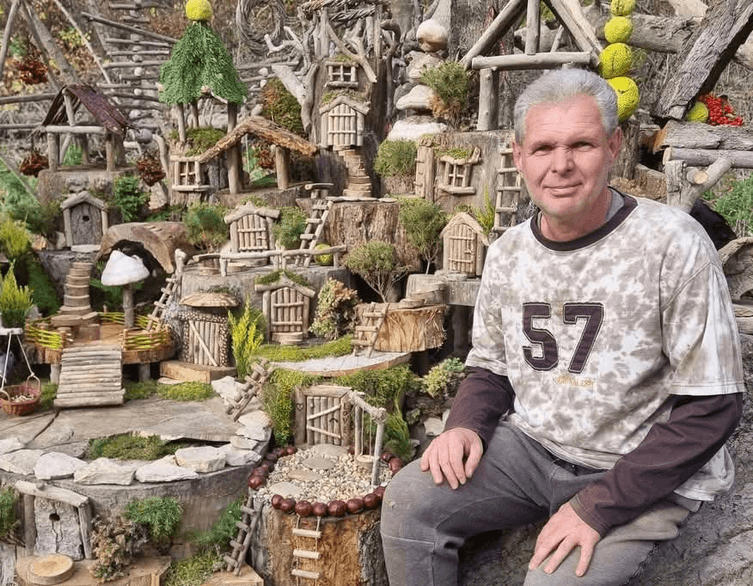
You may have read about Manófalva — the miniature goblin village that Kánya built from bark, pebbles, and driftwood in the Budakalász floodplain forest, complete with tiny houses, rope ladders, terraces, and little sculptures that enchanted thousands of visitors. It was vandalized overnight in November 2025, smashed so thoroughly that he couldn’t repair it. It was a genuinely awful thing to happen to a genuinely wonderful project.
But here is the thing about Tamás Kánya: he kept going. He went back to the forest, fed the squirrels, picked up some mud, and made something new. Because that is what he does. The goblin village was one chapter in a story that has been running for thirteen years and shows absolutely no signs of stopping. While online critics were busy being unpleasant in his Facebook comments — and yes, there were people who accused him of destroying it himself for the publicity, which tells you everything you need to know about certain corners of the internet — Kánya was outside building a pipe-smoking forest elder out of driftwood and tinder fungus.
How to Find His Work
Getting to the Roman Bank is straightforward and very much worth the detour. Take the suburban HÉV railway from Batthyány Square toward Szentendre and get off at Budakalász — roughly 25 minutes from the city centre. From there, the floodplain forest is a short walk, and the cycling path along the Danube toward Szentendre passes directly through Kánya’s outdoor studio. If you are already planning a bike ride along the river — and the Budapest–Szentendre route is one of the loveliest easy rides in the region — you are already going exactly the right direction.
There is no entrance fee, no opening hours, and no guarantee that anything specific will be there when you arrive, because the work is living, temporary, and made on a whim. That unpredictability is, in its own way, the most honest thing about it. You might find a freshly decorated tree face. You might find a mandala still wet from the morning. You might find nothing at all and simply enjoy a very beautiful walk along the Danube — which, honestly, is also a perfectly good outcome.
Why It’s Worth the Trip
Budapest rewards the curious traveller who goes slightly off-script, and the Roman Bank is one of its best-kept secrets. What Tamás Kánya offers isn’t a ticketed attraction or a scheduled event. It’s the rare experience of encountering real creative generosity in the wild — art made by someone who does it because the alternative, apparently, is unthinkable. He has thousands of followers on Facebook, has been covered by Hungarian media multiple times, and has inspired a dedicated support group of fans who send him photos of his own work. He remains, stubbornly, a man who goes to the forest every day to feed the squirrels and make something beautiful out of whatever he finds.
For tourists who come to Budapest looking for something beyond the thermal baths and the tokay wine — and there is nothing wrong with either, for the record — the Roman Bank offers a different kind of discovery. Slower, quieter, and completely free. Just keep your eyes open for anything that looks slightly too wonderful to be an accident.
Related news
The Fairy Village That Disappeared: A Sad Tale from Budapest’s Bike Path
When Art Meets Vandalism Along the Danube For one brief, magical week, a hidden corner along Budapest’s popular Szentendre cycling route became...

Vikings Star Travis Fimmel Spotted at Budapest’s Római Part While Filming Dune with Jason Momoa
Who would have thought that the wild, bearded Viking king himself would trade his longship for a casual stroll on Budapest’s Római Part? Yet...
Related events