Staying Cool in Budapest: Everything You Need to Know During the Heatwave
Budapest is brilliant in summer — but this weekend, the heat is no joke. A second-level heat alert is in effect across Hungary from June 20 through June 23, 2026, and temperatures are pushing into seriously uncomfortable territory. The good news is that the city has prepared thoughtfully, and if you know where to look, staying safe, hydrated, and cool is surprisingly straightforward. Here’s everything you need to know as a visitor navigating Budapest during one of the hottest stretches of the year.
Free Water Distribution Across the City
The most immediately useful thing to know: you don’t need to spend a forint on bottled water this weekend. Hungarian State Railways (MÁV) is distributing free bottled water at Budapest’s three main railway stations — Keleti (Eastern), Nyugati (Western), and Déli (Southern) — at the platforms, every day between 10:00 AM and 5:00 PM for the duration of the alert. If you’re catching a train out of the city or arriving into one of these stations, make a point of grabbing a bottle before you board.
The water distribution extends well beyond Budapest too, covering major regional stations in Debrecen, Győr, Miskolc, Nyíregyháza, Szeged, Pécs, Székesfehérvár, and Szolnok, among others. For those using the suburban HÉV rail line, free water is also available at Batthyány Square station, right on the Danube embankment in Buda.
Bus travellers are equally well covered. Volán, Hungary’s intercity bus network, is handing out free mineral water at Kelenföld Bus Station and Népliget Bus Station in Budapest, as well as at major bus stations in county seats across the country. If you’re day-tripping by bus, you’re sorted.
Best deals of Budapest










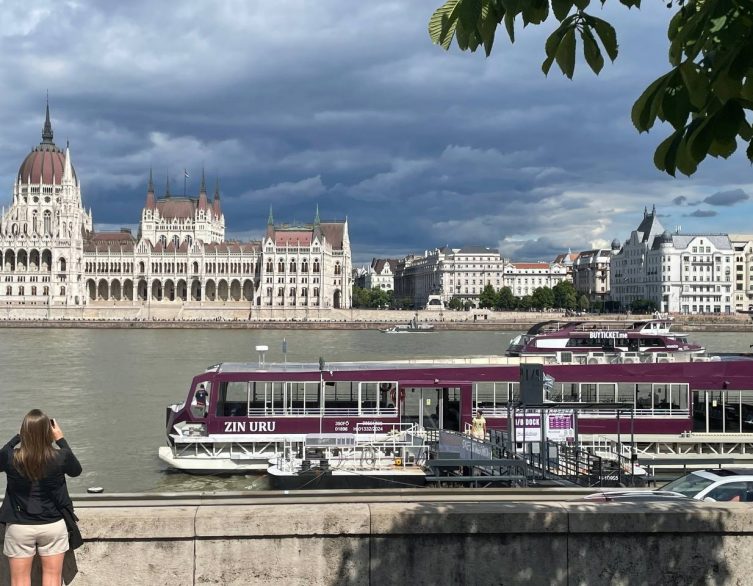
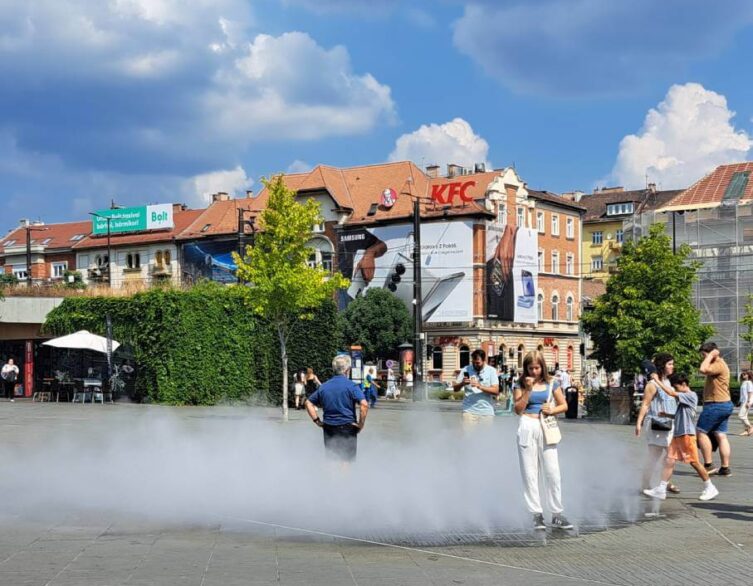
For an extra layer of relief, mist gates — cooling arches that spray a fine mist of water — have been set up at several busy stations including Nyugati and Déli in Budapest, as well as in Debrecen and Pécs. More locations are being added over the coming days, so keep an eye out for them as you move around.
Budapest’s Drinking Fountains: Hundreds of Free Refill Points
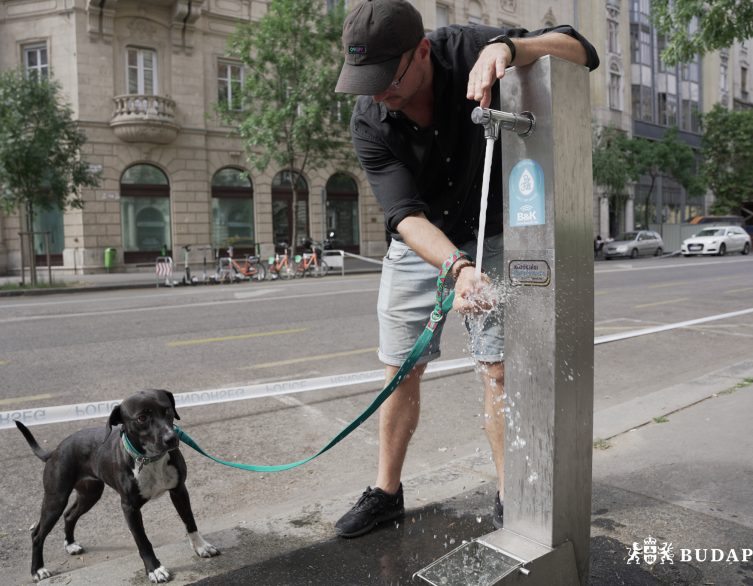
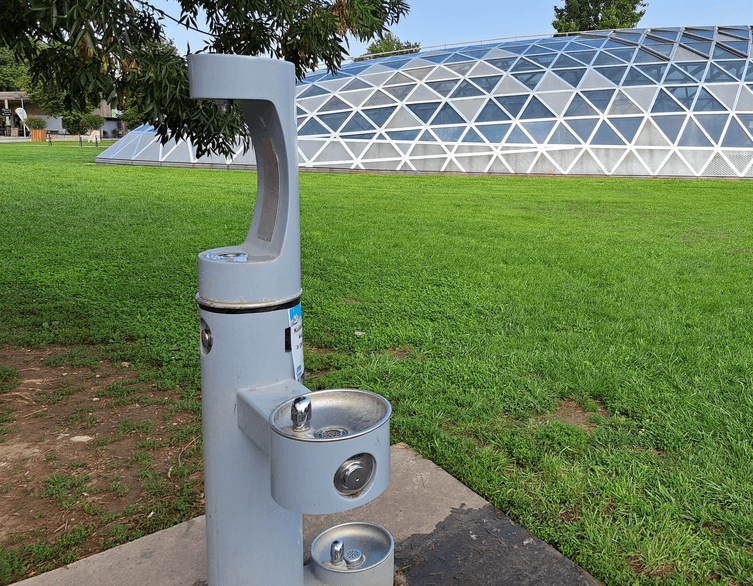
One of Budapest’s quieter but genuinely impressive infrastructure achievements in recent years is its expanding network of public drinking fountains. Since 2020, the city has installed 93 new fountains in partnership with Budapest Waterworks, bringing the total to several hundred spread across the city. In densely populated and high-traffic areas, you’ll find one roughly every 300 to 500 metres — which means a refill is almost always within comfortable walking distance.
You can find your nearest fountain on the city’s official budapest.hu website or directly in the BudapestGO app. If the fountains don’t appear in BudapestGO by default, head to the Planning tab, open the Filter menu, and enable them under the Budapest Info section. It’s a small step that’s well worth taking before you head out for the day. Bring a reusable water bottle or a refillable flask — the water is clean, safe, and completely free, and you’ll be doing the environment a favour by skipping the single-use plastic.
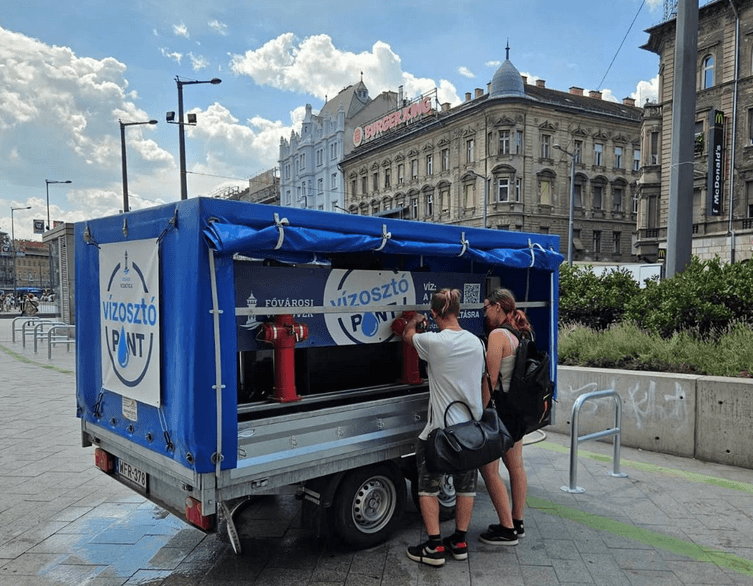
On top of the permanent fountains, Budapest Waterworks is also running a mobile water distribution point this weekend in City Hall Park (Városháza Park), where a 700-litre tanker is offering free drinking water throughout Saturday and Sunday. Bring your own bottle or flask, as cups and plastic containers are not provided — a conscious environmental choice that’s easy to work around with a little planning.
How the City Is Keeping Streets and Transport Cool
Budapest takes its heat management seriously at an infrastructure level, and this weekend is no exception. Street-cooling vehicles from city services are deployed based on heat maps, spraying down the hottest streets and surfaces during the peak hours of the day. This kind of cooling can reduce pavement surface temperatures by as much as 6 to 8 degrees Celsius — which makes a genuinely noticeable difference when you’re walking around. It also helps settle dust and pollen, which is welcome news for anyone prone to allergies.
On public transport, Budapest’s transport authority BKK is continuously monitoring the air conditioning systems on buses, trams, and metro trains. Inspection results are published on the BKK website, and passenger feedback is actively encouraged. If you find a vehicle with a malfunctioning air conditioning unit, reporting it helps the system improve in real time. In the meantime, the metro network — especially the deeper lines — offers some natural relief from the heat and is worth factoring into your movement around the city on the hottest parts of the day.
Parks, Shade, and Green Spaces Worth Seeking Out
Budapest’s parks and tree-lined streets are your best friends during a heatwave, and the city has been investing steadily in its green infrastructure with exactly this in mind. Studies show that well-planted, multi-layered green spaces can be up to 15 degrees Celsius cooler at ground level than paved surfaces — and in a city with as many parks and boulevards as Budapest, that’s a resource worth using.
City Park (Városliget) is an obvious choice — expansive, well-shaded, and central. Margaret Island (Margit-sziget) in the middle of the Danube is another excellent option, car-free and breezy with plenty of tree cover and fountains. For something quieter and more local, the parks and garden squares of the inner districts offer pockets of shade and cooler air that are easy to stumble into between sights. The city has also significantly expanded its wildflower and low-maintenance green areas under the Wildflower Budapest programme — these naturally managed spaces run measurably cooler than manicured lawns and are increasingly woven into the city’s fabric.
Practical Tips for Staying Safe
The city’s guidance is straightforward but worth taking seriously. Don’t set out without sufficient water — the free fountains and distribution points are plentiful, but it’s wise to start hydrated rather than play catch-up in the heat. Try to plan your outdoor sightseeing for the morning and early evening hours, avoiding direct sun between roughly noon and 4:00 PM when temperatures peak. Air-conditioned spaces — museums, shopping centres, libraries, and cafés — are genuinely worth using as rest stops during the middle of the day rather than pushing through in the heat.
Keep an eye on those around you, particularly elderly travellers and families with young children who may need more time to rest and rehydrate. The city’s social services and municipal patrol officers are actively monitoring public spaces and distributing water to those in need — but a kind check-in from a fellow traveller costs nothing and can matter a great deal.
For real-time updates on the heat alert, any transport schedule changes caused by the weather, and the latest information from Hungarian State Railways, check the MÁVINFORM official channels before you travel each day.
Budapest at its hottest is still Budapest — and with a little preparation, the city’s warmth is far more pleasure than problem.
Related news
Budapest Weather Alert: Thunderstorms and Scorching Heat to Know Before You Explore
Anyone planning a day out in Budapest this week should keep half an eye on the sky. The Hungarian Meteorological Service, known locally as HungaroMet,...
St. Stephen’s Day Fireworks Meet a Level 2 Heat Alert
Budapest is gearing up for its biggest weekend of the year, and it’s arriving with a side of serious summer heat. From Thursday, August 20...
Heatwave Alert: What Tourists Should Know Before Visiting Budapest This Week
If you’ve got Budapest on your itinerary for the coming days, it’s worth packing your sunscreen and rethinking your afternoon plans....
Budapest Heatwave Alert: Hungary Set to Become Central Europe’s Hottest Spot This Summer
If you’re planning a trip to Budapest in the coming days, brace yourself: the Hungarian capital and the surrounding region are about to experience...
Budapest Heatwave 2026: Record Temperatures Are Hitting the City
Budapest is in the grip of a serious heatwave right now, and it’s not letting up. On Sunday, June 28, a new daily heat record was set in Budakalász,...
UPDATE! – Budapest Heatwave Warning: What Tourists Need to Know This Weekend (June 27–30, 2026)
If you’re planning to explore Budapest this weekend, there’s one thing that should be at the top of your packing list — and it’s...
Heat Warning in Budapest: What Tourists Need to Know This Weekend (June 20–23, 2026)
If you are visiting Budapest this weekend, there is one thing you need to plan around just as carefully as your museum visits and river cruises:...