Budapest’s Festival of Folk Arts 2026: Pottery Takes Center Stage in Buda Castle
If you’re spending the third week of August in Budapest, clear your calendar for one of the city’s most colorful traditions: the Festival of Folk Arts (Mesterségek Ünnepe), turning 40 this year and taking over Buda Castle from August 20 to 23. Billed as the largest handicraft festival in the Carpathian Basin, it transforms the cobbled courtyards and promenades of the Castle District into a living, breathing museum of craftsmanship, with the United States joining as the special guest of honor to mark the 250th anniversary of American independence.
Forty Years of Craftsmanship in Buda Castle
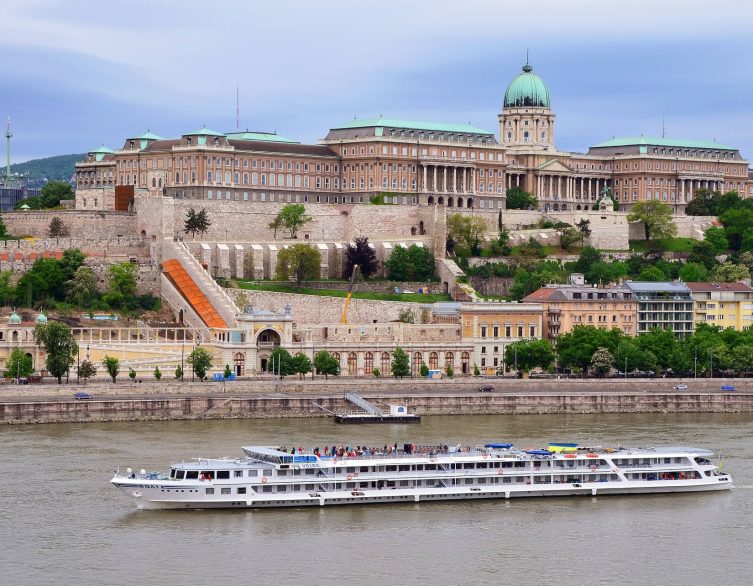
The festival sprawls across the atmospheric streets of Buda’s civic town, including the Anjou Promenade, the Tóth Árpád Promenade, Holy Trinity Square, and Tárnok Street, all set against the historic backdrop of the Royal Palace. Organized by the Association of Hungarian Folk Artists, it brings together 60 folk-art communities and roughly 800 craftspeople who set up shop in nearly one hundred hands-on workshops. Entry is free, and the festival runs daily from around 10am into the evening hours, with stage programming continuing after dark on several days.
Where Clay Becomes Tradition: Pottery in the Spotlight
Every edition of the festival spotlights one craft, and this year the honor goes to pottery, an ancient trade where earth, fire, and human hands come together to create something lasting. Under the coordination of the Pottery Professional Committee of the Association of Hungarian Folk Artists, the Esztergom Bastion becomes a dedicated pottery hub for all four festival days, hosting a rotating program of demonstrations that trace the entire life of a clay vessel from raw lump to finished piece.
Best deals of Budapest








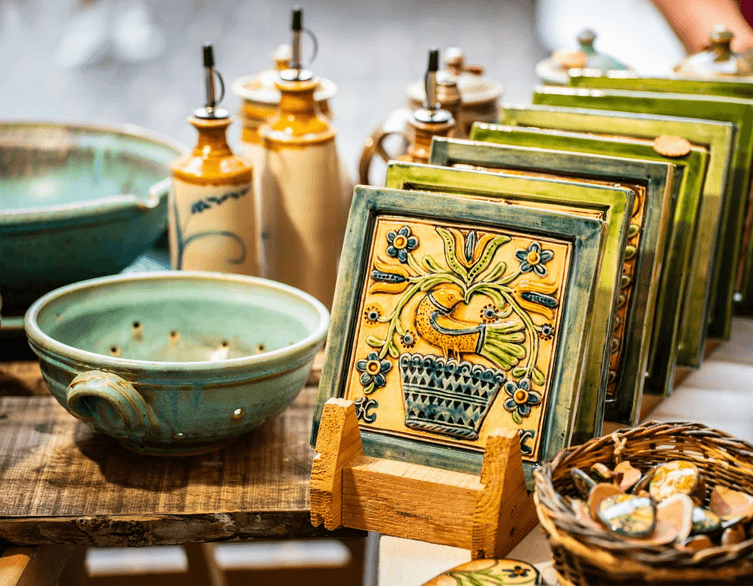
Visitors can watch potters throw traditional vessel shapes on the wheel and apply the elaborate decorative techniques that give each region’s pottery its distinct character. Look out for the earthy vessels of Debrecen, the sculptural forms of Mezőtúr, the intricately patterned wares of Tiszafüred, the rustic pieces of the southern Great Plain, colorful Habán majolica, whimsical miska jugs shaped like mustached men, and the round-bellied butella flasks once carried by shepherds. Each of these forms tells a different regional story, and seeing them made by hand, right in front of you, is a rare chance to understand just how much variety exists within a single craft tradition.
Pottery this year knows no borders, either. Alongside the Hungarian masters, American potters join the Esztergom Bastion program for an hour each day, demonstrating their own techniques and creations and showing how this ancient trade continues to evolve on the other side of the world. It’s a neat parallel to the festival’s wider theme, since the United States delegation elsewhere on the grounds includes its own woodcarvers, printmakers, embroiderers, and ceramicists.
Kids are far from forgotten. Interactive sessions at the Bastion let children get hands-on with the basics of wheel-throwing, giving them a genuine, if messy, taste of what it takes to shape clay into something useful and beautiful. The pottery program at the Esztergom Bastion runs throughout the festival, from August 20 to 23, and is realized with co-financing from the European Crafts Alliance and the European Union, underlining just how much international collaboration underpins Hungary’s living craft traditions today.
America Takes the Guest of Honor Spot
To mark 250 years of U.S. independence, 18 American artisans have crossed the Atlantic to join the festival, demonstrating woodcarving, pottery, printmaking, and embroidery in Holy Trinity Square. Among them, textile artist Stefan Romero and Karen Wallach present America’s Tapestry, a community embroidery project made up of thirteen hand-stitched panels honoring the original thirteen colonies, created by volunteers aged five to ninety-six from New Hampshire to Georgia. Festival visitors are invited to add their own signature, drawing, or stitch to a related community tapestry built around Benjamin Franklin’s famous rattlesnake symbol.
Knoxville-based woodcarver Douglas Molinas Lawrence turns simple blocks of timber into sculptural vessels, while potter couple Mark and Joyce Nafziger walk audiences through throwing, hand-building, and slip-trailing techniques across the four days. Ceramicist Kate Schroeder demonstrates her hand-built “Shelfie Mug” pieces, and printmaker and bookbinder Thayer NG Bray combines bookbinding, relief printing, and zine-making into a single hand-printed book by the festival’s final day. On the entertainment side, San Francisco Bay Area bluegrass outfit Hot Buttered Rum brings Appalachian-inspired tunes on banjo, fiddle, and mandolin, while TwoShields Productions, a Native American ensemble representing Utah’s Northern Ute and Laguna Pueblo nations, performs traditional dances and demonstrates beadwork, drum-making, and flute-making throughout the festival.
A World of Traditions Under One Roof
The international lineup goes well beyond the United States. Craftspeople travel in from Japan, South Korea, Kyrgyzstan, Poland, Kazakhstan, China, Azerbaijan, and Uzbekistan, turning the Castle District into a genuine world showcase of folk art. South Korean artisans demonstrate najeonchilgi, a centuries-old technique of inlaying mother-of-pearl into lacquered wood, while Japanese masters present bamboo weaving, sashiko stitching, and mizuhiki paper-cord artistry. Every morning, the main stage hosts a demonstration of the Kyrgyz elechek, an intricately wrapped traditional headdress recognized on UNESCO’s Representative List of the Intangible Cultural Heritage of Humanity. Kazakh textile artists and jewelers, Chinese indigo-dyeing specialists, Azerbaijani silk kelaghayi scarf makers, and Uzbek suzani embroiderers round out the international program.
Hungary marks 20 years since joining the UNESCO Convention for the Safeguarding of Intangible Cultural Heritage this year, so the festival gives special billing to Hungarian traditions on UNESCO’s lists, including the folk art of Kalocsa, the Matyó embroidery tradition, Sárköz needlework, the Mohács busó carnival figures, indigo dyeing, egg writing, Hövej lace, Szeged slippers, and úrihímzés embroidery.
Music, Fashion, Family Fun, and Getting the Most Out of Your Visit
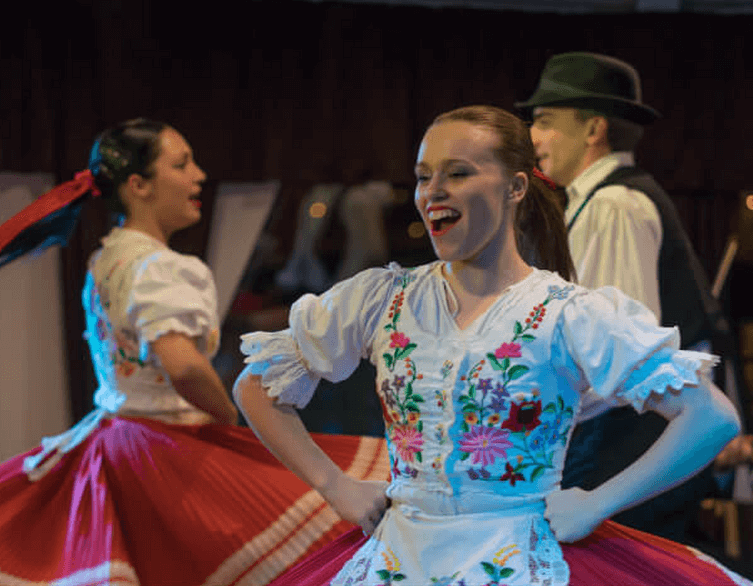
Beyond the workshops, a packed stage program runs on the main square near the Saint Stephen statue, featuring folk music and dance acts such as the Fitos Dezső Company, Bársony Bálint with the Magyar Rapsody Project, Petrás Mária and her band, and, marking the Hungarian-Serbian cultural season, joint performances by the multigenerational Vujicsics and Söndörgő ensembles. The folkTrend fashion show is another highlight, reimagining traditional Hungarian folk costume through a contemporary lens, choreographed this year by Kocsis Enikő and Fitos Dezső with dancers from the Fitos Dezső Company and the Szentendre Dance Ensemble.
Families are well looked after too. Craft associations run children’s workshops throughout the grounds, the Hungarian Heritage House sets up at a new location on the Tóth Árpád Promenade with puppet theater, folk singing and dance lessons, and concerts for little ones, and the Hungarian Folk Storytellers’ Association keeps kids entertained with live storytelling. One highlight not to miss falls on August 20 itself: a traditional harvest procession winds through the Castle District before arriving at Holy Trinity Square for a ceremonial bread blessing, a genuinely moving nod to Hungary’s agricultural roots and Saint Stephen’s Day.
Practically speaking, the festival is completely free and set entirely outdoors across the Castle District, so comfortable shoes and a bit of patience for crowds go a long way. Driving is not recommended, since the surrounding streets are closed to traffic for the duration of the event.
Related events
Related attractions