The Garden of Philosophers: Budapest’s Hidden Spiritual Sanctuary on Gellért Hill
Tucked away on the tranquil western slopes of Gellért Hill, the Garden of Philosophers (Hungarian: Filozófusok Kertje or Filozófiai Kert) stands as one of Budapest’s most profound yet lesser-known attractions. This remarkable sculptural sanctuary offers visitors not only breathtaking panoramic views of the Hungarian capital but also a unique opportunity for spiritual reflection and cross-cultural understanding.
A Monument to Universal Understanding
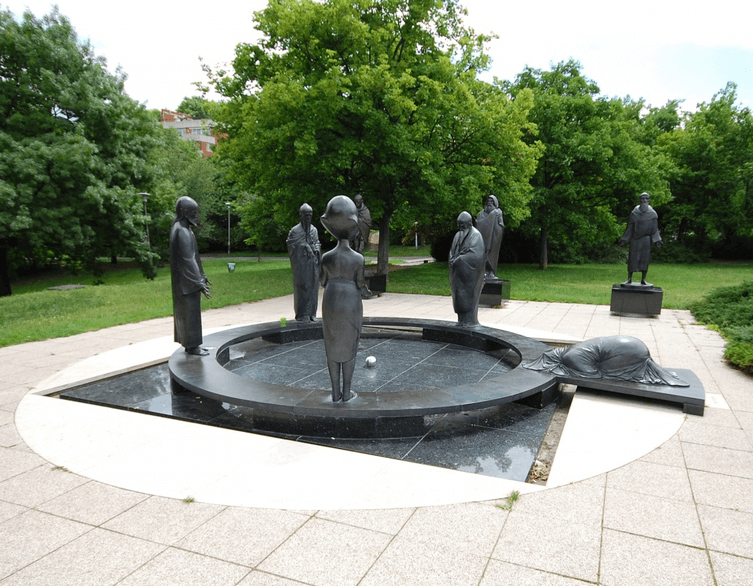
The Garden of Philosophers centers around a powerful message carved in stone at its entrance: “For a better understanding of each other” (Hungarian: “Együttműködés egymás jobb megértéséért”). Created by Hungarian sculptor Nándor Wagner, this extraordinary monument features eight bronze and granite figures representing humanity’s greatest spiritual leaders and thinkers. The sculpture group was specifically designed to promote harmony among the world’s diverse religious and philosophical traditions.
At the heart of the installation, five monumental figures stand in a circle around a gleaming spherical orb that symbolizes the divine essence shared by all faiths. These figures represent the founders of the world’s major religions: Abraham (Judaism), Akhenaten (ancient Egyptian monotheism), Jesus Christ (Christianity), Buddha (Buddhism), and Laozi (Taoism). Each figure faces inward toward the central sphere, emphasizing their spiritual unity despite their different cultural origins.
Best deals of Budapest











The Sculpture’s Deeper Symbolism
The arrangement carries profound symbolic meaning that becomes apparent upon closer observation. Abraham, the founding father of Judaism, is uniquely positioned in a crouching pose with his head in his hands, reflecting the tradition that he always hid his face when God spoke to him. The circular formation represents the universe itself, while the central orb symbolizes the divine presence that connects all spiritual paths.
Behind the inner circle, three additional figures stand in contemplative poses: Mahatma Gandhi, Bodhidharma (also known as Daruma), and Saint Francis of Assisi. Wagner selected these figures as representatives of spiritual enlightenment who successfully translated their divine understanding into practical action within their societies.
The Artist’s Remarkable Journey
The Garden of Philosophers represents the life’s work of Nándor Wagner (1922-1997), a Hungarian artist whose personal story is as compelling as his artwork. Born in Oradea (then part of Hungary), Wagner fled his homeland after the failed 1956 Hungarian Revolution, eventually settling in Japan where he spent the final 25 years of his life. This cross-cultural experience profoundly influenced his artistic vision of universal spiritual harmony.
Wagner dedicated the last 15 years of his life to creating this sculpture group, beginning with the figure of Laozi in 1977 and completing the others throughout the 1980s. The artist created three identical sets of the sculptures, gifting them to Budapest, New York, and Tokyo as symbols of international understanding. Wagner died in 1997, and his wish to donate the sculpture group to Budapest was fulfilled posthumously by his Japanese wife, Chiyo Wagner.
A Location Chosen with Care
The sculpture group found its permanent home on October 18, 2001, in a carefully selected location atop the Gruber József water reservoir built in 1902. Architect István Makk, who had personally known Wagner, chose this serene spot on Gellért Hill’s western slope for its symbolic significance and peaceful atmosphere. The timing of the installation, coming just weeks after the September 11 terrorist attacks, gave the monument’s message of mutual understanding particular resonance.
Discovering Additional Treasures
Visitors to the Garden of Philosophers will find more than just the main sculpture group. Just a few meters away stands the charming Kilátókő (Lookout Stone) sculpture, featuring Prince Buda and Princess Pest with outstretched hands reaching toward each other across a gap representing the Danube River. This 1.5-meter-tall bronze sculpture by Márta Lesenyei, unveiled in 1982, symbolizes the unity of Budapest’s two historical districts.
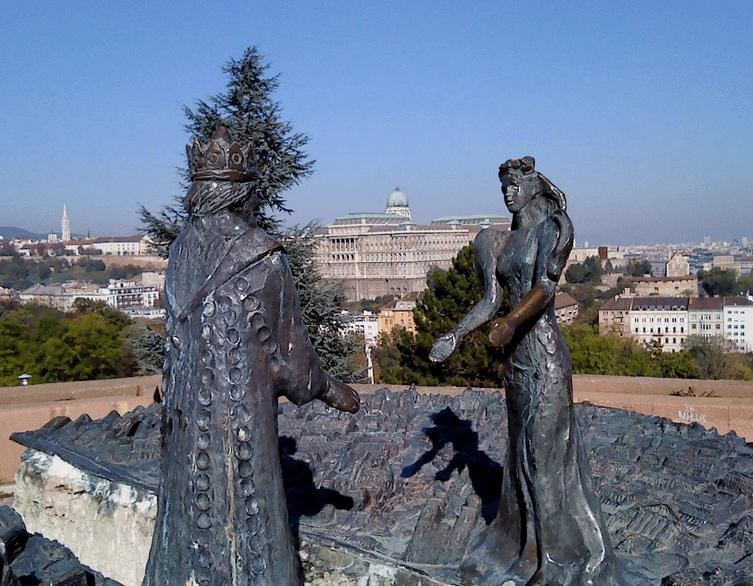
Photo by Lesenyei Márta and Vadász György
The location itself provides one of Budapest’s most spectacular viewpoints, offering panoramic vistas of the Parliament Building, Buda Castle, Chain Bridge, and the entire cityscape stretching along both banks of the Danube. The elevated position, combined with the surrounding greenery and peaceful atmosphere, creates an ideal setting for contemplation and photography.
Planning Your Visit
The Garden of Philosophers (Filozófusok Kertje) is located on the southern side of Gellért Hill, accessible via Hegyalja Street in Budapest’s District I. Visitors can reach the site by taking buses 8E, 108E, 110, or 112 to the Sánc utca stop, followed by a short uphill walk. Alternatively, the garden is approximately a 10-15 minute walk from the famous Citadel or can be reached by climbing up from the Gellért Hill area near the thermal baths.
For the most memorable experience, plan your visit during golden hour when the setting sun bathes both the sculptures and the city below in warm, magical light. This timing also tends to attract fewer crowds, allowing for more peaceful contemplation of the monument’s profound message. The site is freely accessible year-round and offers excellent opportunities for photography, meditation, and quiet reflection away from Budapest’s busier tourist attractions.
A Testament to Human Unity
The Garden of Philosophers represents more than just another tourist attraction – it stands as a powerful testament to the possibility of harmony among diverse cultures and beliefs. Wagner’s vision of creating a space where the world’s great spiritual traditions could coexist peacefully has resulted in one of Budapest’s most meaningful and inspiring destinations. Whether you’re interested in art, philosophy, spirituality, or simply seeking a moment of tranquility with spectacular city views, this hidden gem on Gellért Hill offers an experience that resonates long after your visit.
Related news
Autumn Meets Spring in Budapest’s Gellért Hill Rose Garden
Autumn colours and fresh flowers in the same place? On Gellért Hill, the two make a lovely pairing. While the season brings a different mood to...

Watch the Skies, Not Just the Streets: Why Budapest’s Parks Come With a Summer Warning This Year
Budapest is having one of its hottest, driest summers in recent memory, and the city’s beloved green spaces are feeling the strain in a way...
Please Don’t Turn Gellért Hill’s Trees Into Gym Equipment, Budapest’s Park Rangers Ask
If you’re planning to visit Gellért Hill in Budapest, you’re in for one of the city’s most scenic natural escapes — but local...
Why the Elizabeth Lookout Tower on János Hill Is Closed — and What It Means for Your Budapest Trip
If you were hoping to climb Budapest’s highest viewpoint this year, there’s some disappointing news: the beloved Elizabeth Lookout Tower...
A Perfect Day Around Gellért Hill, the Citadella, and Bartók Boulevard
Some of the best days in Budapest aren’t built around ticking off famous landmarks one by one, but around letting one neighbourhood lead naturally...

New Bus Rules on Gellért Hill: What Tourists Need to Know Before Visiting the Citadella
Budapest’s most dramatic hilltop is about to get a little more peaceful — and a lot more exciting. Gellért Hill, home to the newly renovated...
Pink Petals Over the Danube: The Almond Blossoms of Gellért Hill and the Extraordinary History Beneath Your Feet
Budapest’s Most Beautiful Spring Secret Every March, while the rest of the city is still pulling on its coat and considering whether it needs...

Skip Váci Street: 5 Secret Budapest Spots Only Locals Know (and Love)
Imagine that you’re shuffling along Váci Street, squeezed between tour groups like a sardine in designer jeans, staring at the same global...
Fall in Love with Budapest: 6 Picture-Perfect Spots for Autumn Photos
There’s something absolutely magical about Budapest when autumn rolls around. The city puts on its most colorful outfit, draping golden, crimson,...

A Perfect Autumn Day in Budapest: Make the Most of One Day in the City
Waking Up Above the City: Budapest’s Autumn Magic Imagine starting your Budapest adventure at the city’s very top, where the crisp October air...
Related attractions