Budapest’s Terézváros District Just Turned a Gloomy Parking Street Into a Charming Mini Park
If you’ve ever wandered through Budapest’s Sixth District — the lively, café-lined neighborhood officially known as Terézváros, or Theresa Town — you already know it has a special kind of energy. It’s the district of the Hungarian State Opera House, the buzzing Liszt Ferenc Square, and the iconic Király Street. But tucked just a short walk from the Grand Boulevard, a quiet little transformation has been unfolding, and on June 16, 2026, it was finally celebrated with a picnic.
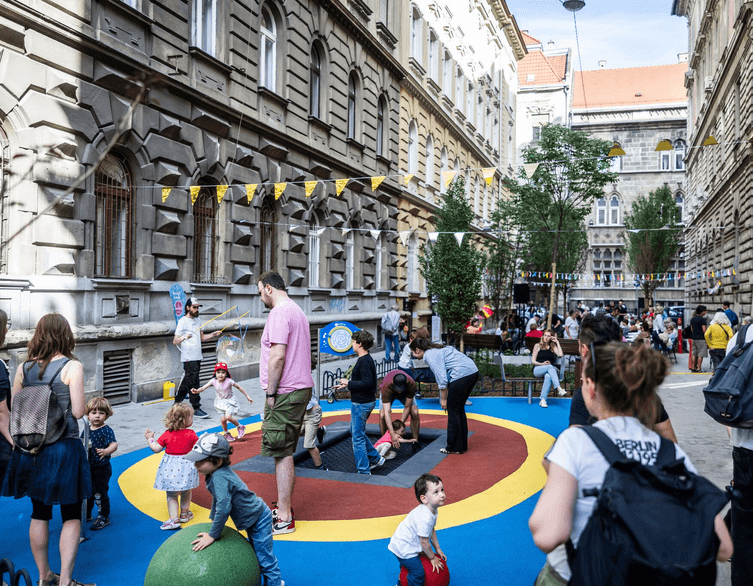
Kármán Street — a short, shadowy lane that most locals only knew as a place to park their cars or cut through on foot — has been reborn as a genuine community mini park. And judging by the laughter, the chanson melodies floating through the summer air, and the sound of children bouncing on a trampoline, the neighborhood couldn’t be happier about it.
From Car Park to Community Hub
Not so long ago, Kármán Street was, by most accounts, a hard place to love. The district’s own mayor, Tamás Soproni, put it plainly at the opening event: “I’ve passed by here so many times on my way home from Nyugati Station — I’ve known Kármán for decades. I love every street in Theresa Town, but this one was difficult to love for a long time. A slightly sad, slightly dark street that people only used to drive through or park in.”
That candid admission makes the transformation all the more satisfying. The cobblestones are gone, replaced by thirteen new ground-connected trees that are already casting welcome shade over the street. Compact green islands, shrubs, and raised planting beds soften what was once an unbroken stretch of grey. Benches, bicycle racks, play equipment, and — the undisputed star of the show — a trampoline have taken the place of parked cars. The mini park is enclosed by lockable gates at both ends of the street, so it can be secured at night, while daytime security is provided by the district council.
Best deals of Budapest










Mayor Soproni noted that since the park opened, he makes a point of walking past regularly. “There’s always someone here,” he said. “People chatting, sitting on the benches, and almost always someone bouncing on the trampoline.”
The Grand Plan Behind the Small Street
Kármán Street’s makeover is part of a much bigger picture. Back in 2022, the Sixth District launched the Terézváros 2030 programme, which the council describes as the largest public space development initiative in the district in thirty years. Its motto is simple but ambitious: wherever possible, replace concrete with trees.
The philosophy driving the programme is a shift away from car-centric urban planning toward human-centered design. Rather than optimizing streets for traffic flow, the goal is to make the district more livable — quieter, greener, and more welcoming to the people who actually walk its pavements every day.
Kármán Street was chosen for this particular project for very practical reasons, as Deputy Mayor Máté Győrffy explained at the opening. The street carries no through traffic, the lost parking spaces can be compensated with resident permits elsewhere in the neighborhood, there’s no dense utility infrastructure beneath the road surface, and no building entrances open directly onto it — making it an ideal candidate for a full pedestrian transformation. Győrffy was also quick to point out that the renewal doesn’t stop here: under the same programme, a tree-lined avenue will be planted along the nearby stretch of Eötvös Street, and the adjacent Szobi Street will also receive greening works.
Other streets have already benefited from the Terézváros 2030 vision. Bajcsy-Zsilinszky Passage has been transformed into a pedestrian zone, while Csengery Street and a section of Szondi Street have both been renovated and greened in recent years.
A Picnic, Not a Ribbon-Cutting
What made the Kármán Street opening genuinely special was the way the district chose to celebrate it. Instead of the usual ribbon-cutting ceremony, residents were invited to a proper community picnic — complete with traditional Hungarian pogácsa (savory scones), fruit syrup drinks, bubble-blowing stations for children, and a live quiz that had groups competing to name, among other things, the year the Hungarian classic film Körhinta (Merry-Go-Round) was first screened, which old Theresa Town street once went by the name “Szerecsen,” and whose statues grace Liszt Ferenc Square. One particularly enthusiastic participant even had to beat out a Whitney Houston rhythm on a drum.
The musical backdrop was provided by composer and pianist Ferenc Darvas, whose chansons and beloved 20th-century Hungarian melodies drifted through the sunny afternoon. Older attendees told reporters they especially appreciated the repertoire, with the timeless hit Kétszer kettő néha öt (“Two Times Two Is Sometimes Five”) drawing warm smiles from the crowd. People came not just from the immediate street, but from Teréz Boulevard, Király Street, and the Rózsa Street neighborhood — drawn in by the programme, happy to discover this hidden corner of the district.
For the younger visitors, the Eötvös10 cultural venue organized glitter tattoos, bubble shows, and an acrobatic performer who danced with a flag throughout the afternoon. The picnic’s youngest participant — fifteen-month-old Manó, whose family lives on the nearby Csengery Street — hadn’t quite mastered the flag tricks, but his mother Elvira shared that since the park opened, they come down twice a day just for the trampoline. “We really missed having a mini park like this in this neighborhood,” she said. “I’m so glad Kármán Street has been renewed.”
EU Funding and a Cross-Border Partnership
The project has an interesting European dimension worth knowing about. The renovation was funded through the Interreg Hungary-Slovakia Programme, under a cross-border urban sustainability initiative called Upscale — Cross-border Cooperation for Promoting Urban Permaculture Solutions. Theresa Town is participating in the programme alongside the city of Košice (Kassa) in Slovakia, with a total grant of 150 million Hungarian forints supporting several green projects across the district. Beyond Kármán Street, the funds will also revitalize the community garden on Rózsa Street, create a green wall at the Mesevilág kindergarten, and establish a community garden at the Kincseskert kindergarten.
The street was designed by Mundus Viridis Ltd., built by Everling Ltd., and coordinated by Theresa Town’s asset management company.
Why It’s Worth a Detour
For visitors exploring Budapest beyond the main tourist trail, Kármán Street offers a lovely glimpse into how the city is quietly reinventing itself. It’s a two-minute walk from the Grand Boulevard and just around the corner from the lively Liszt Ferenc Square area, making it an easy addition to any stroll through the Sixth District. Pull up a bench, watch the local kids on the trampoline, and enjoy the kind of unpretentious, everyday Budapest life that no guidebook ever quite captures.
The transformation of one grey, forgotten street into a shaded, green community hub might seem like a small thing. But on a warm June evening, with chansons in the air and neighbors sharing pogácsa on benches where bumpers used to scrape, it felt like exactly the right kind of city-making.
Related news

Airbnb in Budapest: What Terézváros’ 2026 Ban Means for Tourists
Budapest’s vibrant inner districts have long been a favorite among travelers, offering historic streets, lively nightlife, and easy access to iconic...
Budapest’s Old Phone Booths Are Disappearing: A Long-Awaited Change in Terézváros
Budapest is a city where history and modern life constantly meet—and sometimes clash in unexpected ways. One such story has been unfolding in the...

Terézváros Nightlife Rules in 2026: What Budapest Visitors Should Know
Terézváros, Budapest’s 6th District, has tightened its late-night opening rules in a move that matters both to locals and to visitors who want...
How Budapest’s Terézváros District Is Letting Women Shape Their Own Neighbourhood
Budapest is a city that never stops surprising. Famous for its grand boulevards, thermal baths, and vibrant cultural scene, it is also — perhaps...
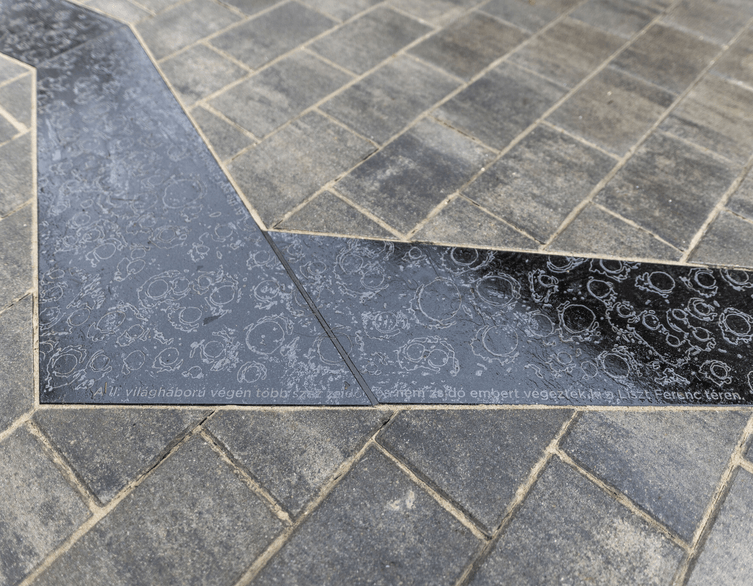
Beneath the Surface: The New Holocaust Memorial at Liszt Ferenc Square in Budapest
In the heart of Budapest’s elegant 6th district, not far from the vibrant cafés and music that fill Liszt Ferenc Square, a new memorial interrupts...