See a Rock Legend’s Extraordinary Model Railway in Budapest
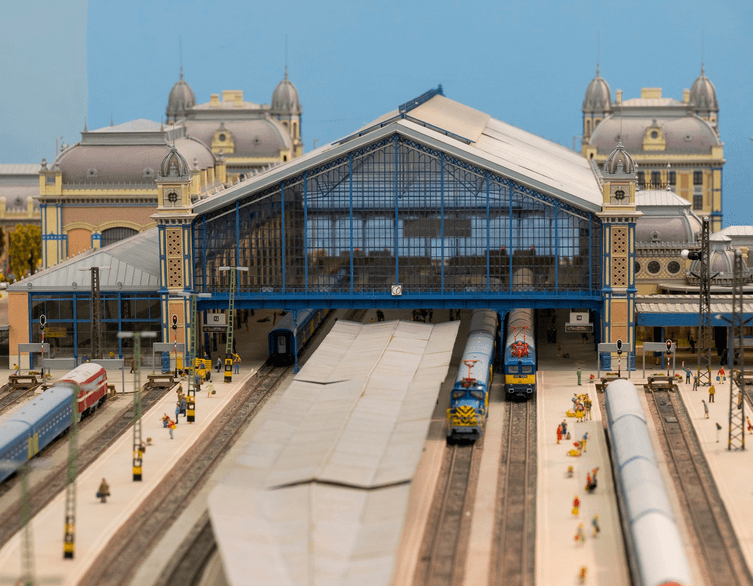
Budapest is full of surprises, and this one is genuinely unlike anything else in the city. Tucked inside the atmospheric halls of the Eiffel Műhelyház (Eiffel Art Studios) in the Kőbánya district, you’ll find one of the most extraordinary personal art projects ever put on public display in Hungary — a nearly 50-square-metre model railway layout built over several decades by Szabolcs Szörényi, the Kossuth Prize-winning composer and bassist of the legendary Hungarian rock bands Illés and Fonográf. The exhibition is called A Pályaudvaron Otthon Vagyok, which translates as “I Feel at Home at the Station,” and it’s every bit as captivating as it sounds.
Who Was Szabolcs Szörényi?
Szabolcs Szörényi, who passed away in 2024, was one of Hungary’s most celebrated musicians — a Kossuth Prize-winning composer, musical director, and the bass guitarist of Illés and Fonográf, two bands that defined Hungarian rock music for generations. But alongside his remarkable musical career, Szörényi nurtured a lifelong passion for railways, and specifically for Budapest’s grand Keleti and Nyugati (Western) railway stations. His love for Nyugati Station began in childhood, and it stayed with him for the rest of his life. When he built his family home in Hidegkút, he designed the basement around the future model railway layout — and then designed the house around the basement.
Decades of Work on a 50-Square-Metre Masterpiece
Szörényi began planning his model railway layout in 1988, working from his own photographs and drawings. He finally built it in 1993, at the age of fifty. The result is a breathtaking 1:87 scale (H0 gauge) recreation of Budapest’s Nyugati (Western) Station and the Északi Locomotive Depot as they appeared in the 1980s — before the Westend City Center shopping mall was built alongside the station. On the layout, you’ll find:
- 16 locomotive models
- 97 passenger carriage models
- 48 freight wagon models
- Custom-built period-accurate buildings, figures, and trackside details
The level of craftsmanship is extraordinary. Every building is handmade, every vehicle is period-correct, and the entire composition brings a lost era of Budapest’s railway history vividly back to life.
Best deals of Budapest










The Remarkable Story of Moving It Here
Getting this layout to the Eiffel Műhelyház was, by all accounts, a near-impossible task. The model had been assembled in Szörényi’s basement and could only be removed through a door just 80 centimetres wide and up a narrow staircase — meaning the entire layout had to be carefully dismantled piece by piece. The meticulous disassembly alone took around six weeks, followed by another six weeks of reassembly, rewiring the electrical system, and erasing all traces of the cuts. Museum restorer Dániel Erky-Nagy compared the operation to trying to remove a ship-in-a-bottle from the glass — a feat that seemed impossible but was carried out with extraordinary precision.
The layout was donated to the Hungarian Museum of Transport and Technology (Magyar Műszaki és Közlekedési Múzeum) in the summer of 2025 by Szörényi’s family, and is now on display thanks to a collaboration between the museum and the Hungarian State Opera House.
A Living, Working Display
The model railway isn’t a static exhibit — the trains and lighting are digitally controlled, making it a genuinely dynamic experience. Watching the miniature locomotives move through a meticulous recreation of 1980s Budapest is quietly mesmerizing, and the level of detail rewards careful looking. It’s a wonderful experience for adults and children alike, and for train enthusiasts, it’s nothing short of a pilgrimage.
Guided Tours and Special Events
The exhibition is available as part of guided tours, architectural walking tours of the Eiffel Műhelyház building, and special events. Registration for guided tours is already open. And if you’re planning to visit in late June, mark your calendar for June 20, 2026 — the Night of Museums (Múzeumok Éjszakája) — when the layout’s nighttime lighting will be switched on for the very first time for the general public. It promises to be a magical sight.
Practical Visitor Information
- Exhibition: A Pályaudvaron Otthon Vagyok (I Feel at Home at the Station)
- Venue: OPERA Eiffel Műhelyház, Kőbányai út 30, 1101 Budapest (10th district, Kőbánya)
- Access: Via guided tours, architectural walks, and special events — advance registration recommended
- Special event: Night of Museums, June 20, 2026 — first-ever public display of the layout’s nighttime lighting
- Getting there: Accessible by tram and bus from central Budapest; check the BKK public transport app for the best route from your location
- Tickets: Check the Hungarian State Opera House website (opera.hu) for tour schedules and booking
The Eiffel Műhelyház itself is a stunning venue — a repurposed historic railway workshop that now serves as a multifunctional cultural center for the Hungarian State Opera House. Even the building is worth the trip. Combined with Szörényi’s extraordinary model railway, a visit here offers a genuinely unique window into Budapest’s cultural and railway heritage that you won’t find anywhere else in the world.