Manga – Hokusai – Manga: Where 200 Years of Japanese Art Collide
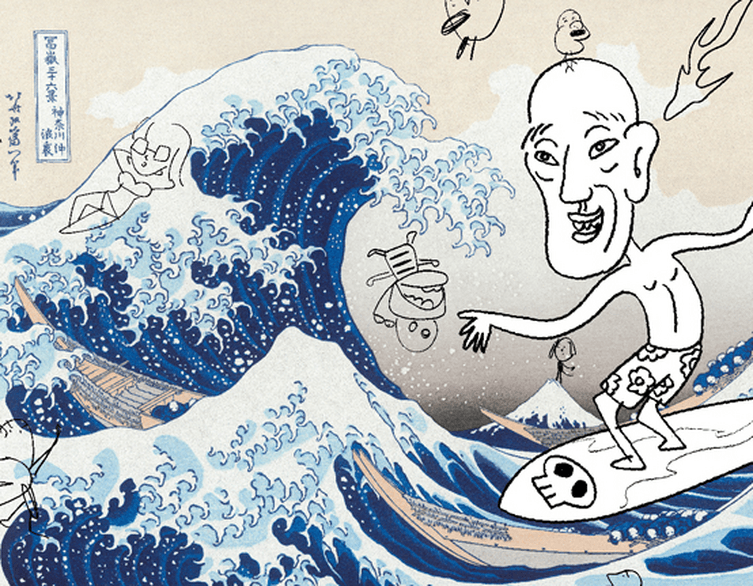
There are exhibitions that display art, and then there are exhibitions that make you rethink everything you thought you knew about it. The Manga – Hokusai – Manga show at Budapest’s Museum of Ethnography firmly belongs in the second category. This is one of the most thought-provoking cultural events in the city this summer — and it’s considerably more surprising than its title suggests.
It’s Not the Exhibition You’re Expecting
Most people walking in will assume this is a straightforward celebration of Japanese comics. It isn’t. The exhibition — an international traveling show by The Japan Foundation — opens with a genuinely bold premise: it doesn’t try to prove that legendary ukiyo-e master Katsushika Hokusai (1760–1849) “invented” manga. Instead, it asks a far more interesting question: what even is manga, and how has that meaning shifted and stretched over 200 years? That single question drives the entire experience, and it takes you somewhere unexpected. The show was organized by Jaqueline Berndt of Kyoto Seika University and curated by Ito Yu and Takahashi Mizuki — academics who bring serious intellectual depth to a subject that popular culture tends to flatten into simple origin stories.
The Hokusai Manga: A Visual Encyclopedia Like No Other
At the heart of the exhibition sits Hokusai’s remarkable Manga — and it’s worth understanding just how unusual this work really is. This is not a comic book in any modern sense. It’s a sprawling, multi-volume visual encyclopedia of thousands of sketches with no narrative thread connecting them. On any given page you might find a sumo wrestler mid-throw sitting beside a detailed study of pine bark, a ghost making a grotesque face, a farmer bent under a load of rice, and a perfectly observed cat stretching in the sun — all on the same spread. There is no story. There is no order. There is simply an inexhaustible curiosity about the visible world, rendered with extraordinary skill and a quiet sense of humor.
Hokusai designed the Manga primarily as a teaching tool. His students and followers used it as a pattern book, copying its motifs, adapting its figures, and building new compositions from its visual vocabulary. In this sense, it functioned less like a finished artwork and more like a shared creative resource — a library of images that anyone could borrow from and build upon. The exhibition draws a direct and fascinating line from this practice to the way manga culture operates today, where copying, referencing, and reimagining existing work is not plagiarism but a fundamental part of how the tradition renews itself.
A Show That Trusts You to Think
What sets this exhibition apart from most art shows is its deliberately non-linear structure. Rather than walking you through a tidy chronological art history lesson, it places drawings from Hokusai’s era directly beside manga pages from the 20th and 21st centuries and invites you to draw your own conclusions. The effect is genuinely striking. The similarities leap out — the dynamic, almost cinematic poses, the intensely expressive faces, the appetite for the absurd and the monstrous alongside the tender and the mundane. But the differences are equally revealing, and the show is honest about them. Manga is not a single style or a closed tradition — it’s a continuously evolving visual practice, and the exhibition makes that case beautifully without ever forcing it.
Best deals of Budapest







Original Artworks That Make This Show Exceptional
While the core of the exhibition uses panels and reproductions to build its argument — as is typical of traveling shows — Budapest visitors encounter a carefully selected group of original works that give the experience genuine weight. Four original woodblock prints from Utagawa Hiroshige’s celebrated series The Fifty-three Stations of the Tōkaidō are on display, offering a direct encounter with the exquisite craftsmanship of the Edo period. These prints, with their atmospheric landscapes and subtle human detail, sit in rich dialogue with Hokusai’s more encyclopedic approach — two masters of the same era, working in very different registers.
Alongside these, original Japanese comic books from the second half of the 20th century bring the story forward into the postwar period when manga as a modern mass medium truly took shape. Seeing those actual printed pages — the paper, the ink, the hand-lettered speech bubbles — alongside 19th-century woodblock prints makes the continuity between these worlds feel visceral rather than theoretical.
Seven Artists, Seven New Perspectives
Perhaps the most extraordinary element of the Budapest showing is the inclusion of original drawings and prints by seven contemporary manga artists, created specifically for this exhibition. These commissioned works take Hokusai Manga motifs as their starting point and reinterpret them through a thoroughly modern visual language. The results are not homage pieces or nostalgic recreations — they are genuine artistic responses, each one bringing a distinct voice and sensibility to the dialogue. Together they make the most powerful argument the show has to offer: that Hokusai’s visual legacy is not a museum piece frozen in amber, but a living source of inspiration that practicing artists are still actively drawing from today.
Hokusai as a Manga Character
One of the exhibition’s most playful and revealing sections examines how Hokusai himself has been absorbed into the manga universe as a fictional character. The master turns up across dozens of stories in remarkably varied forms — a meticulous, obsessive historical figure wrestling with artistic ambition, a larger-than-life hero on improbable adventures, a wise mentor figure, and sometimes a fully fledged pop culture icon with his own fan following. This section says something quietly profound about how cultures keep their legends alive: not by preserving them in glass cases, but by endlessly reinventing them, projecting new desires and questions onto familiar figures. Hokusai, who spent his entire life reinventing his own style and even changed his name dozens of times, would probably have appreciated the irony.
A Participatory Medium, Then and Now
Running through the whole exhibition is one central idea that ties everything together: manga has always been a participatory medium. It was built on copying, sharing, and reimagining from the very beginning, and it remains so today. The images in this show — whether 200 years old or freshly drawn — don’t simply depict the world. They reach out and pull the viewer into the act of making meaning. You are not a passive observer here. The exhibition design by Szobue Shin reflects this philosophy, creating a space that encourages wandering, comparing, and returning to works you’ve already seen with new eyes.
That quality makes the Manga – Hokusai – Manga exhibition unusually rewarding for repeat visits. The more you bring to it — whether that’s a love of contemporary manga, an interest in Japanese art history, or simply an open curiosity — the more it gives back.
Related events