Budapest’s Green Future: The City Turns Into a “Sponge City”
Budapest has just taken a major step toward becoming one of Europe’s most climate-resilient capitals, and it’s a story worth knowing if you’re wandering through a city that’s quietly rethinking its relationship with rain, drought, and green space. The Hungarian government has approved a new Sustainable Water Management Action Plan, and Budapest’s mayor, Gergely Karácsony, calls it nothing short of a historic shift in how the whole country handles water.
If you’ve noticed leafy pockets, unusually spongy-looking gravel paths, or newly planted trees standing in what looks like an odd metal grate around their base during your Budapest trip, you’re already looking at the future the entire country is now moving toward. Here’s the fuller picture, including the specific spots around the city where this transformation is already visible and walkable today.
A Change in Thinking About Rainwater
For roughly a decade and a half, Hungary’s approach to rainwater was simple: get it away from cities and into the drainage network as fast as possible. The newly approved national plan flips that logic entirely. From now on, the guiding principle is to keep rainwater exactly where it falls, in the landscape, on the surface, and in the soil, so that it can be used later during dry spells rather than disappearing down a storm drain within minutes of a summer shower.
Karácsony described the shift in blunt terms, pointing out that after years of the state largely ignoring the issue, this marks a genuine turning point buried, as he put it, a little deep in the legal text but historic all the same. The reasoning is easy to grasp once you consider Budapest’s climate reality: the city receives nearly 280 million cubic meters of rainfall every year, and tens of millions of cubic meters of that could realistically be captured and stored locally instead of vanishing into the sewer system just before the next drought hits.
Budapest’s Head Start: The Radó Dezső Plan
While the national government is only now catching up, Budapest has been building toward this vision since 2021 through the Radó Dezső Plan, a citywide green infrastructure program covering 59 separate projects focused on parks, nature conservation, and water retention, backed by a planned budget in the range of 130 to 150 billion forints. The plan is the backbone of what city officials call the Sponge City concept, and unlike a lot of urban policy talk, this one is genuinely visible on the ground if you know where to look.
The idea itself is refreshingly intuitive. Instead of funneling every drop of rain into underground pipes, the city holds onto it using rain gardens, trees, living soil, and permeable paving that lets water seep back into the ground rather than run off the surface. What makes Budapest’s version interesting for visitors is that these aren’t abstract pilot schemes tucked away in a lab somewhere. They’re built into some of the most walkable, central parts of the city.
Where You Can See It Already: Real Spots Around the City
Vérmező, the large park sitting between Buda Castle and the Southern Railway Station, is one of the earliest and best examples. Since 2023, its southern section has featured purpose-built rain gardens planted with shade-tolerant shrubs and perennials, designed specifically to catch and hold stormwater runoff from the surrounding paths. If you’re exploring Castle Hill, it’s an easy detour and a nice quiet green space in its own right, rain garden aside.
Best deals of Budapest










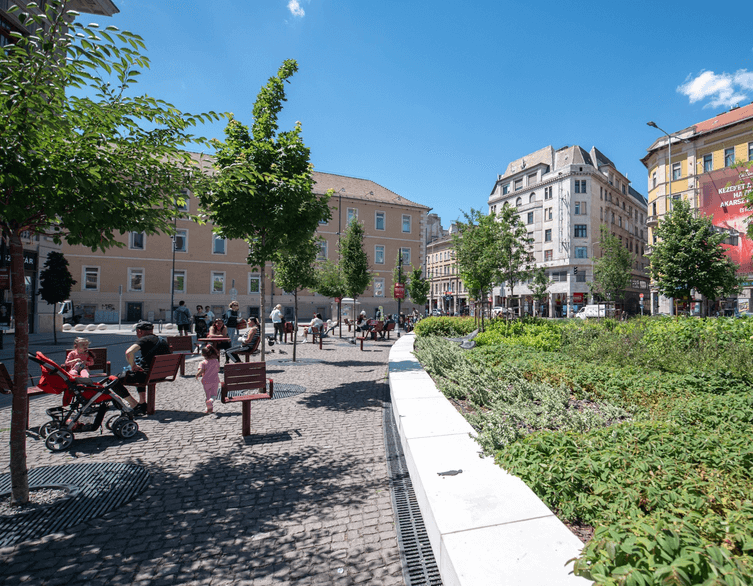
Blaha Lujza Square, one of the busiest transit hubs in central Pest, went through a dramatic transformation completed in late 2022 that doubles as a sponge city showcase. The square gained roughly 1,000 square meters of new green space and 80 newly planted trees, many of them installed using the so-called Stockholm tree-planting system across an area of about 2,400 square meters, a technique that gives urban trees a loose, well-aerated soil structure so their roots can actually thrive beneath a busy paved square instead of suffocating under compacted ground. A full soil replacement was needed underneath, since the site sat on debris left over from World War Two, but the payoff is a leafy little grove right in the middle of one of the city’s most trafficked squares.
Along the lower Pest embankment known as id. Antall József rakpart, between the Hungarian Parliament and Margaret Bridge, the city planted 34 large-canopy oak trees directly into the paved riverside walkway back in 2021, using root-cell technology: underground structural cells filled with loose growing medium and wrapped in water-permeable material, engineered specifically so trees can put down healthy roots even when boxed in by pavement on all sides. It’s the same root-cell approach that’s since been extended to other streets, including Podmaniczky utca, with Mester utca, Bartók Béla út, and the park at City Hall named as upcoming sites for the same tree-planting method.
Up on Gellért Hill, water-retention elements have been worked into the landscape to help manage runoff on the hill’s steep slopes, complementing the more famous waterfall and viewpoint that draw most visitors there in the first place. And around several inner-city streets, older impermeable paving has been gradually replaced with surfaces that let rainwater filter straight down into the soil rather than pooling or rushing into storm drains.
Why Visitors Should Care
For a tourist wandering through Budapest, sponge city features are easy to appreciate even without knowing the technical backstory. A rain garden simply looks like an especially lush, well-planted corner of a park, and permeable paving just feels like a nicer, cooler surface to walk on after a summer shower. But these details are part of a much larger public health and climate strategy for the city, one that changes how comfortable Budapest feels to visit as summers grow hotter.
As Karácsony put it, the recent heat and drought crisis made clear that urban greenery isn’t a decorative bonus or a nice-to-have amenity. It’s functioning infrastructure, on par with water and sanitation systems, that keeps a city livable and walkable as extreme weather becomes the norm rather than the exception. That reframing now shapes how Budapest plans everything from new squares to major boulevards.
What Comes Next for the Cityscape
The mayor’s stated goal is to make sponge city thinking mandatory for every future public space, road, and transportation project in the capital, rather than treating it as an occasional experiment reserved for flagship parks. Planned or in-progress applications reportedly include the park at City Hall, the Great Boulevard, and further stretches of the lower Pest embankments, meaning some of the most heavily visited parts of central Budapest could look noticeably greener, shadier, and more water-conscious in the coming years.
With the national government now aligning behind the same nature-based philosophy Budapest pioneered, the pieces are falling into place for a city that stays green through the summer instead of turning drought-yellow by August. For visitors, that translates into more shaded rain gardens to stumble upon, sturdier street trees offering real shade on a hot walk, and a cityscape that’s investing seriously in staying comfortable and beautiful no matter what the weather throws at it next.
Related news
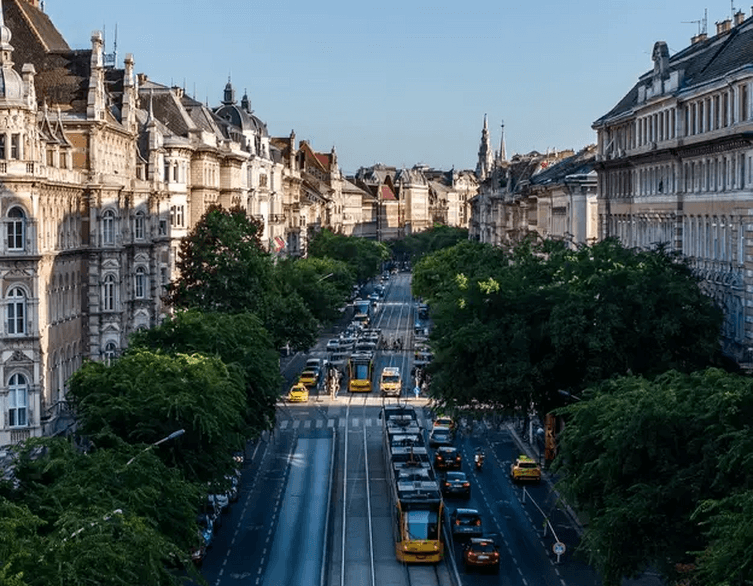
A Greener Grand Boulevard: Budapest’s Major Tree-Lined Renewal Takes Shape
Budapest’s Grand Boulevard is set to become greener, healthier and more pleasant to explore. New plans aim to renew the historic tree-lined avenue...
Breathe Easy in Budapest: Why September 7th Matters for Every Visitor
If you’re wandering through Budapest this week, admiring the Danube from Fisherman’s Bastion or sipping coffee on a leafy terrace in...

Summer’s Grip on Budapest Is About to Loosen: What Visitors Should Know About Next Week’s Cooling Trend
If you’ve been soaking up Budapest’s late summer sunshine and wondering whether to pack that light jacket, now’s a good time to...
Budapest Airport Powers Up Its Green Future with EU Backing
Landing in Budapest is about to get a little cleaner and greener. Budapest Airport, the main gateway for most tourists arriving in Hungary, has ramped...
Pünkösdfürdő Park: Budapest’s Most Beautiful Eco-Friendly Green Space
Budapest has no shortage of parks, but Pünkösdfürdő Park in the city’s leafy 3rd district is something genuinely different. Stretching...
Budapest’s Greenest District Is Fighting Back Against Flash Floods — and the Results Are Beautiful
If you’ve ever strolled through the leafy hills of Budapest’s 12th District — known locally as Hegyvidék, meaning “Highland”...

Green Ways to Explore Budapest: Your Guide to Eco-Friendly Transport
Earth Day is a great reminder that protecting our planet doesn’t require grand gestures. In fact, some of the most meaningful changes start...
Budapest Is Getting Greener: Over 560 New Trees Planted Across the City This Spring
If you’re visiting Budapest this spring, you might notice something fresh in the air — and not just the warmer temperatures. The city is...

Understanding Budapest’s Climate and Green Spaces Today
Budapest’s environment faced some tough challenges in 2024, as laid out in the city’s official 2025 state assessment, approved last December...
Budapest’s Sponge City Initiative: A Sustainable Approach to Urban Water Management
In the heart of Hungary, Budapest is embracing an innovative approach to urban water management known as the “Sponge City” concept. This...