Budapest Installs 61 New Digital Timetable Displays: What Visitors Need to Know
Waiting for a bus or tram in an unfamiliar city often comes with a familiar question: is the service running on time, or has something changed? Budapest’s new digital timetable displays aim to make that uncertainty a little easier to manage.
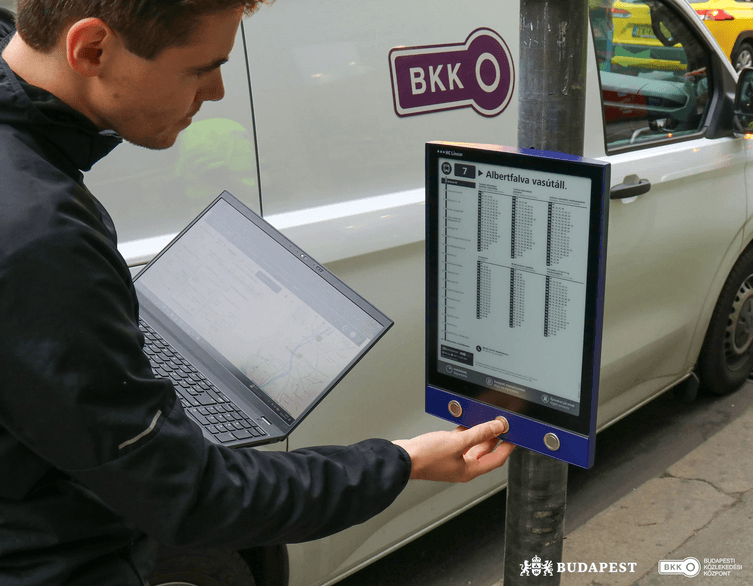
The installation of 61 e-paper displays is now complete, bringing up-to-date timetables, real-time departures and service disruption information to selected public transport stops across the city. Introduced from September 2026, the displays provide more information than a traditional printed timetable—and you do not need your phone to check them.
For tourists exploring Budapest by public transport, they offer a convenient way to see what is happening before the next bus or tram arrives.
What Do Budapest’s New Digital Timetables Show?
At first glance, the new displays might look like a modern version of an ordinary stop timetable. Their main advantage, however, is that the information can change as conditions on the transport network change.
Passengers can check scheduled services, view real-time departures and read current traffic information, including notices about changes affecting bus or tram routes. That distinction matters when a printed timetable alone cannot tell you whether your journey is being disrupted.
Buttons on the display let you switch between the different information screens. Rather than presenting everything at once, the boards allow you to browse departure information and conventional timetables as needed.
BKK, Budapest’s public transport authority, describes them as “mini FUTÁR displays”—a smaller-scale way of providing live passenger information at stops.
Where Can You Find the New Displays?
The rollout reaches well beyond the city centre, with locations chosen to test the technology in different neighbourhoods and transport settings. For visitors, several of the selected stops are places you may naturally pass through during your stay.
Central locations include Astoria, Kossuth Lajos Square, Széchenyi István Square and the Parliament Visitor Centre stop. Displays have also been installed at Fővám Square, Blaha Lujza Square, Jászai Mari Square and Uránia.
If you are arriving by train or changing between services, you may encounter them at selected stops serving Eastern Railway Station and Southern Railway Station. On the Buda side, the Buda bridgehead of Margaret Bridge is another location included in the programme.
The important detail is that this is a targeted rollout, not a replacement of every timetable in Budapest. A display at a named location does not necessarily mean that every stop or boarding point around that junction has one.
Best deals of Budapest










How to Use the Displays During Your Visit
If you spot one while waiting, use the buttons to move between the available screens. You can consult the regular timetable, check upcoming real-time departures and look for information about service changes.
For visitors, it is worth distinguishing between a scheduled departure and a live departure estimate. The timetable shows the planned service, while real-time information gives a more current picture of what to expect.
The disruption notices are another useful addition. If a route is operating differently, the display can provide information that would not appear on a fixed paper timetable. You can therefore check more than simply when the next service is due.
Why Budapest Is Testing E-Paper Technology
E-paper combines a paper-like appearance with information that can be updated remotely. According to BKK, the displays are designed to remain clearly readable in different lighting conditions while using very little energy.
The units operate using solar power or rechargeable batteries, so installing them does not require a new connection to the electricity grid. This makes it possible to introduce digital information without the same infrastructure requirements as a conventional powered display.
Remote updates also reduce the need to print replacement timetables and send staff to individual stops whenever information changes. The environmental benefit is therefore tied not just to low energy use, but also to fewer printed materials and maintenance visits.
More Accessible Information at the Stop
Accessibility is an important part of the project. The displays are designed to be comfortable to use from a wheelchair, helping more passengers access the information directly.
Blind and partially sighted passengers can use a remote control to activate spoken information about upcoming departures and current service changes. This brings real-time audio announcements to selected stops that do not have a full-size FUTÁR display.
It is a reminder that improving passenger information is not only about adding screens. It also means making the same information available in different ways.
A Two-Year Trial With Passenger Feedback
Although all 61 displays have been installed, the project remains a trial. BKK plans to assess their performance over the next two years, looking at how reliably they work in everyday conditions, how easy passengers find them to use and what could be improved.
Those findings will help inform decisions about wider use. Passengers are encouraged to share their experiences through BKK’s online feedback system under the passenger information category.
For tourists, the immediate benefit is straightforward: at selected Budapest stops, you can now check the timetable, live departures and service updates in one place. It is a modest change to the streetscape, but a useful one when you are finding your way around an unfamiliar city.
Related news
Budapest Digital Tickets: Easier Validation on Buses and Trams from October 2026
Catching a tram just before it pulls away? A new Budapest public transport update should make that moment a little less stressful. BKK, the Centre...
Budapest Is Rolling Out Digital Bus Stop Screens, and Tourists Will Notice the Difference
Budapest’s public transport network just got a genuinely useful upgrade for anyone navigating the city without perfect Hungarian skills. The...