Budapest’s New 1956 Memorials: Three Squares Remember the Revolution’s Victims
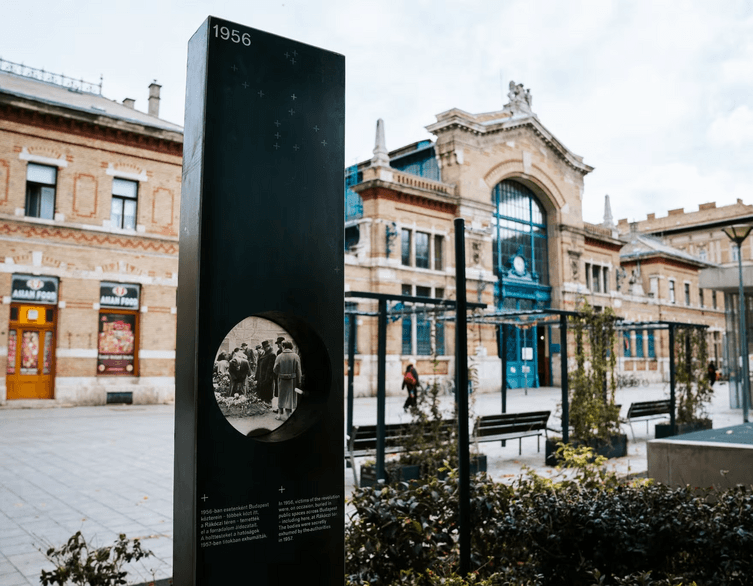
A busy Budapest square can hold a history that is almost impossible to see. People hurry towards the metro, stop for coffee or pass through while sightseeing, unaware that the same ground once held temporary graves.
In October 2026, Budapest unveiled three memorials marking these largely forgotten burial sites, commemorating the 70th anniversary of the 1956 Hungarian Revolution and War of Independence. Standing in Ferenciek Square, Rákóczi Square and Markusovszky Square, the slender black stone columns remember people buried in public spaces during the fighting and its aftermath.
For visitors, they offer a quieter, deeply human way to encounter Budapest’s history. Rather than focusing on political leaders or military victories, they bring attention to the dead—and to the photographs that preserved evidence of their temporary resting places.
Three Black Stone Columns With a Meaningful Design
The memorials are deliberately restrained. Each rough-surfaced black stone column stands 1,956 millimetres tall, its height referencing the year of the revolution. These upright commemorative stones are known as stelae.
At the top of each column is an archival photograph taken at that particular location in 1956. Accompanying inscriptions help connect the present-day square with the improvised graves that once occupied it.
The photographs are not simply illustrations. They are historical evidence, allowing visitors to compare the place in front of them with a scene recorded seven decades earlier.
The project grew from an idea by Fortepan founder Miklós Tamási and was commissioned by the Municipality of Budapest in collaboration with the Eidolon Centre for Everyday Photography and Fortepan. Architect Levente Szabó and typographer Ákos Polgárdi designed the memorials, with design work credited to Hetedik Műterem and SUBMACHINE.
Where to Find Budapest’s New 1956 Memorials
The three memorials stand in neighbouring districts on the Pest side of the city, making it possible to visit them together as part of a reflective walk.
In District VIII, the Rákóczi Square memorial stands on the northern side of the square, opposite a corner of the market hall. The square once contained one of the area’s best-known temporary burial grounds, approximately where the entrance ramp to today’s underground car park is located.
A second column stands in Markusovszky Square in District IX, while the third is in Ferenciek Square in District V.
The memorials were inaugurated on 23 October 2026 with a walk beginning in Rákóczi Square, continuing through Markusovszky Square and ending in Ferenciek Square. Following that sequence gives visitors a way to connect all three sites, while remembering that they represent only a small part of a much wider story.
Why People Were Buried in Budapest’s Public Spaces
During the revolution, transporting the dead to a cemetery was not always possible. Fighting and disrupted conditions forced people to arrange temporary burials close to where deaths occurred.
Historian László Eörsi describes burials in gardens, courtyards, near hospitals and close to the fighting. Public squares also became emergency burial grounds: places normally associated with neighbourhood life suddenly took on the role of cemeteries.
Best deals of Budapest










Those buried there did not belong to a single social or political group. They included insurgents, unarmed civilians and children, as well as members of the armed forces loyal to the regime. This makes the history more complex than a simple division between opposing sides.
In District VIII alone, temporary burial sites included Rákóczi Square, Molnár Ferenc Square, Harminckettesek Square and the Botanical Garden. The exact number of improvised graves across Budapest, and the total number of people buried in them, remain uncertain.
Around All Saints’ Day and All Souls’ Day in 1956, flowers and candles marked these graves. For a brief time, mourning extended beyond the established cemeteries and into the streets and squares of the city.
What Happened to the Temporary Graves?
The graves were never intended to be permanent. Bodies were later exhumed and transferred to cemeteries, particularly Fiumei Road Cemetery. According to the memorial project’s historical account, temporary graves in public spaces were secretly cleared in early 1957, removing their visible traces from the city.
What followed reflected the political divisions of the Kádár era. Those recognised by the authorities as the regime’s own dead received privileged commemorative treatment, including reburial in designated areas associated with the workers’ movement. Revolutionary victims received no comparable public recognition, and their stories were suppressed.
For some families, uncertainty lasted for decades. Relatives could be left relying on second-hand information about where a loved one had ultimately been buried.
The new columns do not mark graves that remain beneath the squares today. They mark former burial places, restoring a visible reminder of a history that had largely disappeared from the streetscape.
How Photographs Brought the Burial Sites Back Into View
The project began with photographs because, for some of these sites, little other evidence survives. There is no comprehensive register of the temporary graves, and the identities of those buried in them are often unknown.
Amateur photographers nevertheless recorded what was happening around them. Their images captured simple crosses, disturbed earth, flowers and people mourning in familiar city spaces.
Tamási and the project’s collaborators used these surviving photographs to help identify former burial locations. By incorporating a photograph taken at each site into the corresponding memorial, they returned the image to the place it documents.
That relationship is what makes the columns so affecting. Visitors do not have to imagine an entirely distant setting: they can look from an archival photograph to the square around them and recognise the connection.
A Different Way to Explore Budapest’s History
These memorials reward a pause rather than a hurried glance. Their modest scale and dark surfaces do not compete with the surrounding city; instead, they ask visitors to notice something that everyday life has covered over.
At Rákóczi Square, Markusovszky Square and Ferenciek Square, the story of 1956 becomes more than a sequence of dates and political events. It becomes a story of neighbours arranging burials, families searching for relatives and photographers preserving scenes whose importance would only grow with time.
For anyone interested in Budapest beyond its best-known landmarks, the three memorials offer a meaningful encounter with the city’s past—one grounded in ordinary places and the extraordinary events they witnessed.
Related news

October 23 in Budapest 2026: National Holiday Events and Visitor Tips
Visiting Budapest over October 23? Hungary’s national holiday marks the 70th anniversary of the 1956 Revolution in 2026, bringing commemorations,...
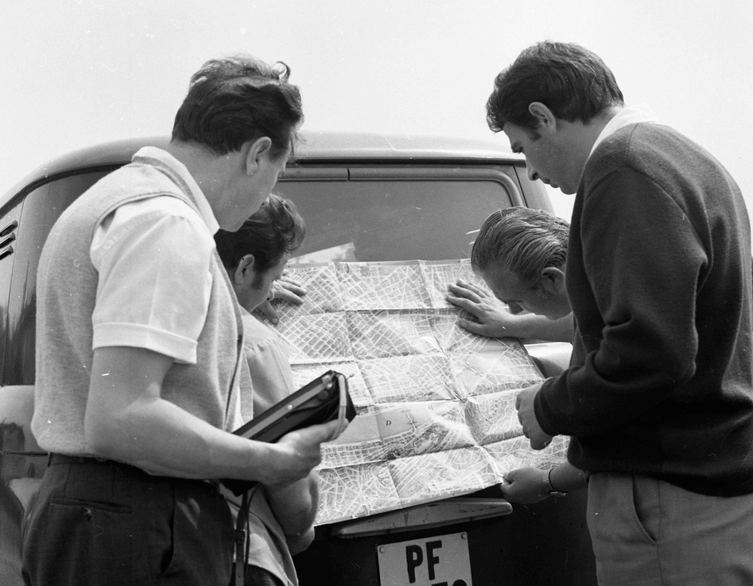
Budapest Just Got a Time Machine, and You Can Use It Right From Your Phone
Imagine standing on a street corner in Budapest, opening an app, and seeing exactly what that same spot looked like fifty or eighty years ago. That’s...

The Danube and Budapest: A Changing Relationship Through the Lens of Fortepan and Valyo
The Danube River has been an integral part of Budapest’s history, culture, and daily life for centuries. As the city evolved, so did its relationship...
Related events