Budapest’s 1956 Commemorations: Light Shows and New Memorials on October 24–25, 2026
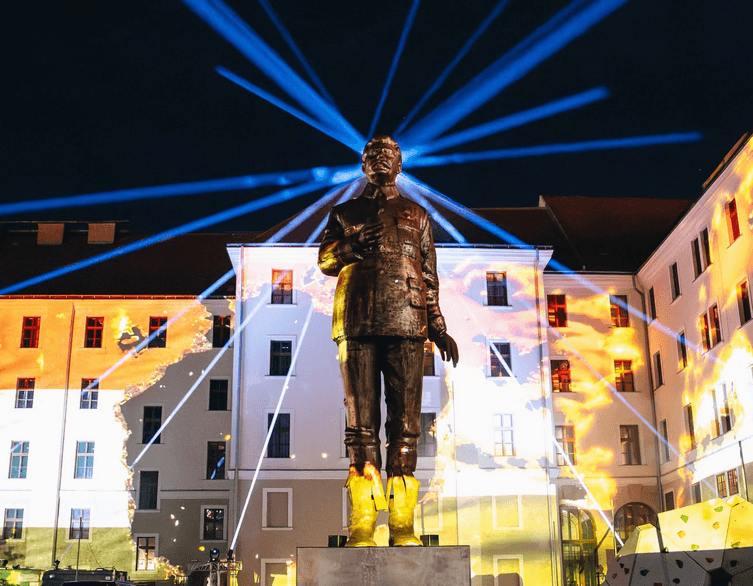
Budapest’s history steps into the spotlight this weekend as City Hall Park hosts immersive light projections and a symbolic recreation of the toppling of Stalin’s statue. Marking the 70th anniversary of Hungary’s 1956 Revolution, the three-day commemorative event continues on Saturday, October 24, and Sunday, October 25, with four evening performances each day. For visitors, it offers a striking way to connect with a defining moment in the city’s past.
Beyond the evening spectacle, newly unveiled memorials in three Budapest squares tell a quieter, deeply moving story: that of the revolution’s victims and the temporary graves that once occupied the city’s public spaces. Together, these commemorations invite you to look beyond Budapest’s familiar sights and discover the personal histories beneath its streets.
See History Recreated at City Hall Park
For three evenings, City Hall Park symbolically becomes “Boots Square,” with immersive light projections and a recreated statue-toppling recalling one of the revolution’s most recognisable moments. The programme centres on the removal of a powerful symbol of tyranny, bringing the themes of freedom and collective action into a shared public setting.
This is a commemorative recreation rather than the removal of a historic monument. Organisers use a smaller statue resembling the original, alongside light effects, to evoke the dramatic scene. The intention is to make the memory of 1956 accessible through an experience that visitors can witness together, rather than through a conventional ceremony alone.
Best deals of Budapest










For international travellers, that visual approach offers an immediate point of connection. You do not need to follow a lengthy historical presentation to understand the central image: a towering symbol of power brought down by people determined to challenge it.
Performance Times on October 24 and 25
On both Saturday, October 24, and Sunday, October 25, the immersive light show and symbolic statue-toppling begin at 7 pm, 8 pm, 9 pm and 10 pm at City Hall Park. These repeat performances follow the opening evening on October 23 and give visitors several opportunities to catch the event over the weekend.
Plan to arrive before your chosen start time. The statue-toppling sequence is brief, so this is not an event where arriving a few minutes late necessarily means catching most of the action. Allow yourself time to find a viewing position and be ready when the programme begins.
Discover the New 1956 Memorials Around Budapest
While City Hall Park focuses on a moment of collective defiance, three new memorials draw attention to the human cost of the revolution. Unveiled on October 23, 2026, the stone memorial pillars stand in Rákóczi Square, Ferenciek Square and Markusovszky Square, marking places where victims were temporarily buried during the fighting.
Created through a collaboration involving Budapest, the Fortepan photographic archive and the Eidolon Centre, the memorial project brings historical photographs back to the locations they document. The pillars were designed by architect Levente Szabó and typographer Ákos Polgárdi. Rather than separating the past from the present in a museum setting, they place evidence of the revolution within the everyday city.
That connection is what makes these memorials so affecting. A square you might otherwise cross without a second thought becomes a place to pause, look at an archival image and consider what happened on the same ground 70 years earlier.
Photographs That Preserve Otherwise Unrecorded Stories
The photographs are especially important because the temporary burial sites were not comprehensively documented. According to the account accompanying the commemorations, no lists were made of those buried at the sites, and the victims’ identities are not fully known. In some cases, a photograph is the only surviving evidence of a burial place.
The project has already prompted moving responses from people who recognised relatives or loved ones in the images. Researchers working with Fortepan and the Eidolon Centre have identified 15 confirmed temporary mass-grave locations, with the longer-term aim of marking every one of them. The three newly inaugurated memorials are therefore the beginning of a wider effort to make these largely unmarked histories visible.
For visitors, these are places for quiet reflection rather than simply another sightseeing stop. Their significance lies in the relationship between the image and its setting: the photograph shows what happened, while the memorial reminds you that it happened here.
A Different Way to Experience Budapest This Weekend
The evening programme and the new memorials offer two complementary ways to encounter Budapest’s 1956 history. At City Hall Park, light and movement recall the energy of public resistance. At Rákóczi Square, Ferenciek Square and Markusovszky Square, archival photographs bring attention back to individual lives and the aftermath of the fighting.
If you are visiting Budapest on October 24 or 25, you can make room for both: visit a memorial during the day, then arrive at City Hall Park ahead of one of the four evening performances. It is an opportunity to experience the anniversary not just as a date in Hungary’s history, but through the public spaces where Budapest continues to remember it.
Related news

What’s On in Budapest This Weekend: October 23–25, 2026
Looking for things to do in Budapest this weekend? The city has plenty to tempt you beyond its famous landmarks, from pumpkin-filled family outings...

October 23 in Budapest 2026: National Holiday Events and Visitor Tips
Visiting Budapest over October 23? Hungary’s national holiday marks the 70th anniversary of the 1956 Revolution in 2026, bringing commemorations,...

Budapest Public Transport on October 23, 2026: Metro Closures and Route Changes
Budapest Public Transport on October 23, 2026: Metro Closures, Tram Changes and Travel Advice Exploring Budapest on Friday, October 23? Public transport...

Budapest Weather: A Brief Warm Spell Before Rain Arrives for the October 23 Weekend
Budapest’s autumn weather is about to change, so make the most of the sunshine while it lasts. Wednesday, October 21, brings a brief spell of warmer...
Related events