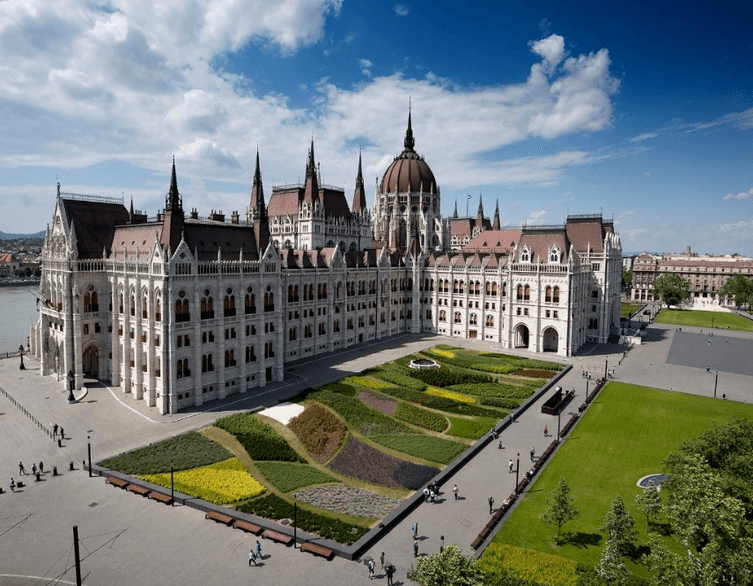
Budapest’s Palace of Justice Nears Restoration: A Historic Landmark Opposite Parliament
Budapest’s Parliament Building has a way of commanding your attention, but look across Kossuth Square and you will find another architectural treasure worth pausing for. The Palace of Justice, with its monumental façade and richly decorated interiors, is approaching the end of a major restoration that will return it to its original role as a courthouse.
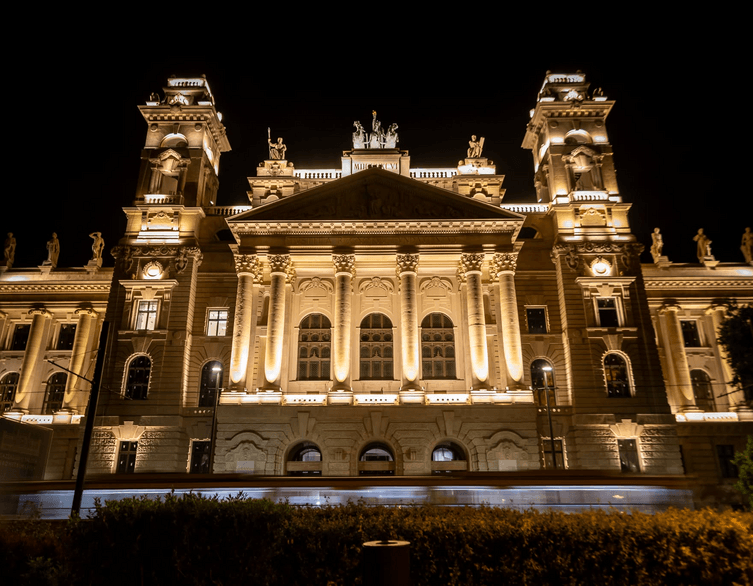
As of October 2026, the approximately HUF 41 billion reconstruction is around 90% complete. To celebrate the building’s 130th anniversary, selected restored interiors have opened for special guided visits from October 20 to 23. Those tours are already fully booked, but the palace remains an impressive exterior sight for anyone exploring the Parliament area—especially after dark, when its newly illuminated façade creates a magnificent spectacle.
An Architectural Counterpart to Parliament
Standing opposite the Hungarian Parliament Building, the Palace of Justice was designed by Alajos Hauszmann and built between 1893 and 1896. Its combination of Neo-Renaissance and Neo-Baroque architecture gives it a distinct character: grand, richly detailed and intended to express the importance of the institution it housed.
Emperor Franz Joseph inaugurated the palace in 1896, during Hungary’s millennium celebrations. Its decoration brought together some of the leading creative figures of the period, including painter Károly Lotz, sculptors Alajos Strobl, Károly Senyei and György Zala, and furniture maker Endre Thék.
For visitors, the setting is part of the appeal. Parliament may be the square’s best-known landmark, but the palace helps explain why this part of Budapest feels like such a carefully composed architectural ensemble. Rather than treating it as a backdrop to your Parliament photographs, give yourself a moment to study the building in its own right.
What the Restoration Is Bringing Back
The project is about more than refreshing an ornate historic building. Its purpose is to recover the palace’s original layout and artistic details while creating a suitable modern working environment for the returning Kúria, Hungary’s supreme court. The restoration is being carried out by Market Építő to designs by Archikon.
The decision to reconstruct the palace dates back to 2016, followed by years of research, documentation and planning. Construction began in 2022, making the approaching completion the result of a decade-long process rather than ten uninterrupted years of building work.
Among the most meaningful changes are the return of historic furnishings preserved by the Kúria, the reinstatement of the original inscription on the main façade and the restoration of ceremonial spaces. The aim is to bring back the building’s architectural coherence while accommodating the practical requirements of a functioning courthouse.
Inside the Palace: Painted Ceilings, Historic Rooms and Justitia
The central hall is one of the highlights of the restored interiors. Here, visitors on the anniversary tours can see Károly Lotz’s ceiling painting and Alajos Strobl’s statue of Justitia, which has returned to its original position after around 70 years away.
That return carries particular significance in a building created for the administration of justice. Justitia is not simply an ornament added to a grand entrance: her presence reconnects the hall with the palace’s original purpose.
The guided route also includes the reconstructed ceremonial hall, furnished in keeping with its historic character, two heritage courtrooms and a newly created contemporary courtroom. Together, these spaces show the two sides of the project: preserving the palace’s artistic identity and preparing it for everyday judicial work.
Best deals of Budapest









A Magnificent Sight After Dark
The Palace of Justice is now illuminated at night, making it a magnificent sight after sunset. The lighting brings its grand façade and sculptural details into focus, giving the building a different character from its daytime appearance.
If you are exploring the Parliament area in the evening, take a moment to look across Kossuth Square. The illuminated palace adds another memorable spectacle to one of Budapest’s most impressive architectural settings, making an evening visit worthwhile even if you cannot step inside.
Can You Visit the Palace of Justice?
The anniversary opening runs from October 20 to 23, 2026, with free guided walks lasting approximately 55 minutes. Visits require advance registration and take place in groups of 30. Children under 16 must be accompanied by an adult.
All places for these October tours have already been taken within hours on the day of the announcement. The opening should therefore not be treated as an opportunity to arrive without a reservation and walk inside. Demand was exceptionally strong, and organisers are considering additional visiting dates before the building is handed over in 2027. Further opportunities have not yet been confirmed.
The palace is also not reopening as a freely accessible museum. Once it resumes operation as a courthouse, any visitor access will need to fit around judicial activity and stricter security arrangements. Future guided visits may be possible, but travellers should not assume the current anniversary programme will become a regular attraction.
From Museum Building Back to Courthouse
Some returning visitors may recognise the palace as the former home of the Museum of Ethnography. Over the decades, it also housed the Hungarian National Gallery, reflecting the many changes in the building’s use since it ceased serving as the Kúria’s headquarters in 1949.
The current reconstruction reverses that change of function. The Kúria is expected to return in 2027, with March identified as the target period for its full move back into the palace. Final construction work and the handover process still need to be completed, so this remains a planned timetable rather than a finished reopening.
For tourists, that distinction matters: this is the restoration of a working public institution, not the launch of a new museum.
Why It Belongs on Your Parliament-Area Walk
Even without an interior reservation, the Palace of Justice deserves a place on a walk around Kossuth Square. Its position directly opposite Parliament makes it easy to appreciate both buildings together and compare their different architectural characters.
Take time to look beyond the square’s most famous landmark. The palace’s scale, sculptural decoration and ceremonial presence reveal another side of late-19th-century Budapest—a city that gave its institutions some of its most ambitious buildings.
Whether you stop to admire the details by day or enjoy the illuminated façade after sunset, the palace offers a rewarding reason to linger in the square rather than simply passing through on your way to Parliament.
Related attractions