Wild Boars vs. Budapest: How One City District Declared War on Its Hairiest Residents
When most people picture a run-in with local wildlife while visiting Budapest, they probably imagine a particularly bold pigeon eyeing their lángos. They do not typically picture a several-hundred-kilogram wild boar trotting across the road in front of them at dusk. And yet, in Budapest’s 12th District — the leafy, hilly, genuinely gorgeous neighbourhood known as Hegyvidék — that has become a surprisingly common occurrence. The good news is that the district has had enough, and its solution to the problem is so clever, so humane, and so thoroughly thought through that municipalities across the country are now lining up to copy it.
How Did We Get Here? Blame a Pig Plague
To understand how hundreds of wild boars ended up living full-time in one of Budapest’s most elegant residential neighbourhoods, you need to go back to 2019 and the arrival of African Swine Fever in Hungary. African Swine Fever — or ASF — is a devastating viral disease caused by a large, complex DNA virus. It has an extremely high mortality rate in wild boars and domestic pigs alike, and because no commercially available vaccine has ever been developed for it, the only way to control it is through strict movement restrictions and minimising contact between animals.
The rules put in place to contain ASF completely changed the game in Budapest’s hills. Feeding stations and water troughs in the forests were shut down to reduce animal contact. Hunting associations continued culling wild boars on outer, non-residential land. But in the city’s inner residential areas, where hunting is not permitted, the previous practice of live-trapping boars and transporting them to wildlife reserves was suddenly banned — the ASF rules prohibited releasing live animals. With no predators, no culling, no live trapping, and a residential landscape full of overgrown gardens, unsecured food waste, irrigated lawns, vegetable patches, and abandoned plots, an extraordinarily intelligent and adaptable animal did exactly what you would expect. It moved in, made itself comfortable, and started a family. Then another. Then about three hundred more.
The Wild Boar That Now Calls Hegyvidék Home
It is worth pausing to appreciate just how clever wild boars actually are, because it explains a lot about why this problem is so hard to solve. These are not dim, lumbering creatures blundering into the city by accident. Many of Budapest’s urban boars are now genuinely urban animals — born in the city, socialised in the city, and perfectly adapted to city life. They know the streets. They know when bins go out. They know which gardens have the juiciest compost heaps and which lawns are freshly irrigated and full of earthworms. Several hundred wild boars are estimated to be living in the 12th District’s residential areas alone.
For most of the year this coexistence is merely unnerving, but it occasionally tips into something more serious. Boars have been spotted at doorways, in parks, and on residential streets, and while a healthy wild boar will generally avoid confrontation, a surprised or protective sow — especially one with piglets — is not something you want to stumble across on an evening walk. Several incidents in recent years resulted in injuries, and in a number of cases dogs were killed during encounters. Residents had even created their own online maps tracking boar sightings across the district just to keep tabs on where the animals were. Something had to be done.
Enter the “12th District Model”
When the district’s new leadership took office in October 2024, they walked straight into a crisis that had been quietly escalating for five years with zero meaningful intervention. Shooting boars in densely populated residential streets — the solution used in some other Hungarian cities — was immediately ruled out as too dangerous and, given the sheer population size, not particularly effective anyway. Releasing live-trapped animals was still banned under ASF rules. So the district had to invent something new.
What they came up with is what they now call the hybrid protocol, and it is genuinely ingenious. Boars are lured gradually into cage traps over a period of several weeks using carefully placed food. Once a whole group — called a sounder — has been successfully trapped, the cages are sealed remotely, the animals are transported by specially licensed vehicles to an authorised forestry facility, and then humanely euthanised using a two-stage sedation process rather than being shot in the cage. Every single step of the procedure was designed to comply fully with strict ASF veterinary regulations while minimising unnecessary suffering — and to keep the entire operation completely safe for residents nearby.
Getting the programme off the ground required months of preparation before a single animal was caught. The district had to obtain special government dispensation to transport live wild boars at all. Licensed vehicles had to be sourced and certified. A multi-agency meeting was convened involving the Pilis Park Forest management, the 12th District Police, the county food chain safety authority, the district’s own Green Office, and several other stakeholders. Old traps that had sat unused for years were dug out, repaired, and redeployed.
The Gadgets, the Patience, and the 120 Boars
The actual trapping process started in late summer 2025 with seven traps, and the patience required is considerable. Baiting a single trap can take several weeks before the animals trust it enough to enter in meaningful numbers. A trained specialist had to be physically present at the trap to spring it manually at exactly the right moment, waiting until enough animals were inside to make the capture worthwhile. It worked, but it was slow.
Then came the technological upgrade. At the end of 2025 and into early 2026, the mechanical traps were fitted with camera monitoring systems and remote-controlled locks. Without a human lurking nearby — and wild boars are extraordinarily sensitive to human presence — far more animals entered the traps. Multiple traps could now be triggered simultaneously from a distance. The results speak for themselves: in the first phase of the programme between October and December 2025, 48 animals were captured. In the three months following the tech upgrade, that number jumped to 72. In total, 120 wild boars have been removed from the residential areas of the 12th District in just six months.
Residents have noticed. Reports of sightings are down. Encounters are less frequent. The district’s own summary notes that the reduction is now clearly perceptible to everyday residents going about their daily lives in the neighbourhood — which, if you have ever had a large wild boar trot past your front gate at 10pm, is an enormously reassuring development.
Best deals of Budapest











The Saboteurs, the Selfie-Seekers, and the People Who Mean Well
Not everything has gone smoothly, and this is where the story takes a slightly surreal turn. The trapping programme has been repeatedly hampered by members of the public tampering with the cages, damaging equipment, stealing gear, and in several documented cases — opening the traps and releasing the captured animals back into the neighbourhood.
This is, as the district’s official report delicately puts it, a gesture that may seem kind but is in fact deeply problematic. Releasing a live wild boar from a cage puts the person doing it, and everyone nearby, in immediate physical danger. It also directly violates Hungary’s strict ASF biosecurity regulations, which prohibit the release of captured wild animals for precisely these reasons. In one case, a formal criminal complaint was filed for obstructing epidemic control measures. In another, someone climbed on top of a cage to take photographs, making noise and distressing the trapped animals — which, as the district rightly pointed out, is entirely incompatible with the humane treatment the programme is designed to ensure.
The district has responded by repositioning traps in locations that are harder to access, and by committing to a much stronger public education campaign going forward, using online content, leaflets, posters, and press articles to explain why the programme exists and why interfering with it is counterproductive.
The Boar Gets Its Portrait: Hegyvidék’s Stunning Mural
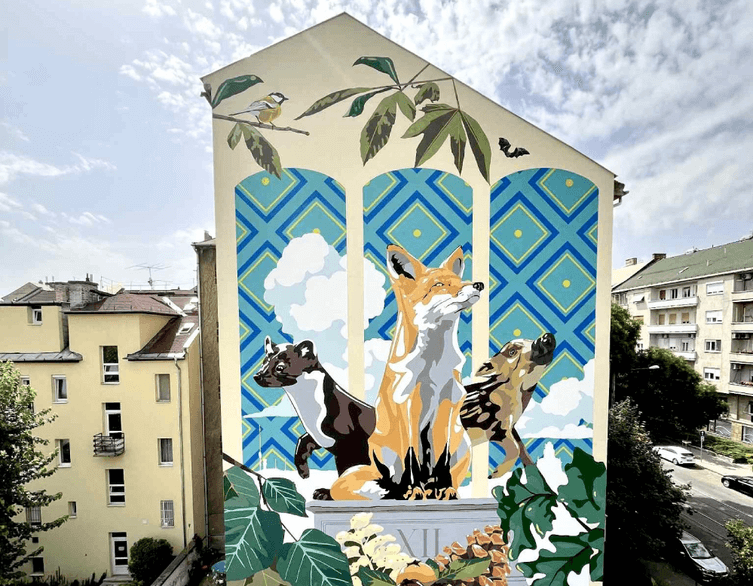
There is something wonderfully contradictory about the fact that even as the 12th District works tirelessly to reduce its wild boar population, it also commissioned a magnificent mural last year in which a wild boar stands front and centre as one of the neighbourhood’s most dignified symbols. The piece — a large-scale wall painting created by the acclaimed neopaint mural team for the district council — places a fox, a beech marten, and a wild boar at the heart of the composition, rendered as elegant porcelain figurines, as though they were the noble rulers of the neighbourhood rather than the subjects of a six-month trapping operation.
The mural is a love letter to the 12th District’s extraordinary natural character. Framing the three animal figures is a lush canopy of foliage representative of the district’s forests — horse chestnut leaves, linden, and oak — along with a horse chestnut blossom, the cone of a black pine, and the bright berries of firethorn, a childhood favourite. Joining the central trio are a great tit, one of the district’s most characteristic songbirds, and a common bat, another frequent visitor to the hillside gardens. In the background, barely visible behind the arches of the MOM Cultural Centre, the outlines of the Széchenyi Hill transmission tower and the Elisabeth Lookout Tower rise against the sky — unmistakable landmarks of the Buda Hills.
It is, in short, a work that captures exactly what makes Hegyvidék so special: the improbable, occasionally chaotic, deeply charming coexistence of city life and wild nature. The boar in the mural does not look like a pest problem. It looks like it belongs. And in a way, that is precisely the point — the goal was never to eliminate the wild from Budapest’s hills, but to find a way to live alongside it without anyone getting hurt.
A Budget, a Plan, and a Nationwide Audience
The 12th District has set aside a serious budget for 2026 to take the programme to the next level. Twenty-three million forints are earmarked for building boar-proof fencing. Nine million will go toward expanding the camera and remote-control trap network. Four million is allocated for wildlife counting — because, remarkably, no one yet has a precise count of exactly how many boars are living in the district’s residential areas — and a further four million will fund deterrent devices including sound and light repellents that can be deployed in areas already cleared of animals to prevent recolonisation. Five million more covers vehicle upgrades and equipment.
The district is also the first in Hungary to have developed a complete, legally compliant protocol for live-trapping, transporting, and humanely euthanising urban wild boars under ASF restrictions — and word has spread quickly. Several other municipalities have already contacted the district leadership asking for guidance and professional support in dealing with their own urban boar problems. Budapest’s 12th District has, rather unexpectedly, become a national pioneer in urban wildlife management.
What Does This Mean for You as a Visitor?
If you are planning a trip to Budapest and were slightly alarmed by the words “hundreds of wild boars in the city,” take a breath. The vast majority of the city is entirely unaffected, and the 12th District itself — home to the beautiful Normafa park, the Buda Hills hiking trails, and some of Budapest’s loveliest residential streets — is very much open for business and absolutely worth visiting. The boar population is measurably declining, and the district’s increasingly sophisticated trapping operation is gaining pace month by month.
That said, if you are hiking in the Buda Hills or walking in the greener, more wooded parts of the 12th District after dark, it is sensible to be aware of your surroundings. If you do happen to encounter a wild boar — which is now considerably less likely than it was a year ago — the advice is simple: stay calm, do not run, do not shout, and walk steadily away. The animal will almost certainly do the same. And if it does not, at least you will have a story that absolutely nobody back home will believe.
Hegyvidék: Still One of Budapest’s Best Neighbourhoods
It would be a shame to let the boar situation overshadow what is genuinely one of the most charming parts of Budapest. The 12th District’s hillside setting, its elegant villas, its forest walks, and its sweeping views over the city are among the Hungarian capital’s best-kept secrets for visitors who venture beyond the central tourist trail. The mural commissioned last year captures this spirit beautifully — a wild boar rendered as a dignified porcelain figure, surrounded by the leaves and berries of Hegyvidék’s forests, with the towers of the Buda Hills rising in the background.
The district’s own conclusion is refreshingly honest: completely eliminating urban wild boars is an illusion. But peaceful coexistence, managed carefully, is an entirely achievable goal. And with 120 boars relocated, a national model established, a brand-new camera-equipped trap network humming away quietly in the hills, and a stunning mural on the wall to prove that this neighbourhood truly embraces its wild side, Budapest’s 12th District is well on its way to getting there.
Related news
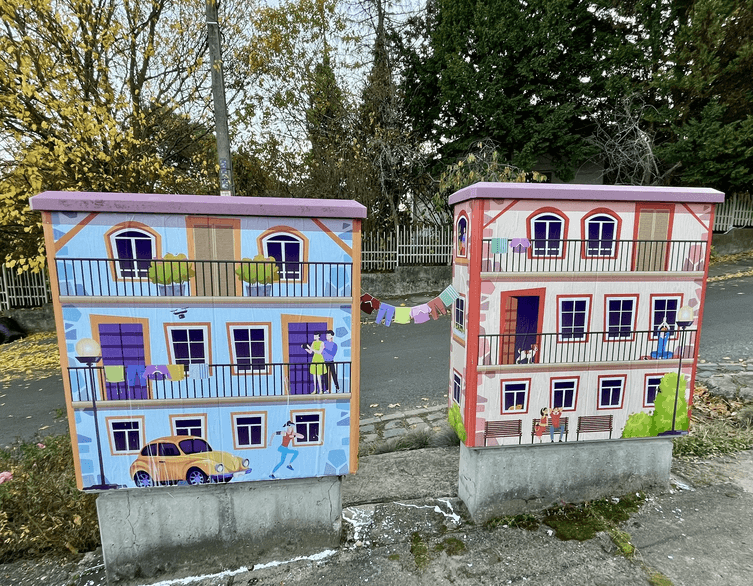
This Budapest Neighborhood Just Turned Ugly Electrical Boxes Into the Cutest Art Installation Ever
Let’s talk about something you’ve probably never given a second thought to: electrical boxes. You know the ones—those squat, brutish...
Wild Boars in Budapest: Your Complete Guide to Understanding This Unique Urban Wildlife Experience
When you think of visiting Budapest, you probably envision soaking in thermal baths, exploring the majestic Parliament building, or strolling along...
Budapest: Where Urban Life Meets the Wild Side – Hilarious Wildlife Encounters in the City
Budapest, the vibrant capital of Hungary, is renowned for its stunning architecture, thermal baths, and rich history. But beyond the bustling city...