Happy Birthday, Hungaroring! Hungary’s Legendary F1 Circuit Turns 40 — and It’s Never Looked Better
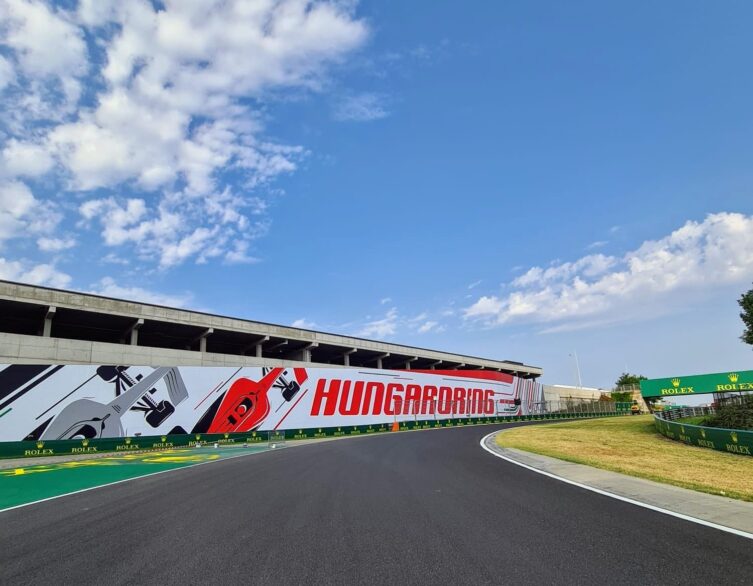
Forty years. That is how long the Hungaroring — Hungary’s iconic Formula 1 circuit sitting in a beautiful valley just outside Budapest — has been making drivers nervous, fans ecstatic, and the rest of the world wonder why they aren’t in Hungary right now. The circuit is celebrating its 40th anniversary in 2026, and it is doing so in the most fitting way possible: freshly renovated from top to bottom, packed with new facilities, and ready to welcome the biggest names in motorsport all over again. If there was ever a year to make the Hungarian Grand Prix part of your Budapest adventure, this is absolutely it.
How It All Began — Behind the Iron Curtain
The story of the Hungaroring starts, as many great stories do, with one man having a slightly audacious idea. Bernie Ecclestone, the all-powerful ringmaster of Formula 1 in the 1980s, decided he wanted to take the sport where no racing series had ever gone before — behind the Iron Curtain. His first instinct was Moscow’s Red Square, which would have been quite the spectacle, but a visit to Budapest in 1985 changed his mind entirely. He initially envisioned a street circuit through City Park in the heart of the city, but Hungarian sports officials had bigger ambitions, and the decision was made to build a brand-new, purpose-built racing facility from scratch.
The chosen location was a naturally scenic, bowl-shaped valley near the town of Mogyoród, about 25 kilometres northeast of Budapest — ideal for spectators, with the hillsides offering sweeping views of nearly the entire circuit. Construction began in October 1985, and in a feat of engineering hustle that still raises eyebrows today, the track was ready in just eight months. Design and construction ran practically in parallel, and the Hungarian engineers who built it had to rely on FIA yearbooks for reference since none of them had ever built an F1 circuit before. The result, opened on August 10, 1986, was a sinuous, technical, 4,014-metre ribbon of asphalt that immediately earned a nickname it has never quite shaken: the Monaco of the East.
The Greatest First Race in History
If the Hungaroring needed to make an impression on the world, the very first Hungarian Grand Prix delivered in spectacular fashion. Over 200,000 fans turned up — an astonishing crowd by any measure — many of them Hungarian, East German, and Polish, finally getting their chance to see Formula 1 live. And the race itself? Absolutely unforgettable.
Nelson Piquet, driving for Williams, won the inaugural race, but the moment everyone still talks about is the pass that put him in contention to win it. With Ayrton Senna’s Lotus blocking his path, Piquet pulled off what many to this day consider the greatest overtaking manoeuvre in Formula 1 history — sweeping around the outside of Senna through Turn 1 with his wheels on the grass, opposite lock applied, sheer bravado keeping the car on the track. It was an absolutely wild move on a circuit that barely seemed to have room for it, and it set the tone for everything that followed. Hungary’s first Grand Prix was an instant classic.
A Track That Loves Drama — and Drama Loves It Back
Over four decades, the Hungaroring has served up enough memorable moments to fill several encyclopaedias. In 1988, Ayrton Senna and Alain Prost — teammates at McLaren and barely concealing their mutual disdain — fought a ferocious internal battle, with Prost hunting down Senna and making a pass, only for Senna to respond and cross the line just 0.529 seconds ahead of his teammate. Pure theatre.
In 1990, Thierry Boutsen led every single lap and held off a charging Senna for his third and final F1 victory — a performance so immaculate it is still talked about as one of the cleanest drives in the sport’s history. No Belgian has won a Grand Prix since. In 1992, Nigel Mansell — who always seemed to celebrate his birthday in Hungary and once received a horse named Skála as a birthday gift from the locals, which is exactly the kind of story you cannot make up — sealed his World Championship title with a second-place finish. It was the first time the Hungaroring had crowned a world champion, and it would not be the last.
Perhaps the most heartbreaking moment came in 1997, when Damon Hill was leading comfortably in the final laps before a mechanical failure sent his car grinding to a halt. As Hill disappeared from the timing screens, Hungarian commentator Palik László’s bewildered cry of “Where did Damon Hill go?” became one of the most iconic lines in Hungarian sports broadcasting history. Meanwhile, 1995 offered a moment of sheer slapstick comedy when Taki Inoue attempted to extinguish the flames on his stricken car — only to be clipped at low speed by the onrushing medical car, sent tumbling, and achieve worldwide fame in the process. He was uninjured, and motorsport has never been quite the same since.
The Venue That Makes First-Time Winners
One of the strangest and most wonderful quirks of the Hungaroring is how many drivers scored their first-ever Formula 1 victory here. Damon Hill won for the first time in Hungary in 1993. Fernando Alonso took his maiden victory here in 2003, becoming the youngest F1 race winner in history at the time. Jenson Button finally broke his duck on the Hungaroring asphalt in 2006, charging from 14th on the grid in wet-dry conditions while Fernando Alonso — with a touch of irony — lost a wheel nut and spun off. Heikki Kovalainen won here in 2008, and in one of the most surprising results of recent times, Esteban Ocon crossed the line first in 2021 for what remains his only Formula 1 victory. No other circuit on the calendar has produced so many first-time winners in proportion to the races it has hosted — not even Monaco or Monza.
Best deals of Budapest






Winning here is genuinely hard. Sebastian Vettel, one of the most complete drivers in the sport’s history and a four-time world champion, needed nine attempts before finally conquering the Hungaroring in 2015. The track’s tight, twisty layout with few overtaking opportunities rewards cleverness and precision over raw speed — which is exactly why so many unexpected results happen here, and why fans keep coming back.
Lewis Hamilton and the Hungaroring: A Love Story
If one driver owns the Hungaroring, it is Lewis Hamilton. The British seven-time world champion has won the Hungarian Grand Prix eight times — more than anyone else in the history of the race — and holds both the outright lap record and the qualifying record. His 2009 win was historic as the first-ever victory for a car equipped with KERS hybrid technology. His 2020 qualifying lap of 1:13.447 remains untouched to this day, a benchmark that has survived years of technical evolution and will likely be tested hard again this July.
The Big Renovation: A Brand-New Venue for an Old Classic
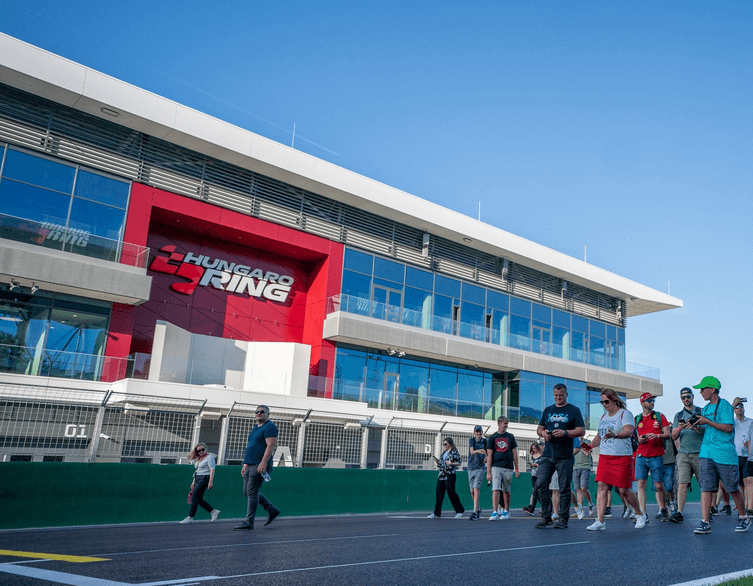
To celebrate turning 40 in suitable style, the Hungaroring has just completed the most comprehensive renovation in its entire history. A multi-phase development programme that began in 2023 has now finished, delivering a completely rebuilt main building and main grandstand, 36 race pits and 4 technical boxes, a new race control centre, a media centre, an expanded VIP area, and a rooftop terrace with views that will make your jaw drop. The new main grandstand covers 13,000 square metres, holds 10,000 spectators under a full roof, and is connected to the main building by two tunnels running under the start/finish straight. The entire venue can now operate as a fully multifunctional events centre 365 days a year, hosting everything from corporate conferences to experience driving days and family open days.
To mark the reopening, the circuit threw a 4,000-person community celebration called “The Track Is Yours,” where visitors jogged on the actual asphalt, joined rooftop pilates classes, sipped coffee on the start/finish straight, and got guided tours of the dazzling new facilities. Not a bad way to turn 40, all things considered.
The result has already earned recognition: the 40th Hungarian Grand Prix in 2025 was officially awarded the Best Fan Experience prize for the entire Formula 1 season. A remarkable achievement for a circuit that, just a year earlier, was still partially a construction site.
The 2026 Race — and Why You Should Be There
The 2026 Hungarian Grand Prix takes place on July 24 to 26, and with Sunday tickets already sold out, the demand speaks for itself. Friday and Saturday tickets are still available, and both days offer the full Hungaroring experience — practice sessions, qualifying, the electric atmosphere of an F1 weekend — with slightly more breathing room than race day. The Hungaroring is easily reachable from central Budapest by shuttle services during race weekend, so getting there is far simpler than navigating to most F1 venues in the world.
And beyond race weekend, the Hungaroring will also be hosting the International GT Open on July 4 and 5, 2026 — another spectacular motorsport event celebrating the circuit’s 40th birthday year with wheel-to-wheel GT racing and a packed programme of side events.
Budapest + Formula 1: The Combination That Just Works
Part of what makes the Hungarian Grand Prix uniquely brilliant for visitors is the fact that Budapest itself is one of Europe’s most captivating cities. The thermal baths, the ruin bars, the jaw-dropping river views, the food, the architecture — it all sits just 25 kilometres from the circuit, waiting to be explored after the engines have gone quiet for the day. In 2025, nearly 300,000 fans attended the race weekend, and Budapest’s hotels filled to well over 86 percent occupancy. The city and the race have grown up together over 40 years, and the relationship has never been stronger.
So book the trip. Grab those Friday or Saturday tickets. Raise a glass in a ruin bar to forty years of the Monaco of the East — and witness what happens when a circuit that was built in eight months, against all odds, behind the Iron Curtain, becomes one of the most beloved venues in the history of the world’s greatest motorsport championship.
Related news
What’s on in Budapest This Weekend: July 23–26, 2026
This weekend, Budapest turns into a playground of extremes — from screaming Formula 1 engines to howling doom-rock guitars, splashing thermal pools...
The Ultimate Guide for Formula 1 Fans Visiting Budapest This July
Budapest in late July belongs to Formula 1. If you’re flying in for the Hungarian Grand Prix, you already know the race itself is the main...
Hungarian Grand Prix 2026 Gets Ready for Lights Out
Budapest and its Hungaroring racetrack are gearing up for one of the biggest weekends of the summer. The 41st Formula 1 Hungarian Grand Prix takes...
Hungaroring Goes Green: Why Budapest’s F1 Track Just Became a Sustainability Star
If you think Formula 1 is all roaring engines and burning rubber, Hungary has a little surprise for you. Just outside Budapest, the Hungaroring –...
Formula 1 Goes Digital: The Hungaroring’s Cashless Revolution
Welcome to the Future of Racing Picture this: you’re at the Hungarian Grand Prix, the roar of engines fills the air, and you want to grab a...

Alonso: Renovated Hungaroring Could Become “One of the Best European Venues” as Budapest Prepares for Formula 1’s Return
The Formula 1 world is buzzing with excitement as the newly renovated Hungaroring prepares to welcome drivers and fans back to Hungary this summer....
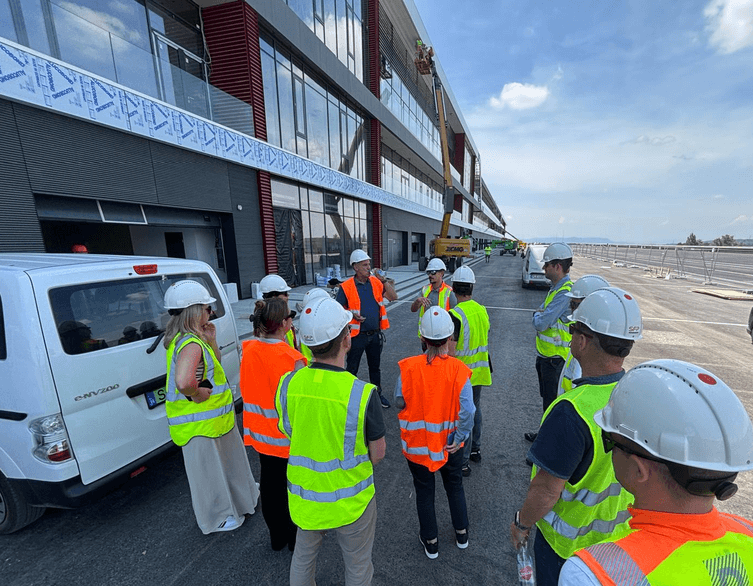
Hungaroring Receives International Praise as F1 Officials Tour Renovated Facilities
Formula 1 officials, the FIA, and racing teams have completed a comprehensive three-day inspection of the Hungaroring circuit near Budapest, expressing...

Brad Pitt’s F1 Movie Trailer Drops: Budapest’s Hungaroring Steals the Show
If you thought Budapest’s summer was just about sipping fröccs by the Danube or soaking in thermal baths, think again. This year, the city is...
Related events