Budapest’s Hunger Rock Is Back — And It’s Both Fascinating and Alarming
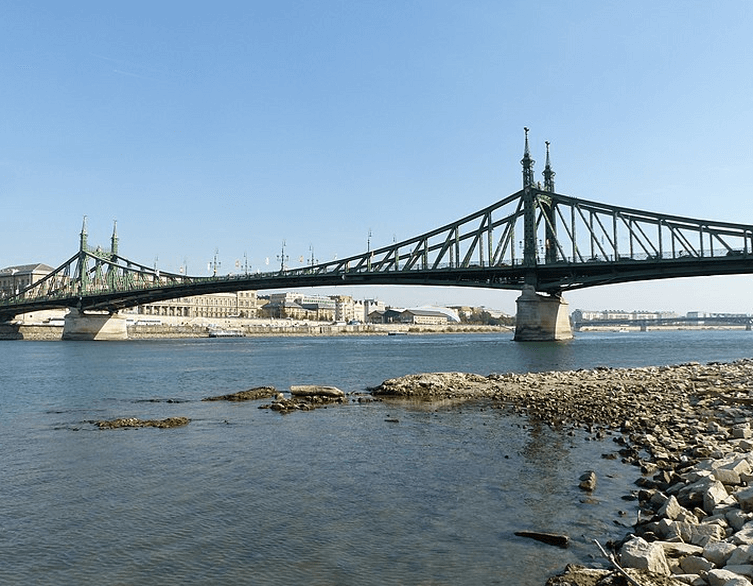
If you happen to be strolling along the Danube embankment in Budapest right now, you might notice something a little odd poking out of the river near Liberty Bridge. No, it’s not a rogue piece of furniture that someone tossed from a window (Budapest has seen stranger things). It’s the Hunger Rock — and its reappearance is one of the most dramatic, if slightly ominous, sights the city has offered tourists in quite some time.
Meet the “Lowest Mountain Peak in Hungary”
The Hunger Rock — known in Hungarian as Ínség-szikla — is a legendary chunk of stone sitting at the foot of Gellért Hill, right around river kilometer 1645.4 on the Danube. Its official elevation is 95.76 meters above sea level, which means it only breaks the surface when the Danube’s water level drops below roughly 95 centimeters on the Budapest gauge. Locals, with their characteristic dry humor, have nicknamed it “Hungary’s lowest mountain peak.” It’s not exactly the Alps, but it does have a flair for dramatic appearances.
The rock’s name, Ínség, literally translates to “hardship” or “destitution” in Hungarian — and that name is no accident. Historically, the Hunger Rock was a warning sign: when it emerged from the river, it signaled drought, poor harvests, and lean times ahead. So yes, while it makes for a fantastic photo-op, it’s essentially nature’s version of a red alert.
Best deals of Budapest











How Low Has the Danube Gotten?
Quite low — embarrassingly low, if rivers could feel embarrassed. On Monday, April 27, 2026, at 11 AM, Budapest’s water gauge dropped to exactly 95 centimeters. By late that same evening, the river had shed another 6 centimeters, settling at just 89 centimeters. Further south along the river, the situation gets even more eyebrow-raising. At Ercsi and Dunaújváros — two towns south of Budapest — the water gauge was reading minus 18 centimeters. Near Dunaföldvár, it hit a jaw-dropping minus 132 centimeters. In other words, in some stretches, the Danube is running well below its official zero mark, and the riverbed is making an unexpected guest appearance.
A Spring That Forgot to Rain
Here’s the thing: Budapest is supposed to get around 35–45 mm of rainfall in April on average, spread across roughly 8–11 rainy days. This April? The city managed a grand total of four rainy days, with a collective rainfall of just 1.2 mm. One point two millimeters. That’s less moisture than you’d get from breathing on a mirror.
The single most “generous” downpour of the month fell on April 21st, delivering a whopping 0.9 mm of rain — barely enough to dampen a napkin. The other three rainy days (April 6, 14, and 19) contributed a symbolic 0.1 mm each before the sun promptly evaporated any evidence that rain had ever existed. Budapest’s Chief Landscape Architect, Sándor Bardóczi, citing data from Hungary’s national meteorological service HungaroMet, reported that the topsoil — down to a depth of 100 centimeters — is showing a water deficit of 100 mm across Budapest, the Danube-Tisza Interfluve, the Nyírség region, and Békés County.
What Budapest Is Doing About It
To be fair to Budapest, the city isn’t just watching its river shrink and shrugging. There are real efforts underway — some clever, some ambitious, and some still very much a work in progress. The city has been involved in the EU-funded LIFE Urban Runoff project, led by the Hegyvidék district in cooperation with several other Budapest districts and the city municipality. The goal: treat rainwater not as a nuisance to be flushed away, but as a resource worth capturing. The project combines green roofs, underground cisterns, nature-based drainage solutions, and permeable pavements to keep every precious drop in the ground rather than letting it disappear down a drain.
On a building level, some of Budapest’s renovated landmarks are leading by example. The restored Eiffel Palace in the city center features a rainwater harvesting system that collects water from 1,400 square meters of rooftop and stores it in a 250 cubic-meter underground cistern — enough to flush the building’s toilets for an entire year without touching the mains supply. Meanwhile, a pilot project in the Zugló district installed a combined rainwater and greywater recycling system at a local kindergarten, where roof runoff is pre-filtered through gravel and herbs before being stored and reused. It’s charming, practical, and smells slightly of mint.
The bigger structural challenge, however, is that Budapest’s drainage network is a patchwork of old combined sewers and newer separated systems, and the question of who is actually responsible for managing stormwater remains somewhat murky. Budapest’s long-term climate strategy does set out clear goals: on-site water retention, circular water management, and smarter reuse of rainwater across the city. Getting there is the hard part — but at least the Hunger Rock is giving everyone a very pointed reminder of why it matters.
What This Means Beyond the Cool Photo
Let’s be honest — as a tourist, the Hunger Rock is genuinely cool to see. It’s a piece of living history emerging from one of Europe’s most iconic rivers, right in the heart of a gorgeous city. Take the photo, post it, impress your friends. But it’s worth knowing what’s behind the spectacle. Hungary is in the grip of a serious spring drought, and the consequences on the ground are significant. Farmers across the country are reporting that crops of rapeseed and winter cereals are struggling to develop, while summer crops like corn and sunflowers can’t even germinate in the bone-dry soil. Massive cracks have opened up in fields across the country — the kind you trip over, not the kind you artfully photograph. This echoes a troubling pattern: in 2025, the soil in central Hungary was already described as critically dry, and some farmers in the Danube-Tisza region were contemplating abandoning their land altogether.
A Budapest Bucket-List Moment With a Message
So here’s the silver lining for the curious tourist: the Hunger Rock is rare. It doesn’t show up every year, and when it does, it becomes an instant talking point. Head down to the riverbank near Liberty Bridge, snap some photos with Gellért Hill as your backdrop, and take a moment to appreciate that you’re witnessing a piece of Budapest’s geological and historical identity surface — quite literally — from the depths.
Just maybe leave the umbrella at the hotel. According to current forecasts, you won’t be needing it anytime soon.
Related news
The Danube’s Historic Low Water Levels in Budapest
If you’re visiting Budapest, you’ll notice something unusual along the riverbanks — the Danube has dropped to some of its lowest levels...

Budapest Is Drying Out — And Here’s Why You Should Care (Even on Vacation)
If you’ve arrived in Budapest this spring expecting lush green parks and a mighty, roaring Danube, we have some news for you. The river is...

Budapest Airport’s Green Revolution: How RESILIMET Keeps Your Flights Storm-Proof
Ever worried about a sudden downpour delaying your Budapest getaway? At Ferenc Liszt International Airport (BUD), that’s becoming history thanks...

Budapest’s Sponge City Initiative: A Sustainable Approach to Urban Water Management
In the heart of Hungary, Budapest is embracing an innovative approach to urban water management known as the “Sponge City” concept. This...