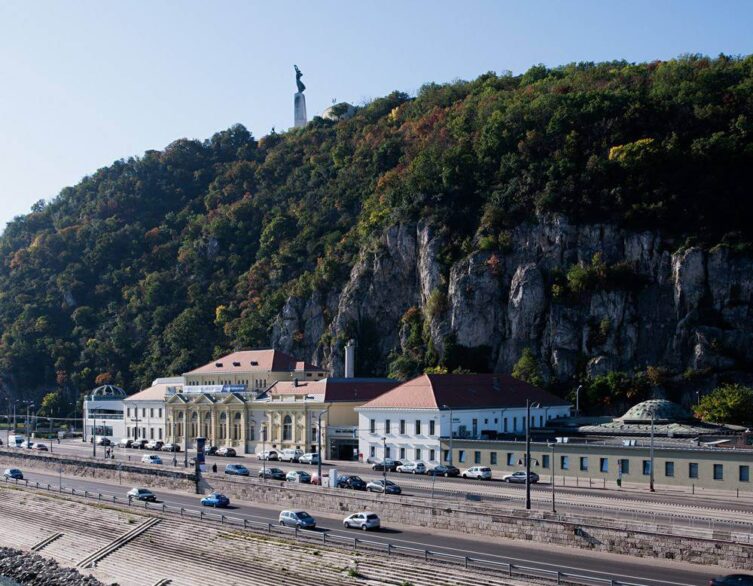
Budapest’s Danube Riverside Gets a Safer Walking and Cycling Route Near Rudas Baths

Exploring Budapest’s Danube riverbank should be about enjoying the city, not constantly checking whether a bicycle is approaching behind you. A new project on St Gellért Embankment, opposite Rudas Baths, aims to make that experience more comfortable by giving pedestrians and cyclists separate spaces. Work began on October 19, 2026, and is expected to finish by mid-November.
For visitors walking along the Buda riverfront or discovering Budapest by bike, it is a modest but useful improvement: around 260 metres of a busy shared route will be redesigned, leaving the pavement to pedestrians and moving cyclists onto a protected, two-way cycle path.
What Is Changing Near Rudas Baths?
The work focuses on the riverside stretch opposite Rudas Baths, between the tram stop and the tree-lined section of the embankment. Here, people on foot and on bicycles have long had to share a pavement that becomes uncomfortably narrow in places.
Under the new layout, cyclists will move off the pavement and onto a two-way cycle path built in place of a lightly used parking lane. A continuous railing will separate the cycle path from motor traffic, while ramps will connect it with the adjoining route. Once the work is complete, the pavement along this section will be reserved for pedestrians.
The redesign does not remove any through-traffic lanes. It also leaves the general and accessible parking spaces on the baths’ side of the road unchanged. The parking lane being repurposed is on the opposite side, where the new cycle path will run.
Why This Stretch of Budapest’s Riverfront Needs Attention
The problem is not new. The pavement became narrower following construction of the tram stop more than a decade ago, creating an awkward shared passage. As cycling and tourism grew, so did the pressure on the available space—and the potential for conflict between people walking and riding.
For visitors, the attraction of this part of the city is easy to understand. Rudas Baths stands at the foot of Gellért Hill, beside Elisabeth Bridge, placing the surrounding riverfront close to several familiar Budapest landmarks. It is a stretch you might encounter while combining a riverside walk with a bath visit or exploring the Buda side of the Danube.
Best deals of Budapest










Separating the two types of traffic should make the upgraded section easier to navigate. Pedestrians will no longer have to share that pavement with passing bicycles, while cyclists will have a dedicated route protected from cars. The project is intended to improve daily journeys for several thousand people using the embankment.
What to Expect During the Construction Work
If you are visiting Budapest in late October or the first half of November 2026, expect minor, localised traffic restrictions around the worksite. Budapest Közút, the city’s road management company, is carrying out the project, with completion currently expected in mid-November rather than on a confirmed opening date.
Allow a little extra time when passing through the immediate area and follow the temporary signs. The important distinction is that this is a targeted improvement, not a reconstruction of the entire riverfront between Liberty Bridge and Elisabeth Bridge. Some neighbouring sections will still be shared by pedestrians and cyclists after the new path opens, so both groups will need to remain considerate and attentive.
A Riverside Improvement Chosen by Budapest Residents
The project began with an idea supported by residents through Budapest’s 2022–2023 participatory budget. This process allows local people to help decide how part of the city’s budget is spent, and separating walking and cycling on St Gellért Embankment was among the winning proposals.
Turning that idea into a complete redesign proved more complicated than initially expected. Improving the entire route between Liberty Bridge and Elisabeth Bridge would require more extensive work, including changes to traffic signals and additional technical interventions at the narrowest points. Those costs exceeded the funding available through the participatory budget.
The city therefore focused on a section where the existing funding could deliver a tangible improvement now. The result is a shorter project, but one that tackles a longstanding pinch point rather than postponing every change until a larger scheme becomes possible.
A First Step Towards a Better Buda Riverside Route
The new cycle path will not resolve every awkward section of St Gellért Embankment. Further improvements remain under discussion, and additional work will be needed to address the surrounding narrow stretches.
For tourists, however, the immediate benefit is straightforward: once this section is finished, walking opposite Rudas Baths should feel less cramped, and cycling through it should involve less weaving around pedestrians. Whether you are heading for a thermal bath visit or simply enjoying Budapest’s Danube riverfront, that clearer separation will make this small part of the journey more comfortable.
Related news
Related attractions