Back to School in Budapest: New “School Squares” and Busier Public Transport Make Mornings Safer
Every September, Budapest quietly reinvents itself around its youngest commuters, and this year is no exception. As the 2026/2027 school year kicks off, the city has rolled out two changes worth knowing about, whether you are visiting with kids in tow or simply curious about how one of Central Europe’s most walkable capitals keeps reinventing its streets. Public transport just got noticeably busier and more frequent, and a growing number of neighborhoods are experimenting with car-free zones right outside school gates, known locally as “school streets” or “school squares.”
If you’re staying in Budapest this autumn, especially in District 8 (Józsefváros), you’ll likely notice fresh pavement markings, planters where parking spots used to be, and trams and buses running tighter schedules during the morning rush. Here’s what’s behind it all.
Busier Trams and Buses for the New School Year
Starting this month, Budapest’s transport authority has increased frequency and capacity on several key routes to handle the return of students to classrooms, from first-graders to university lecture halls. Tram line 1, one of the city’s longest and most useful tram routes for visitors circling the city along the Grand Boulevard area, now runs more often during peak hours. Bus routes 87A, 187, 216, 253, and 298 have also seen either shorter intervals or larger vehicles deployed to handle the surge in passengers.
For tourists, this is genuinely good news. It means shorter waits and less crowding on some of the routes that also serve major sightseeing corridors, particularly during the 7 to 9 a.m. window when local students and commuters overlap with early risers heading to museums, thermal baths, or Buda Castle. If you’re navigating Budapest by public transport this fall, expect the system to feel a bit more responsive than it did over the summer months, when services typically run on a reduced schedule.
Best deals of Budapest









It’s also worth knowing, purely as an interesting local detail, that public transport in Budapest is free for children under 14, and university students on full-time or evening programs can access discounted unlimited passes covering both Budapest and Pest County. It’s a small window into how the city prioritizes affordable mobility for its youngest residents and students, something that reflects well on the broader public transport culture visitors get to enjoy too, including the unified BKK ticketing system that covers metro, tram, bus, and trolleybus lines across the city.
What Exactly Is a “School Street”?
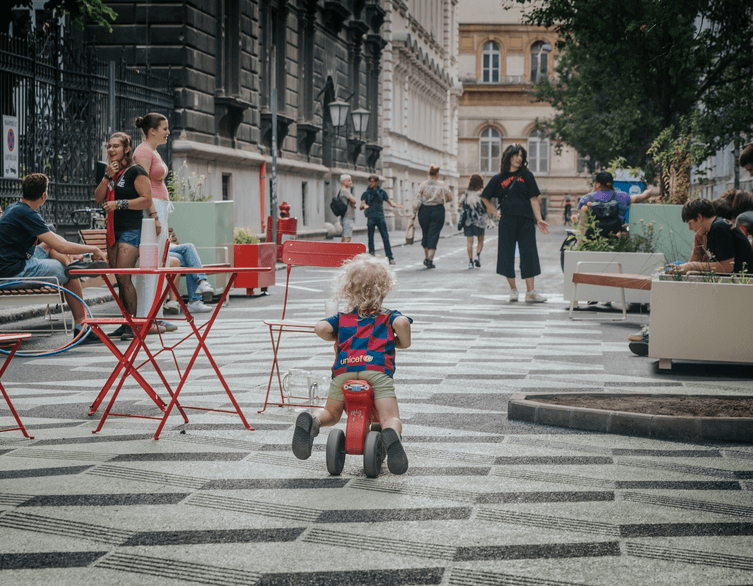
If you wander through District 8’s Palace Quarter this autumn, you might stumble across something unusual for a European capital: a street or square that used to be lined with parked cars, now filled with benches, planters, and colorful painted patterns on the asphalt instead. This is Budapest’s take on the “school street” concept, a car-free or car-reduced zone directly outside a school entrance, designed to make the school run safer and more pleasant for children, parents, and neighbors alike.
The pioneer of this movement in Budapest is Trefort Street, right outside the ELTE Trefort Ágoston Practice High School, one of the country’s most prestigious secondary schools. After months of community consultation, in which nearly 90 percent of respondents supported the idea, the local municipality of Józsefváros permanently closed the section of Trefort Street between Szentkirályi Street and the school’s driveway to car traffic in late August 2025. Where cars once idled and parked, you’ll now find outdoor tables, chairs, bicycle racks, and greenery in planter boxes instead of traditional railings. The rest of the short street still functions, just as a quiet dead end reached from Puskin Street, so through traffic simply reroutes rather than causing chaos elsewhere.
The transformation has turned what was once a car-clogged corner of the Palace District into a genuine community gathering spot worth a quick detour if you’re exploring this atmospheric, museum-rich neighborhood near the Hungarian National Museum.
District 8 Expands the Concept with New School Squares
Building on Trefort Street’s success, Józsefváros’s urban development organization, RÉV8, has been rolling out similar interventions across the district under the name “iskolatér,” or school square. In late August, RÉV8 worked together with students from the Deák Diák Elementary School and Grammar School to hand-paint a brand-new school square on Pope John Paul II Square, using colorful patterns the children themselves designed the previous spring.
What makes this project stand out isn’t just the fresh paint job, it’s the process behind it. According to the organization, the goal was never simply decorative. By involving students directly in designing and painting the space they pass through every single school day, the project aims to give young people genuine ownership over a public space rather than treating them as passive users of it. Urban planners call this approach community placemaking, the idea that people form a fundamentally different relationship with a shared space when they can see their own ideas reflected in it.
To create room for the new square, the municipality freed up ten parking spaces in the diagonal parking bay in front of the school. The result, once finished, will give children a safer, more spacious arrival and gathering area, one large enough to comfortably accommodate three or four school classes at once, according to RÉV8’s own account of the project.
Coming Next: A Car-Reduced Zone at Budapest School
The initiative didn’t stop at Pope John Paul II Square. Work continued into September in front of Budapest School, another institution in the district, where planners are converting seven additional parking spaces into wider pedestrian space and extra bicycle parking. The explicit aim is to nudge families toward walking and cycling instead of driving, part of a broader push across Budapest to make active, low-emission commuting the easier and more obvious choice near schools.
Once the painting phase wraps up at both sites, the next step involves installing planter boxes and planting greenery, again with student volunteers helping out. The idea is that these spaces will end up serving more than just school drop-off and pickup: with part of the former parking area repurposed for shared use, both students and local residents will be able to use the new square, turning what was once a purely functional strip of asphalt into a welcoming, open community space for the whole neighborhood.
Why This Matters for Air Quality and Safety
Beyond the feel-good community angle, these school squares serve a very practical purpose. Fewer idling cars directly outside school entrances means measurably better air quality both on the street and inside the school building itself, a detail worth appreciating if you care about sustainable urban planning while traveling. Safer arrival and departure zones also reduce the everyday friction and minor traffic hazards that tend to build up around any school gate during rush hour, something any parent navigating a foreign city with children will appreciate.
This citywide experiment traces back to the original school street pilot on Trefort Street, where the municipality invited residents to a community painting day, supplying the paint and stencils and asking only that volunteers wear clothes they wouldn’t mind getting a little messy. That grassroots, hands-on spirit has clearly carried over into the newer projects in Józsefváros, and similar conversions are being discussed for nearby Puskin Street and Szentkirályi Street as the concept proves itself.
A Neighborhood Worth Exploring This Autumn
For visitors staying in or near District 8, this quiet urban transformation adds another layer of interest to a neighborhood already packed with things to see, from the Hungarian National Museum to the eclectic Palace Quarter’s cafés and bookshops. Swinging by Trefort Street or Pope John Paul II Square offers a low-key but genuinely interesting glimpse into how Budapest is rethinking its public spaces street by street, one school gate at a time.
And if your Budapest itinerary this September involves hopping on tram 1 or one of the busier bus routes during the morning rush, just budget a little extra patience, you’ll be sharing the ride with thousands of students and university-goers heading back to their desks after the summer break.
Related news
September 1: Budapest Gets Back to Its Rhythm
September 1 is famous around Budapest for one obvious reason: it’s the first day of the new school year. But this year, the date carries an...
Safe Streets, Happy Schools: How Budapest is Redesigning Its Neighborhoods for Kids
If you stroll through certain Budapest neighborhoods on a weekday morning, you might notice something refreshing: colorful signs, children walking...
Fighting School Bullying in Hungary: Two Major Campaigns Tackle a Growing Crisis
Budapest is taking a stand against school bullying through two significant nationwide campaigns that launched this October, bringing much-needed...
Budapest’s First “School Street”: Trefort Street Leads a City-Wide Movement
If you’re strolling through Budapest’s historic eighth district this fall, you might be surprised by the transformation on Trefort Street....
Related events