Budapest’s Tiniest Gallery Is One of Its Most Fascinating: Discover PUCCS Contemporary Art
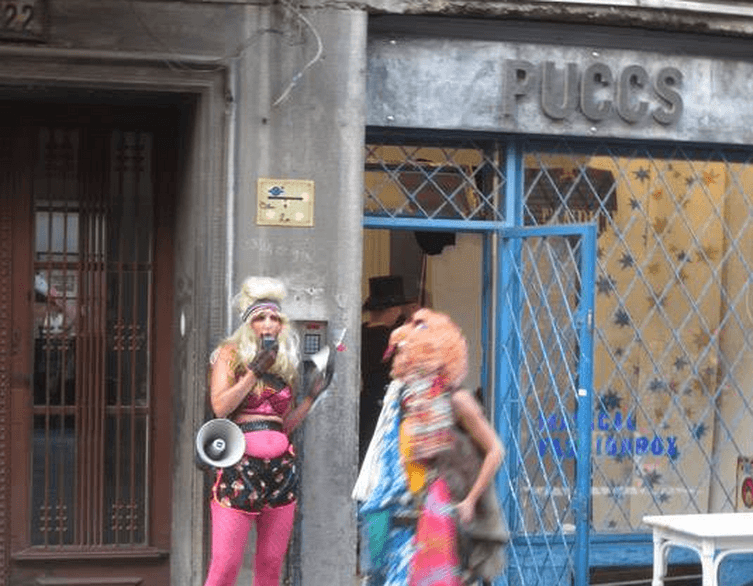
Budapest is a city full of grand gestures — sweeping parliament buildings, ornate thermal baths, UNESCO-listed boulevards stretching as far as the eye can see. But sometimes, the most compelling art experiences come in the smallest packages. Tucked behind the Rákóczi Square Market Hall in the 8th district, on a quiet stretch of Víg Street, there is a gallery that measures just 3 by 3 by 3 meters. You can’t go inside. You don’t need to. PUCCS Contemporary Art has been quietly dazzling passersby — and occasionally stopping them dead in their tracks — for over a decade.
A New York Artist, a Budapest Street, and a Big Idea
The story of PUCCS begins in 2014 with a New York City-born artist named Bullet Shih, who had moved to Budapest and spent years embedding himself into the city’s creative life. Shih — a neo-naïvist painter of Chinese and Eastern European descent who had cut his teeth in the New York art scene — didn’t create PUCCS to show his own work. That distinction matters. His goal was something more generous and more radical: to build a space that would actively participate in the Hungarian art scene and bring contemporary art directly to the street.
He named it after the Hungarian word puccs — meaning putsch, a revolutionary act — and that spirit has infused the space ever since. As Shih himself put it simply: “Puccs is conceived as, and should always be, a place to show art to the people. Street art.”
When Shih passed away in 2021, the loss was felt deeply across Budapest’s artistic community. His family vowed to keep the space alive in his memory, and the Parallel Art Foundation took over the management of PUCCS, ensuring the project would continue to evolve. The lantern stays on.
Best deals of Budapest








Always Open, Never Entered
What makes PUCCS genuinely unlike almost any other gallery you will encounter in your travels is its fundamental operating logic. There are no opening hours, because it is never closed. There is no door to knock on, no ticket to buy, no threshold to cross. The works inside are visible 24 hours a day, seven days a week, illuminated from within and framed by the gallery’s shopfront window like a glowing vitrine in the middle of an ordinary Budapest street.
Visitors — whether they are locals heading to the market, tourists wandering off the main tourist trail, or night owls cutting through the 8th district at 2 AM — encounter the work from the outside. This is not a limitation. It is the entire point. Artists who exhibit at PUCCS must conceive their work with this constraint at the forefront: it must be legible, compelling, and emotionally resonant when viewed frontally through a pane of glass, from the unpredictable distance of a pavement. That is both a formal and a philosophical challenge, and the artists who rise to it produce some of the most thought-provoking work in the city.
There is also something quietly magical about how the experience shifts with time. During the day, the interplay between natural light and the gallery’s interior structures comes to the fore, while at night, the illuminated interior glows against the darkened street, drawing the eye like a beacon. The same work can feel entirely different depending on when you pass it.
The Open Door Policy Behind the Closed Door
One of the most distinctive aspects of PUCCS is its open-call model. Every June, the Parallel Art Foundation publishes a call for proposals — with no genre restrictions and no thematic constraints — inviting artists of any background to submit installation concepts. The only requirement is that the proposed work must be interpretable through the gallery window from the street outside. The selected projects rotate approximately every six weeks, meaning the space is in a constant state of renewal.
What makes the submissions particularly interesting is their diversity. Painters, architects, designers, set designers, university students, and increasingly artists from abroad and the Hungarian diaspora all take part. This breadth of contributors means that PUCCS never settles into a predictable aesthetic register. You might encounter a minimalist spatial experiment one month and an elaborate narrative installation the next.
Trust the Grid: The Current Exhibition
Running until April 24, 2026, the current exhibition at PUCCS is Trust the Grid by Hungarian artist Dávid Biró. The work takes the grid as its central motif, but unpacks it across multiple conceptual layers. On one level, the grid references the physical structure of the gallery itself — its bars and frames, the literal grid through which visitors view the work. On another, it gestures toward the invisible grids of the digital world: the verification systems, the surveillance architectures, and the algorithmic frameworks that quietly structure our online lives.
The installation draws specific inspiration from CAPTCHA-style image recognition tests — those ubiquitous “I am not a robot” puzzles that ask you to identify traffic lights, bicycles, or storefronts in a grid of photographs. What the work asks us to consider is the hidden transaction taking place in those moments: while the user believes they are proving their humanity, they are in fact training artificial intelligence. Biró’s installation sits at the unsettling intersection of perception, reality, and participation — asking what we see, what we think we see, and what systems we are feeding without ever quite realizing it.
It is the kind of conceptually rich, visually arresting work that rewards a long look, whether you encounter it on a Tuesday afternoon or a Friday night.
Art That Belongs to the Street
Curator Gábor Pintér has spoken about accessibility as one of the founding principles of PUCCS — not just physical accessibility, though the space is fully accessible, but intellectual and emotional accessibility too. The accompanying texts are written to be understood by anyone, not just art world insiders. The works are available to anyone who happens to walk past, at any hour, free of charge and free of obligation.
This commitment to openness has had a tangible effect on the neighborhood. Over the years, locals have developed a genuine relationship with the space — noticing when a new installation goes up, forming opinions about it, waiting to see what comes next. PUCCS has become part of the fabric of its street in a way that most galleries, however prestigious, never quite manage. As one regular visitor put it, “You come and go, and it affects you — the works address passersby whether they mean to be addressed or not.”
Finding PUCCS: A Hidden Gem Worth Seeking Out
PUCCS is located at Víg Street 22, in Budapest’s 8th district, just behind the Rákóczi Square Market Hall — itself a wonderful destination if you want to browse fresh Hungarian produce, local cheeses, and handmade goods. The gallery is an easy walk from the heart of the city, and combining a visit to the market with a stop at PUCCS makes for a satisfying and genuinely off-the-beaten-track afternoon in Budapest.
You won’t need to ring a bell or check a schedule. Just walk up, look in, and let the work do its job. In a city already rich with art, architecture, and culture, PUCCS is proof that some of the most affecting experiences don’t require grand buildings or admission fees — just a window, a light left on, and an artist with something worth saying.
Related news
Budapest Spring Festival 2026 – The City’s Biggest Cultural Comeback
There are festivals, and then there is the Budapest Spring Festival. Every May, this city has a way of transforming itself — concert halls fill...
Budapest’s Most Spectacular Free Exhibition: The World’s Most Expensive Zsolnay Ceramics Are on Display Right Now
If you’re visiting Budapest this spring and looking for a cultural experience that is both completely free and genuinely jaw-dropping, look...
Meet Filip — The Artsy Pop-Up That Just Moved to Móricz Zsigmond Square
You know those places that instantly make you feel like you’ve stumbled into a secret? That’s exactly what Filip a városban (“Filip...
Adam Clark’s Lost Drawings: Budapest’s Chain Bridge Secrets Unveiled
Budapest’s world-famous Chain Bridge has long stood as a symbol of connection—between Buda and Pest, past and present. Yet, in autumn 2025, this...
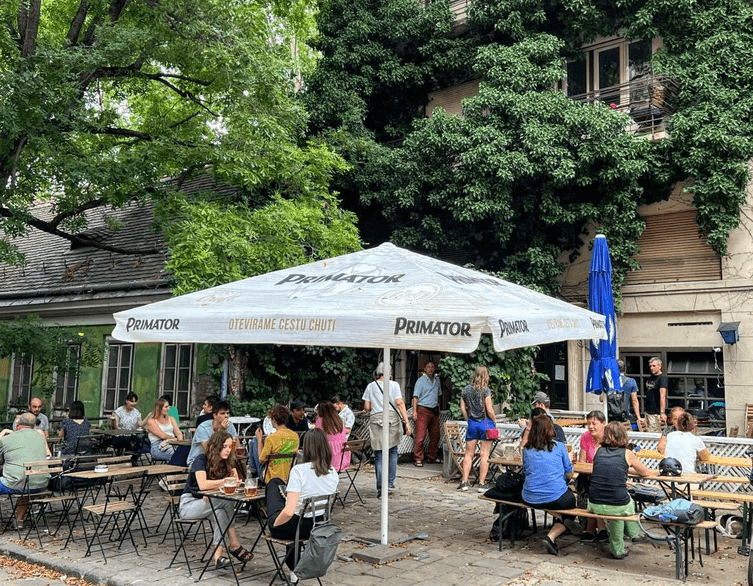
Margit Quarter: Budapest’s Creative Heart Aims to Stay Culture-First
Nestled between the Buda end of Margaret Bridge and Széna Square, the Margit Quarter has become one of Budapest’s most talked-about neighborhoods....
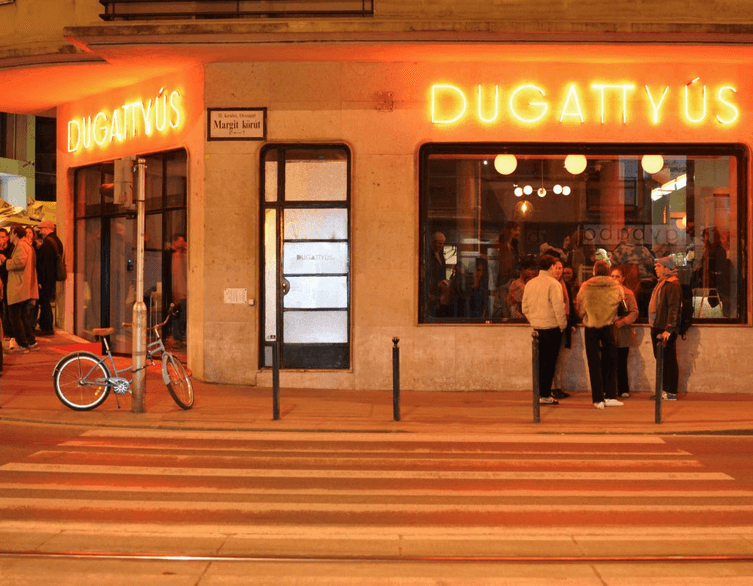
A Creative Hub in Budapest: Check Out DUGATTYÚS in Margit Quarter
Budapest’s vibrant Margit Quarter has welcomed a new cultural gem that promises to redefine the city’s artistic landscape. DUGATTYÚS, a multidisciplinary...