The Masterpiece He Never Finished: Discovering Béla Gruber at the Hungarian National Gallery
There are artists whose lives feel like an unresolved sentence — full of momentum, bursting with ideas, and then suddenly, silence. Béla Gruber was one of them. He died in 1963 at just 27 years old, leaving behind over a thousand works and a generation of fellow artists who never quite got over the loss. This summer, the Hungarian National Gallery in Budapest is dedicating a major retrospective to him, and it’s one of those exhibitions that quietly gets under your skin.
Who Was Béla Gruber?
To understand why this exhibition matters, you need to know a little about the man behind the paintings. Gruber was born in 1936 into a world already fracturing at the seams. His father died in World War II, and his mother raised him and his five siblings in modest circumstances. Art called to him early, but the road wasn’t smooth — he was rejected from the arts high school and spent four years, from 1952 to 1956, working as a laborer at the Óbuda Shipyard. Even there, he couldn’t stop drawing, and eventually found his way to the factory’s decoration department. After two unsuccessful attempts, he was finally admitted to the Hungarian University of Fine Arts in 1956.
What followed was a brief but astonishing burst of creative energy. His teacher Aurél Bernáth, one of the most respected figures in Hungarian painting, called him a “little genius” — and years later reflected: “He lived twenty-seven years. Only someone whose hand is guided by God can create such a rich body of work in so little time.”
An Artist Ahead of His Time
What made Gruber so striking to his contemporaries — and what makes his work so compelling today — was the way he fused bold, expressive figuration with a rigorous, almost geometric compositional logic. Critics of the time described his formal approach as “constructive,” meaning he reduced forms and compositions to their essential geometric shapes, while simultaneously flooding his canvases with vivid, unmistakable color. The combination of emotional rawness and formal discipline is rare in any era. In early 1960s Hungary, it was revolutionary.
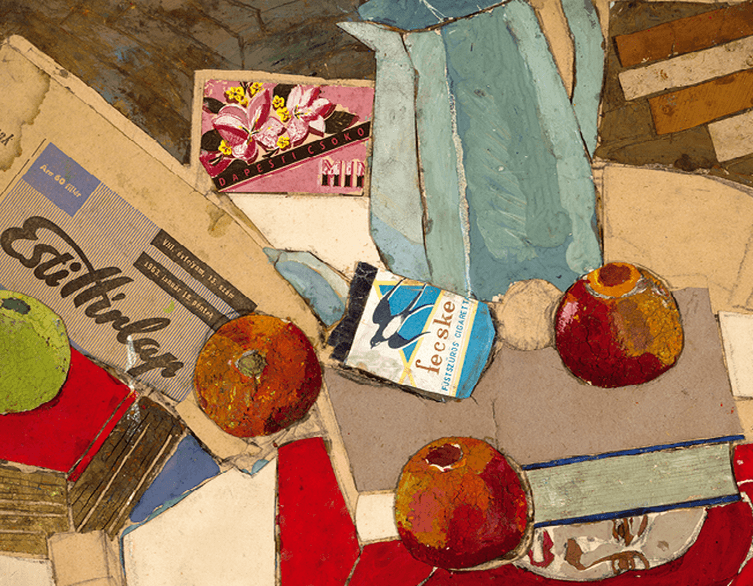
He mixed techniques freely — charcoal drawing, collage, pastel — and his subjects came almost entirely from his immediate world: his models, his studio, his friends and family, the barges on the Danube. There’s an intimacy to his work that draws you in even before you understand the context, and a restless intelligence that keeps you there.
What You’ll See at the Exhibition
The exhibition, titled The Longed-For Masterpiece — The Art of Béla Gruber (1936–1963), is on display on the third floor of the Hungarian National Gallery until August 23, 2026. It brings together the finest works from the Gallery’s own collection and enriches them with pieces from other Hungarian public and private collections, many of which are rarely seen.
The works are organized into five thematic sections that trace the arc of Gruber’s creative life. The journey begins with his self-portraits, intimate and searching, before moving into his still lifes — objects arranged with the quiet intensity of someone who looks at everyday things as if seeing them for the first time. The models section presents his striking figurative work, followed by a section dedicated to his barge paintings, one of his most distinctive and recurring motifs. The exhibition closes with the Painter’s Studio section, which is built around the centerpiece of the entire show.
Best deals of Budapest








The Painting That Defines Everything
That centerpiece is Painter’s Studio (Painter in the Studio), painted in 1962 as Gruber’s graduation work. It is six square meters in size, and although it was left unfinished, it is considered his magnum opus — the painting in which everything he cared about as an artist converges.
The composition is dense and theatrical, like a stage set: the cluttered studio space is populated by the artist’s models, relatives, and friends, all women, each absorbed in her own inner world. Books, furniture, painting tools, and objects lean against one another, creating an enclosed, almost impenetrable universe. The intimacy is striking, but so is the tension. Propped on an easel within the painting is one of Gruber’s barge paintings — a picture within a picture — functioning almost like a window that offers a glimpse beyond the studio walls. The rigid, carefully composed barge image stands in deliberate contrast to the fragile, apparently disordered world surrounding it, and that friction is where the painting’s emotional power lives.
The exhibition also includes a previously unseen short film in which geneticist and physician Endre Czeizel, a longstanding admirer of Gruber’s work, speaks about the artist’s life and legacy. It adds a quietly moving dimension to the experience.
Planning Your Visit
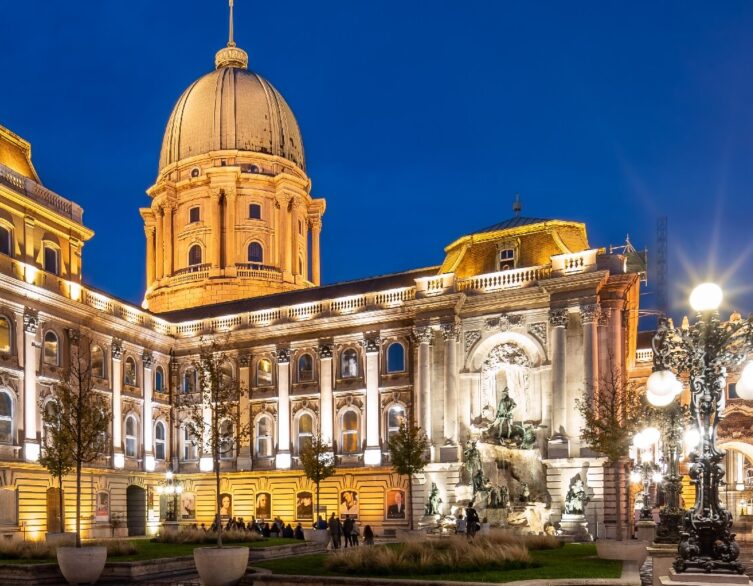
The Hungarian National Gallery sits inside Buda Castle, one of the most magnificent settings for a museum anywhere in Europe. The views across the Danube toward Pest are reason enough to make the trip up the hill, and the gallery’s permanent collection — spanning centuries of Hungarian art — makes it easy to spend a full day there.
The Gruber exhibition is open Monday through Sunday from 10 AM to 6 PM, with last entry at 5 PM and tickets purchased in advance also valid until that time. Note that the gallery is closed on the last Monday of each month. The exhibition closes on August 23, 2026, so if you’re visiting Budapest this summer, this is one not to leave until the last minute.
Hungarian National Gallery, Buda Castle, Budapest. Gruber Béla exhibition: June 4 – August 23, 2026. Third floor. Open daily 10:00–18:00 (closed last Monday of each month). Last entry: 17:00.
Related attractions
Related news