Budapest Just Broke Its Hottest St. Stephen’s Day Ever — And Summer Isn’t Done Yet
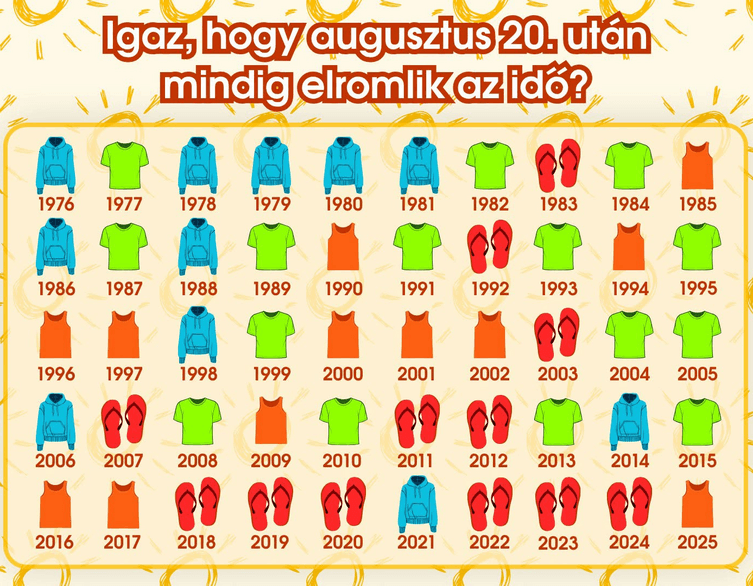
If you’re packing for Budapest right now and wondering whether to throw in a light scarf for cooler evenings, hold that thought. This year’s St. Stephen’s Day, Hungary’s grand national holiday on August 20th, didn’t just deliver fireworks over the Danube — it delivered the hottest August 20th ever recorded in the capital. So if you’re arriving in the coming days, expect the city to still be firmly in summer mode, sunscreen and all.
A Record-Breaking National Holiday
According to Hungary’s national meteorological service, HungaroMet, the mercury climbed to 37.5°C (99.5°F) in the Újpest district on August 20th, smashing the city’s previous daily heat record for that date, which had stood since 2000 at 37.4°C (99.3°F), set at the Pestszentlőrinc weather station. It wasn’t a one-off spike either — Budapest has actually seen two separate extreme heatwaves this summer, both more intense than the city’s previous all-time record from 2007, with some readings peaking above 41°C (105.8°F) and even touching 43°C (109.4°F) on parts of a scorching Wednesday earlier in August. Nationally, the town of Kübekháza hit 39.5°C (103.1°F) on the same day, tying the country’s all-time August 20th heat record shared by Esztergom in 1992 and Kecskemét in 2000.
For visitors, the practical takeaway is simple: this is not a mild “end of summer” holiday. If you’re planning to watch the traditional Hungarian Air Show along the Danube between the Chain Bridge and Margaret Bridge, or the evening fireworks display over the river, come prepared with water, sun protection, and a shaded spot if you can find one, because the crowds along the embankment will be soaking up serious heat well into the evening.
Reading HungaroMet’s Weather Icons
The graphic accompanying HungaroMet’s post is essentially a decades-spanning scrapbook of what the weather has actually done right after August 20th, the date long treated in Hungary as summer’s unofficial closing bell. Instead of numbers, the meteorologists tagged each past year with a small clothing icon that captures how that particular post-holiday stretch actually felt, and the mix tells a far messier story than the old “back-to-school chill” folklore suggests.
A sweater icon marks years when temperatures dropped well below the seasonal average right after the holiday, the kind of genuinely cool, jacket-weather spell that dominated the late 1970s and early 1980s. A t-shirt icon flags years that were only mildly below average, still light-jacket territory in the mornings but far from harsh. A tank top icon appears for years running slightly above the norm, comfortable, sunny, late-summer days. And a pair of beach sandals marks the years that stayed properly hot, like the standout heatwave of 1992 and an increasing cluster of years since the turn of the millennium. Scanning across the collection, the flip-flop years get noticeably more frequent the closer you get to the present, which is exactly the point HungaroMet is making: the idea that August 20th reliably ushers in cooler weather has been eroding for decades, and this year’s record-breaking heat is the latest, most extreme entry in that pattern.
Does the Weather Really “Break” After August 20th?
There’s a long-standing Hungarian belief that St. Stephen’s Day marks the symbolic end of summer, after which cooler, back-to-school weather sets in. Meteorologists are increasingly pushing back on that idea. HungaroMet’s own analysis points out that while the tail end of August did bring genuinely chilly stretches in the late 1970s and early 1980s, the pattern has shifted dramatically since — 1992 brought a full-blown heatwave right around the holiday, and since the turn of the millennium, hot spells stretching past August 20th have become the norm rather than the exception.
The science behind this is refreshingly intuitive once you hear it explained: by mid-August, the oceans and landmasses of the Northern Hemisphere have absorbed months of accumulated heat, and that stored warmth keeps the air temperature elevated for weeks afterward, even as days shorten and the sun sits lower in the sky. It usually takes a genuinely strong cold front to overpower that thermal reserve, and this year, forecasters say that front is only just arriving.
Best deals of Budapest









Meteorologist László Molnár of Kiderül.hu explained that a significant cold front was expected to move in from the west around the end of the weekend following the holiday, bringing widespread rain and a real drop in temperature. But he was careful to call it a “heat-ender” rather than a definitive “summer-ender,” since forecasters can’t rule out another 30–35°C (86–95°F) hot spell returning before summer’s official close. Independent forecasts for the following days show highs still hovering in the high 80s to low 90s Fahrenheit, with only scattered showers expected to bring brief relief.
What This Means If You’re Visiting Budapest Now
Practically speaking, tourists arriving in the city through the rest of August should plan their sightseeing the way locals do during a heatwave: mornings and early evenings for walking tours, castle visits, and river cruises, and the hottest midday hours reserved for indoor museums, thermal baths, or simply a shaded café terrace with a spritzer. Budapest’s famous thermal bath culture, at spots like Széchenyi Thermal Bath or Gellért Baths, becomes especially appealing in weather like this, since many of the outdoor pools offer a genuine way to cool off while still doing something quintessentially Budapest.
The good news is that the city isn’t slowing down despite the heat. Rather than treating late summer as a wind-down period, Budapest’s cultural calendar stays packed. HungaroMet itself has been encouraging people not to let shortening daylight dampen their motivation to get outdoors, pointing to running, cycling, and hiking events across the country as good ways to make the most of the season’s final weeks.
Late-August Events Worth Building Your Trip Around
St. Stephen’s Day celebrations technically run from August 16th through 21st, so if you’re reading this in the days immediately following the holiday, you’ve likely still caught the tail end of the Festival of Folk Arts (Mesterségek Ünnepe) in the Buda Castle courtyards, running through August 23rd with traditional crafts, folk music, and artisan demonstrations set against one of the city’s most photogenic backdrops.
Looking ahead, the final weekend of August brings a cluster of events worth planning around. On August 28th, the Budapest Zoo hosts its Night of Zoos, with evening programs running until midnight under this year’s theme of animal facts and myths, a smart pick for families trying to dodge the daytime heat. The following day, August 29th, the Műegyetem embankment and Szent Gellért Square host Bartók Fest, a free, locally driven celebration of music and community, alongside the Generali Night Run Budapest, which includes a rare Danube swimming leg between the Corvinus University and BME areas. If your trip stretches into September, the 28th Jewish Cultural Festival opens August 30th and runs through September 10th across historic synagogues including the Dohány Street Synagogue, bringing concerts, film, and literature events tied to the city’s Jewish heritage.
For a lower-key weekend option, Budapest’s Central Market Hall hosts regular Sunday tastings of lángos, goulash, and chimney cake, while Margaret Island’s open-air stage continues its Budapest Summer Festival program, including live orchestral film screenings under the stars.
Packing and Planning Advice
Given everything above, the honest advice for anyone visiting Budapest through late August and into early September is to pack as though summer is still fully underway, because it is. Bring breathable clothing, a refillable water bottle, and swimwear for the thermal baths or the Danube-adjacent open-air pools, but also keep a light layer handy for the evenings after the forecast cold front passes through, since temperatures can dip more noticeably after sunset once that shift arrives. Rain gear is worth packing too, since the incoming front is expected to bring the season’s more substantial showers, particularly across the western and northwestern parts of the country.
Ultimately, the message from Hungarian meteorologists is refreshingly clear: don’t assume that crossing August 20th means summer in Budapest is over. This year, more than most, proves that the city’s warmest days can arrive right up to, and even after, its most traditional national holiday.
Related news

Related events