Where to Find a Public Toilet in Budapest’s Theresa Town (District VI)
Need a restroom while exploring downtown Budapest? Theresa Town (Terézváros), the district around Andrássy Avenue and the nightlife streets, has more public options than most Budapest districts. Knowing where they are makes sightseeing far less stressful.
A Very Human Topic
Every traveller thinks about restrooms, and few guidebooks mention them. You rarely plan your day around them, until you suddenly have to. If you’d rather not buy a coffee just to use the facilities, a city’s public toilets matter a lot. The topic even has its own day: World Toilet Day, marked every year on 19 November.
The district’s local magazine has put together a guide to what’s on offer. The local authority maintains a small network of public restrooms, which many other districts simply don’t have. There are no toilets run by the city of Budapest in Theresa Town, so the district and its local partners provide all of them.
Toilets on the Squares
The best-known facility is on Jókai Square (Jókai tér). It’s an automatic toilet, built when the square was renovated and opened at the end of 2022. You pay a fee, which you can settle in forints or euros. It’s open around the clock, which is handy given the lively bars and restaurants nearby.
Best deals of Budapest










Near Lövölde Square (Lövölde tér) you’ll find a paid public toilet that’s open from 7:00 am to 9:00 pm, with a baby-changing facility. The district has rented the space since June 2022. At the playground in Benczúr Garden (Benczúr kert) there is also a restroom with facilities for parents and babies.
On Hunyadi Square (Hunyadi tér), a public toilet sat in one of the units of the temporary container market, outside the market hall, at the time of writing. The Líra Terasz café on the square also has a toilet you can use without buying anything. Finally, the ground-floor lobby of the district’s town hall building at Eötvös utca 3, known as Eötvös10, has a restroom open to everyone during office hours.
The “Urgent Need” Stickers on Liszt Ferenc Square
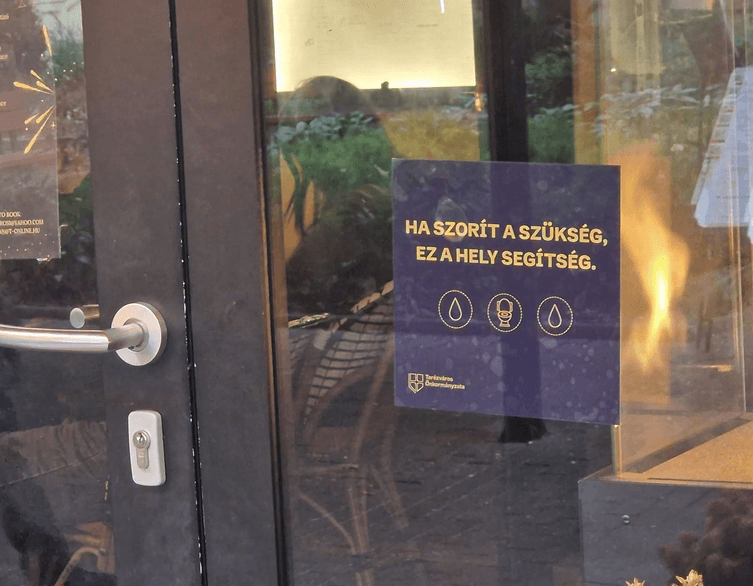
One of the most charming solutions is on Franz Liszt Square (Liszt Ferenc tér), the lively strip of cafés and restaurants just off Andrássy Avenue. The idea came out of the district’s participatory budget. Restaurants and cafés on the square agreed to let people use their restrooms without ordering anything. Six venues had joined at the time of writing: Menza, Porto di Pest, Incognito, Vian, Beckett’s and Korhely.
Look for the sticker at the entrance (see the picture above), which translates roughly as “If you’re desperate, this place will help.” The owner of Cafe Vian says everyone benefits. The square stays cleaner, and it’s no trouble for the venues. Some people who pop in for the restroom end up coming back as customers.
What Happened to the Boulevard Toilets?
If you stroll along the Grand Boulevard (Nagykörút) or around Oktogon, you may notice small flower gardens in odd places. Four former underground public toilets, on Teréz Boulevard (Teréz körút), around Oktogon and on Nagymező Street, have been turned into green spots. The old underground facilities, once run by the capital’s sewage company, had deteriorated so badly that they had to be closed. Renovating and running them would have cost too much, so the district’s gardeners planted rock-garden plants on the roofs, evergreens along the sides and colourful flowers at the front.
The city’s plans for the Grand Boulevard may bring something new. They include so-called comfort points, which would be small municipal shops offering a restroom along with other services. The renovation of the stretch between Western Railway Station (Nyugati tér) and Mester Street could start in 2028.
The People Behind the Clean Restrooms
Behind the busy Jókai Square and Lövölde Square toilets is a mother-and-daughter team, both named Anita, who keep them clean and running. Their phone number is posted on the walls in case of problems. They also deal with vandalism and theft, and some of what they find after a night out is best left to the imagination. Most visitors, though, are grateful for a clean restroom and often say so.
Running public toilets doesn’t pay for itself. The district earned about four million forints from its paid toilets in 2025, which is less than the annual gross pay of a single employee. Replacing damaged or stolen items alone cost around half a million forints that year. The district sees public toilets as an essential public service, not a business.
How to Find a Toilet Anywhere in Budapest
The BudapestGo app can help you by showing the nearby public toilets on the map on the route planning page. Just click the Filter menu below the map and scroll down to the Budapest info menu where you can select toilets, water fountains and other places of interest.
The City of Budapest publishes a map of the public toilets it and its partners operate, on the Clean Budapest (Tiszta Budapest) section of its official website. District-run toilets may not all appear there.
You can also try apps. Budicheck is a new community database listing tens of thousands of toilets across Hungary, including Budapest, with user ratings for cleanliness. Toilet Finder is an international app that shows nearby restrooms on a map and lets you filter for free and accessible ones.
A civil group called The City Is for All (A Város Mindenkié) argues that Budapest needs many more free, accessible public toilets. Its 2020 survey found only about ninety working public toilets in the capital, and fewer than forty of them were free. So carry some small change, keep an eye out for the stickers, and plan your restroom stops when you’re on the move. Opening hours, fees and participating venues can change, so check locally before you rely on a specific spot.
Related news
Budicheck: The Toilet-Finding App That Could Save Your Budapest Sightseeing Day – Update!
Update: Budicheck is now available in English as well with new games built in! Budapest has magnificent architecture, atmospheric cafés and enough...
Visiting Budapest With a Dog? New Castle District Rules and Dog Toilets Explained
Visiting Budapest with your dog? Alongside planning your walks, there is a new local rule to keep in mind. From 21 November 2026, anyone walking...

Budapest McDonald’s Toilet Fees: Why Your Receipt May Not Get You In
Stopping at McDonald’s for a meal and a quick bathroom break? At some Hungarian branches, buying food no longer guarantees free access to the toilets....
Traveling to Budapest with a Dog? Here’s Some Very Good News
Budapest has quietly become one of Europe’s most dog-friendly capitals, and one district is taking that reputation to a whole new level. If...