Secret, Story, Fairy Tale: Uncovering the Golden Ages of the Pesti Vigadó
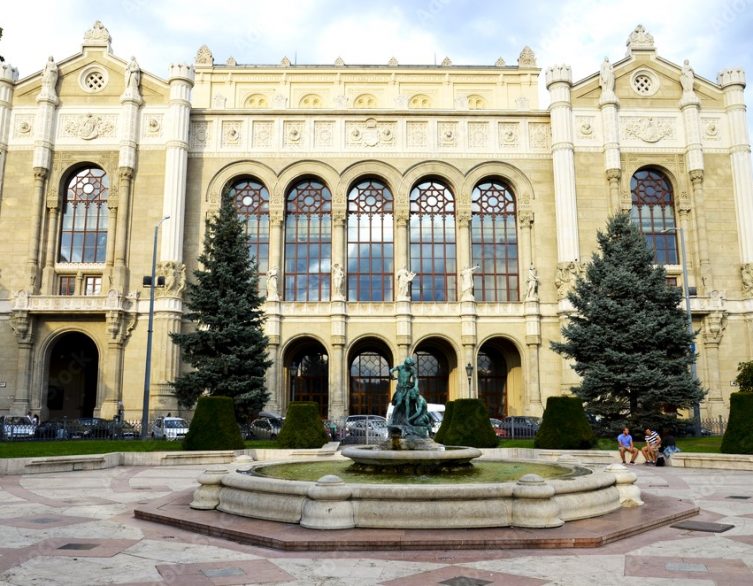
Right on the Danube promenade in downtown Pest stands a building that almost every visitor to Budapest walks past, yet almost nobody actually knows. The Pesti Vigadó has been there in one form or another since 1833, and its walls have quietly absorbed nearly two centuries of Hungarian history. Now, for the first time, the Vigadó is telling its own story. The new permanent exhibition, “Secret · Story · Fairy Tale: The Golden Ages of the Vigadó,” pulls back the curtain on a past far stranger and more dramatic than the building’s elegant façade suggests.
A Concert Hall With a Turbulent Past
The story begins with the Redoute, a classicist predecessor building that opened on the Pest bank of the Danube in 1833 and quickly became the beating heart of the city’s social life, hosting glittering balls and concerts during Hungary’s Age of Reform. That golden run took a dark turn in the summer of 1848, when Lajos Kossuth stood up in the very same hall and delivered a single speech that called 200,000 men to arms for the Hungarian cause. Within months, imperial cannons had reduced the building to rubble.
The rebuilt Vigadó reopened in 1865, and its second act was just as eventful. Franz Liszt, by then a global celebrity, conducted his own oratorio here in a black cassock in front of thousands of spectators and kept returning for the next thirty years. In 1909, four workers assembled aviator Louis Blériot’s airplane inside the ceremonial hall, and a crowd of roughly a hundred thousand people gathered outside to watch it fly. In 1913, the International Woman Suffrage Alliance held its congress here, hoping Hungarian women would soon win the vote, a hope that went unfulfilled for years. In the winter of 1947, a wanted general hid for three weeks in an apartment in the building’s rear wing. And in 1982, the Vigadó hosted the first speedcubing world championship for the Rubik’s Cube, with inventor Ernő Rubik himself sitting among the spectators.
Best deals of Budapest








Here are the essentials for planning a visit:
- Location: Pesti Vigadó, Vigadó Square 2, District V, Budapest
- Exhibition: permanent, open as part of regular museum hours
- Opening hours: daily, 10:00 a.m. to 7:00 p.m. (ticket office closed 12:30–1:00 p.m. for lunch)
- Single-exhibition ticket: 2,000 HUF
- General Admission Ticket (covers the whole building, including the Grand Staircase, Ceremonial Hall, and Panorama Terrace): 3,500 HUF
- Discounts available for students, seniors, and Budapest Card or Hungary Card holders
- Free entry for children under six and visitors aged seventy and older
- Closed on most Hungarian public holidays
Why Secret, Story, and Fairy Tale
The exhibition’s title is built around three ideas, each answering a different question about the building. It is a secret because, despite standing in plain sight on Vigadó Square for close to two hundred years, few people actually know its cheerful triumphs or its darker chapters. It is a story because the curators chose to present lived experience and human drama rather than dry historical dates, making the past feel immediate rather than academic. And it is a fairy tale because above the grand staircase, wall paintings have long depicted the legend of Prince Árgyelus and Fairy Ilona, a reminder that inside the Vigadó, reality and myth have never been entirely separate.
The exhibition leans into the idea that a golden age is usually only recognized in hindsight, and sometimes that recognition is itself a kind of illusion. Rather than arguing that the past was simply better, the show invites visitors to notice the value of what is happening around them right now, while it is still unfolding.
Objects That Tell Budapest’s Story
The decades following the Vigadó’s 1865 reopening coincided with one of the most eventful chapters in Budapest’s history, as the newly unified capital’s population multiplied, new bridges linked Pest and Buda, and the city’s streets filled with the most modern means of transport of the era. Several objects that trace this transformation into a world city now sit inside the exhibition itself.
A bronze scale model recreates the original pillar gateway of the Chain Bridge, the first permanent Danube crossing, built at the initiative of Count István Széchenyi. The model preserves a detail no longer visible on the real bridge: when the wartime-damaged crossing was rebuilt between 1947 and 1949, its gate opening was widened from 5.5 to 6.5 meters to accommodate growing road traffic, permanently altering its original proportions.
Another highlight is a fragment of the ornamental crown that once topped the cast-iron columns of the Margaret Bridge, completed in 1876 as Budapest’s second permanent Danube bridge. The decorative crowns fell into the river when the bridge was destroyed in 1944 and 1945 and were never restored during reconstruction. Decades later, during an exceptionally low water level in 2003, conservators recovered several original bridge elements from the riverbed, including a nearly complete crown broken into two pieces. The smaller fragment, showing the crown’s ring and part of its cross-band, is displayed exactly as it was pulled from the Danube.
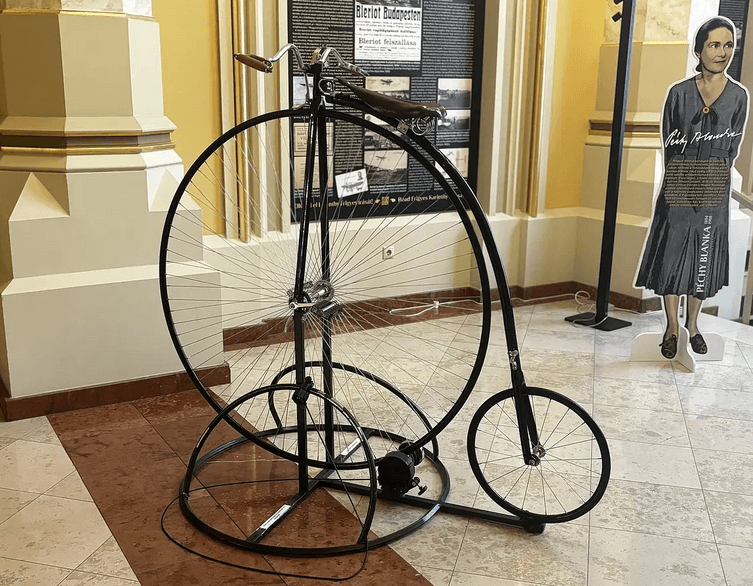
The exhibition also recreates a livelier scene from the summer of 1880, when Budapest residents marveled at cyclist László Kosztovics riding a large-wheeled velocipede through the city, reportedly brought home all the way from England. On loan from the Museum of Transport, a reconstruction of this early bicycle stands in the Vigadó’s passageway, and visitors can actually try balancing on one themselves.
Rounding out the collection is a Rubik’s Cube, which might look out of place among nineteenth-century artifacts but fits the same narrative of Hungarian ingenuity. Invented by Ernő Rubik in 1974, the puzzle became a global phenomenon within a few years and remains one of the most recognizable symbols of Hungarian creativity worldwide.
Stories You Have Probably Never Heard
Beyond the headline moments, the exhibition also explores the roads not taken: ambitious architectural plans for the Vigadó that were drawn up but never built. Visitors get a glimpse into Liszt’s sold-out concerts, the legendary balls of the dualist era, and the buzzing café culture of Budapest’s early twentieth-century literary avant-garde. Life-size figures throughout the galleries bring the building’s famous visitors back to life, and wandering through the rooms, guests might find themselves face to face with Empress Elisabeth of Austria (Sisi), statesman Ferenc Deák, actress Lujza Blaha, composer Zoltán Kodály, or even Freddie Mercury.
Why It’s Worth the Visit
For anyone curious about how a single building on the Danube can hold speeches that shaped a nation, a flying machine assembled indoors, an early world championship, and a fairy tale painted above its staircase, this exhibition offers a rare, unified look at a Budapest landmark that has spent two centuries quietly collecting stories most visitors never get to hear. With plenty of hands-on elements to try along the way, from balancing on a historic velocipede to tracing the fate of a bridge ornament pulled from the Danube, it makes for an easy, rewarding stop on any walk along the Pest side of the river.
Related attractions
Related news