How Budapest’s Terézváros District Is Letting Women Shape Their Own Neighbourhood
Budapest is a city that never stops surprising. Famous for its grand boulevards, thermal baths, and vibrant cultural scene, it is also — perhaps less visibly — a city quietly experimenting with new forms of democracy. The latest example comes from the 6th District, known as Terézváros, where local government has just committed to implementing a comprehensive package of improvements drawn up entirely by the women who live there. For visitors exploring this corner of the city, it’s a compelling story that adds a whole new layer to one of Budapest’s most elegant and walkable neighbourhoods.
The Neighbourhood You’re Walking Through
Before getting into the initiative itself, it’s worth knowing a little about Terézváros. The 6th District stretches along Andrássy Avenue, Budapest’s grand UNESCO World Heritage boulevard — often compared to the Champs-Élysées in Paris — running from the city centre all the way to Heroes’ Square and City Park. Along the way you’ll pass the magnificent Hungarian State Opera House, the Liszt Ferenc Music Academy, beautiful fin-de-siècle mansions, upscale boutiques, and the lively café terraces of Liszt Ferenc Square. Below your feet, the world’s second oldest underground metro line — the Millennium Underground — quietly connects it all together. It’s one of the most walkable, photogenic, and culturally rich parts of the city, and it happens to be home to a remarkable democratic experiment.
Hungary’s First Women’s Citizens’ Assembly
In March 2025, Mayor Tamás Soproni announced that Terézváros would join the 2nd District in hosting Hungary’s first-ever women’s citizens’ assembly — a structured, expert-supported deliberative process focused entirely on how the city could better serve its female residents. The initiative was organised and facilitated by DemNet (Foundation for the Development of Democratic Rights), which has championed participatory democracy tools across Hungary.
The concept of a citizens’ assembly is well established internationally, having been used hundreds of times across Western Europe and the English-speaking world over the past two decades, but this was the first time it had been applied anywhere specifically to women’s experiences of urban life. Every household in the district received an invitation to register, and 301 women came forward. From those, 46 participants — plus 6 reserves — were selected by a weighted random ballot using the Blue Democracy software, which ensured the group reflected the district’s true demographic diversity: age, education level, family status, residential location, and number of children were all taken into account.
Five Weekends, Sixty Ideas, Eight Final Proposals
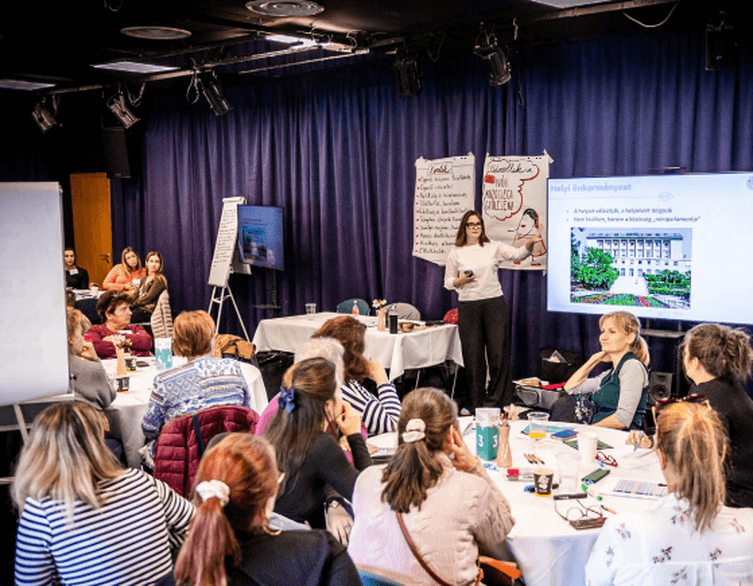
From early October to late November 2025, the 46 selected women gathered five times at the MagNet Community House in Terézváros. Over the course of those weekends, more than fifteen experts — including sociologists, architects, and urban planners — gave presentations on the district’s governance, on international best practices, and on what gender-sensitive city planning actually looks like in practice. By the end of the third day alone, more than sixty ideas had been collected.
The conversations were refreshingly grounded in real, everyday experience. How safe does it feel to walk home alone at night? Where does a pushchair get stuck on the pavement? Is there a bench on Teréz Boulevard where an elderly woman can rest? Is the lighting in a side street bright enough? These may sound like small questions, but they point to something important: cities are often designed without the daily realities of women’s lives fully in mind, and correcting that oversight benefits everyone.
The ideas were then systematically filtered and matched against the district council’s actual powers, before being organised into two broad categories — municipal services and public spaces. In each category, eight proposals made it through multiple rounds of selection to the final package, which was adopted by secret ballot.
Best deals of Budapest





What the Women Proposed
On the municipal services side, the final recommendations include targeted support for single-parent families, expanded home care and caregiving services for the elderly, a women’s crisis shelter for victims of domestic violence, a scholarship programme to support professional career development, a women’s entrepreneurship programme to connect and support female business owners in the district, and a gender-sensitive public safety audit with an accompanying action plan.
The public space proposals are equally practical. The women called for improvements to street lighting, safer pedestrian crossings, accessible and clean public toilets with baby-changing facilities and hygiene vending machines, and a digital problem-reporting map that residents can use to flag issues in real time. They also advocated for more benches along Andrássy Avenue and Teréz Boulevard, stronger night-time patrols, a crackdown on pavement parking, and a more pedestrian-friendly approach to urban design across the district.
Stories from the Assembly
Among the participants was Brigitta, a mother of two young children who has lived in the district for three years and arrived at the assembly with a very concrete dilemma: how to resolve the tension between expanding green spaces and the very real parking difficulties that come with it. Through expert presentations and direct dialogue with the mayor, she came to see the two concerns not as opposing forces but as parts of the same question about what kind of neighbourhood people want to live in. She brought her two-month-old son Misi to every session — since there was no other way to “escape” for five weekends — and joked that he had spent half his life so far contributing to the public good.
Tímea, a film producer who lives and works on Andrássy Avenue, came without fixed expectations but left with a clear conviction: the district urgently needs a network for its female entrepreneurs — not a lobbying body, but a platform offering mentoring, professional training, and visibility. Her energy helped push the women’s entrepreneurship programme into the final package. As she put it, a neighbourhood is only truly modern when it makes women visible in its economic life as well as its civic life.
What’s Already Happening — and What Comes Next
Several of the proposals echoed initiatives already underway in the district. Mayor Soproni pointed out that Terézváros has been introducing women-centred policies for years, including a nationally unique menstrual leave policy for district employees, subsidised intimate hygiene product packages, and on-site mammography screening. A district app is also in development, and a women’s crisis shelter had already been discussed by the local council before the assembly took place.
On International Women’s Day 2026, Mayor Soproni announced that the full package of recommendations would be implemented. He committed to reporting back in one year with tangible results — improvements that make Terézváros a better place to live, to raise a family, and to be a woman. What struck him most about the process, he said, was how clearly the women’s proposals reflected a desire for community building, social solidarity, and meaningful dialogue — and that the assembly itself had already begun delivering on exactly those values, with friendships forming across age groups and backgrounds over the course of those five weekends.
Why It Matters for Visitors Too
For tourists spending time in Terézváros — strolling Andrássy Avenue, catching a performance at the Opera House, or lingering over coffee on Liszt Ferenc Square — this story adds a quiet but meaningful dimension to the neighbourhood. The push for better lighting, safer crossings, cleaner public toilets with proper facilities, and more benches on the city’s grandest boulevards are changes that will make the area more welcoming for everyone passing through, not just those who call it home. Budapest has always been a city that rewards those who look beyond the postcard. This is one more reason to look a little closer.
Related news
Buda’s Game-Changing Women’s Assembly: How Everyday Voices Are Shaping Budapest’s Future
Picture strolling through Buda’s leafy streets, past charming villas and vineyard trails, feeling safer and more connected because local women...
New Date! – Lululemon Hits Budapest: Fashion Street’s Hottest New Activewear Spot for Tourists
Lululemon is landing in Budapest, and it’s the perfect excuse for you to upgrade your travel wardrobe while exploring one of Europe’s...
Making Budapest More Inclusive: A Movement for Women-Centered Urban Planning
Budapest is witnessing a groundbreaking shift in urban planning as two districts launch Hungary’s first community assemblies focused on women’s...
Budapest’s Bold Experiment: Designing a City That Works for Women Too
Budapest’s District II is embarking on something that might sound revolutionary but shouldn’t be – they’re asking women what...

Exploring Budapest Solo: Why Hungary’s Capital is Perfect for Women Traveling Alone
Traveling solo as a woman can be an empowering and enriching experience, offering the freedom to explore at one’s own pace and discover new...