Spinoza Jewish Festival 2026 in Budapest
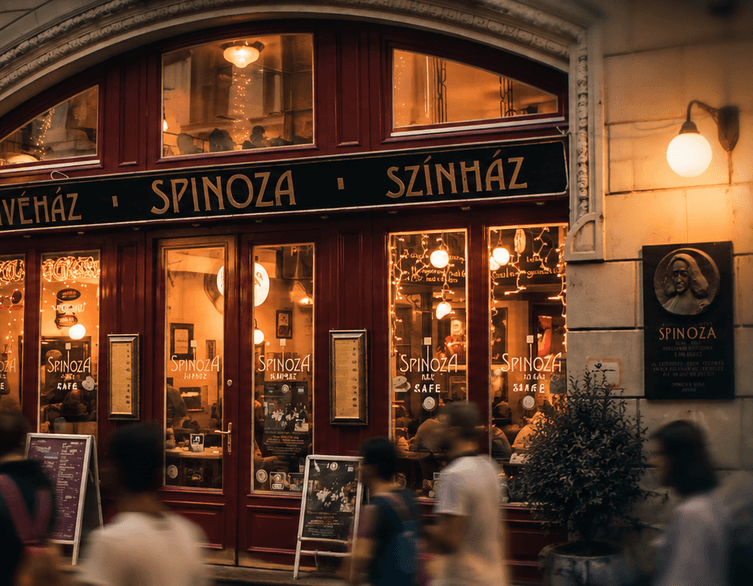
Live music is an inviting way into a festival when you don’t speak the local language. From 7 to 22 October 2026, the 24th Spinoza Jewish Festival brings concerts, theatre, films and talks to the Spinoza Theatre in Budapest’s Jewish Quarter. Its three concerts are a natural starting point for international visitors: you may not catch every lyric or spoken introduction, but you can still enjoy the performances through the music itself.
Essential Event Details
- When: 7–22 October 2026
- Where: Spinoza Theatre, 15 Dob Street, Budapest
- Concerts: 8, 9 and 16 October, all starting at 7 pm
- Other events: Plays, films and a talk, generally starting at 7 pm
- Language: Performances are in Hungarian; the concerts may also include Hungarian lyrics and introductions
- Tickets: The supplied prices for the 9 and 16 October concerts are HUF 6,500, or HUF 15,000 with dinner
Three Evenings of Live Music
The first concert, The Most Beautiful Century of Jewish Evergreens, takes place on Thursday, 8 October. It follows a century of music associated with Jewish composers and songwriters, moving from Mendelssohn through operetta, musicals and popular songs to Hungary’s Rezső Seress. Musical guides Gergő Nógrádi and Balázs Fellegi introduce the works, accompanied by Zoltán Neumark at the piano. The commentary is part of the evening, so Hungarian speakers will get more of the stories behind the songs, but visitors can still enjoy the musical journey.
On Friday, 9 October, Judit Klein and Haverim bring an ensemble sound to the Spinoza stage. Klein sings alongside Neumark on piano, Péter Nagy on clarinet, Zsigmond Lázár on violin and Gábor Zsoldos on drums. It is a good choice for visitors looking for a live performance rather than a dialogue-led play.
The festival’s third concert arrives on Friday, 16 October, when the eight-member Sabbathsong Klezmer Band performs. Its lineup combines vocals with clarinet, violin, trumpet, piano, double bass, percussion and string instruments. Both Friday concerts offer a dinner ticket option, making it possible to build an entire evening around the performance.
Best deals of Budapest









Theatre Beyond the Concerts
Although music is the easiest route into the festival for many foreign visitors, the theatre programme offers plenty to explore if you speak Hungarian. The festival opens on Wednesday, 7 October, with the premiere of Barbra Streisand, a biographical stage production that returns on 21 October. Other famous lives take centre stage in Tony Curtis: The Prince of Hollywood on 10 October and I, Zsa Zsa on 15 October.
The programme also turns to less familiar stories. Albina: The Woman Behind the Nobel Prize is a one-person play on 14 October, while Goldberger, the Textile King closes the festival on 22 October. On 17 October, a performance devoted to Szilárd Darvas brings humour into the mix; Rewrite It, Shakespeare! follows on 19 October. These are Hungarian-language performances, so they are best suited to visitors comfortable following spoken theatre.
Film and Conversation
Filmgoers can see Carl Lutz: The Forgotten Hero on 12 October and the premiere of the sixth instalment of Bélyeges sereg on 20 October. A talk by György Gábor on the Talmud and Torah takes place on 13 October. As with the plays, visitors should expect Hungarian-language content.
One film event may be of particular interest even without fluent Hungarian: the 1926 Russian-Jewish silent film Jewish Luck, screening on Sunday, 18 October at 3 pm. Its would-be businessman and matchmaker, Menachem Mendel, meets one setback after another in a story with a wry title. A conversation with Russian-Jewish silent-film specialist Anna Geréb follows the screening; that discussion is in Hungarian. The supplied ticket price for the event is HUF 4,000.
Spinoza Theatre stands on Dob Street in the heart of Budapest’s Jewish Quarter. Whether you choose a Friday-night concert or a performance tied to a story you already know, the festival offers a chance to experience Jewish culture in an intimate Budapest setting—with the concerts providing the most accessible entry point when language is a concern.