Meet the Muki: Budapest’s 100-Year-Old Freight Trams That Just Went Viral
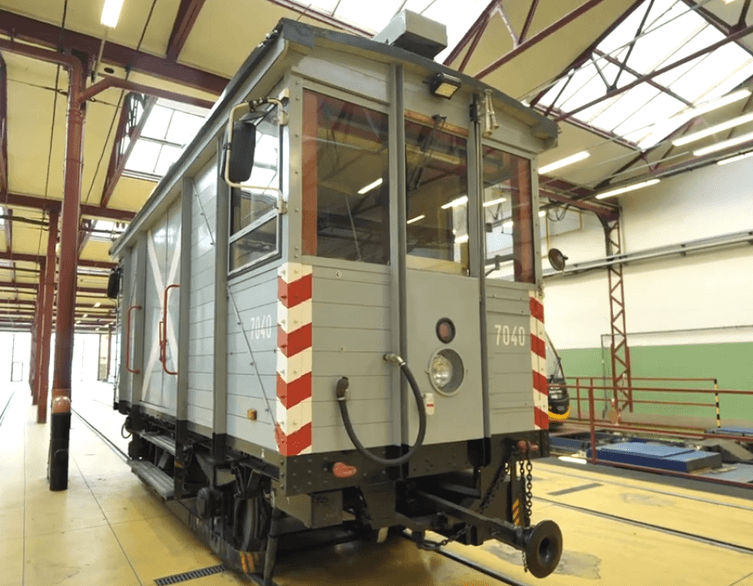
Budapest is famous for many things — its thermal baths, grand architecture, ruin bars, and the Danube views that stop you in your tracks. But tucked among the city’s fleet of iconic yellow trams, there’s something rather different quietly going about its business: a squat, grey, wooden-sided vehicle that looks like it might have rolled straight out of the 1920s. Because, well, it did. Meet the Muki — Budapest’s century-old freight tram, and the unlikely new darling of the international press.
A Living Relic on the Rails
The Muki (the name is an affectionate Hungarian nickname for “locomotive,” coined by transit workers and enthusiasts alike) is the informal title for what BKV — Budapest’s public transit company — officially calls a motoros fedett teherkocsi, or motorized covered freight car. These compact, two-axle trams were never designed to carry passengers. From the very beginning, they were working vehicles, built to haul goods, raw materials, and later all manner of heavy loads across the city’s extensive tram network.
Budapest’s tram network is one of the busiest in the world, and the Mukis have been a quiet part of it for a full century now. While sleek new trams are steadily joining the fleet and carrying nearly a million passengers a day across the city, the Muki keeps chugging along on its own very different mission — and in 2026, it’s turning 100 years old.
Born Out of Necessity
The story of the Muki begins in 1926, at a time when Budapest was still recovering from the devastation of World War I. Much of the city’s freight infrastructure had been destroyed, and the newly unified Budapest transit authority — known at the time as the BSZKRT — needed a practical, affordable solution fast. The answer was a batch of 30 wooden-sided freight trams, with a further 10 ordered the following year, bringing the original fleet to 40 vehicles in total.
Economy was everything. The trams were painted in a somber grey — a color chosen, it seems, more out of budget constraints than any aesthetic vision — and the bodies were manufactured externally at the Roessemann & Kühnemann factory, while the mechanical components were sourced from decommissioned vehicles already in the BSZKRT’s possession. It was resourceful, pragmatic, and very Budapest. The iconic white St. Andrew’s cross (the andráskereszt) that still marks their sides was added a few years later, along with sliding doors on both sides and, in some cases, a built-in crane for loading heavy cargo.
A Century of Heavy Lifting
Over the next hundred years, the Mukis did a little bit of everything. In their early decades they hauled coal, spare parts, and goods to and from factories across the city. After World War II, when Budapest lay in ruins, they were put to work clearing rubble and delivering food supplies to large parts of the capital. During the major metro construction projects of the 1950s, Mukis were used to remove excavated earth from the city center. Some were fitted with advertising boards in the 1940s. Others were converted into snowplows and rail grinders, and in more unglamorous chapters, they even pitched in with refuse collection.
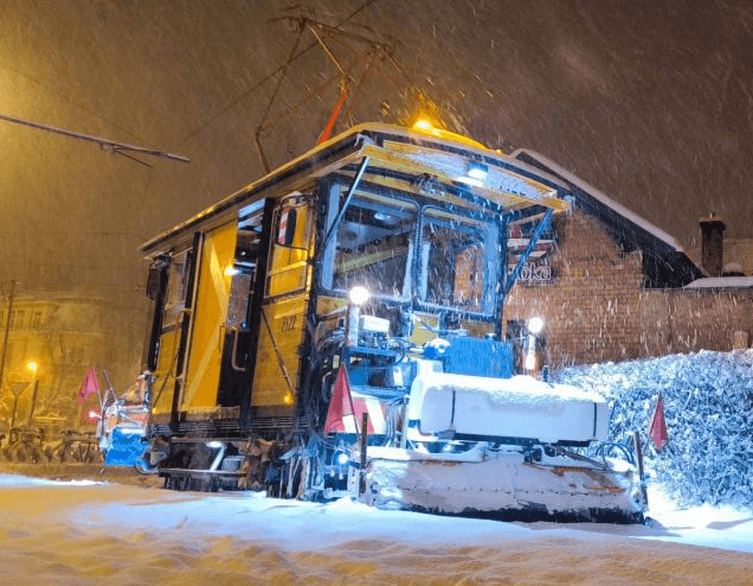
By the 1960s, as Hungary began recovering economically, some of the fleet were fitted with snowplow equipment, and that winter function remains one of their key roles today. They also carry out nighttime maintenance work on the tracks and tow broken-down passenger trams back to depots for repairs. It is quiet, essential, unglamorous work — exactly the kind of thing these vehicles were always built for.
Best deals of Budapest










The Trams That Nearly Disappeared
The Mukis came close to retirement in the mid-1990s, when BKV underwent a major corporate restructuring. In 1996, the company stripped back to its core functions — passenger transport — and discontinued a whole range of ancillary activities, including freight operations. Nurseries and kindergartens for staff were shut down, valuable properties were sold off, and the freight tram service was wound up along with everything else deemed non-essential. For a moment, it looked like the Mukis had finally reached the end of the line.
Fortunately, cooler heads prevailed. A handful of vehicles were kept back — not purely out of nostalgia, but because their practical value for maintenance, snow clearance, and equipment transport was simply too useful to give up. Of the original 40 Mukis, only six survived the century intact, and today three remain in active service, while a fourth is preserved at the tram museum in Szentendre, a charming historic town just north of Budapest that is well worth a visit in its own right.
The Viral Moment That Caught the World’s Attention
For decades, the Mukis were something only local transit enthusiasts and sharp-eyed visitors ever really noticed — a grey anomaly appearing from behind the yellow trams, trundling along tracks that looked like they hadn’t been touched since the socialist era. A Népszabadság journalist wrote about them thirty years ago, noting how they drew small crowds of curious children whenever they appeared, looking “like a small dinosaur among the giant yellow specimens.”
That niche fame went global in the winter of 2025–2026. During a heavy December snowfall, BKV had no choice but to deploy one of the Mukis — affectionately called a Hómuki, or Snow Muki — up to the Széchenyi Hill rack railway line to clear the tracks. Photos and videos of the little grey tram battling through the snow went viral on social media almost immediately. Among those who took notice was Justin Spike, a transport-enthusiast correspondent for the Associated Press, who tracked down BKV officials and filed a feature story published on March 17, 2026, subsequently picked up by news outlets around the world. Suddenly, Budapest’s century-old freight tram had fans it never knew it had.
What Makes the Muki So Special
Part of the Muki’s charm is precisely how out of place it looks. Budapest’s tram network has spent recent years modernizing aggressively — new trams are rolling out across multiple lines, low-floor and air-conditioned and bristling with passenger-friendly technology. Against that backdrop, the Muki — with its boxy wooden body, grey paint, white cross, and sliding side doors — looks almost defiantly old-fashioned. There’s something genuinely moving about the Muki’s longevity. It was built in an era of post-war austerity, assembled partly from scrap components, painted grey because nobody had money for anything prettier — and it has outlasted wars, revolutions, a communist regime, and a complete overhaul of the city it serves. Vehicle number 7040, one of the three currently in active service, is a beautifully restored example that has become something of a mascot for Budapest’s transport history, even appearing at one point as the tow vehicle for a LEGO tram.
Meet the Muki in Person: Open Day at the Szépilona Depot
If all of this has sparked your curiosity and you happen to be in Budapest in mid-April, you’re in luck. On Saturday, April 18, 2026, from 10:00 to 16:00, BKV is holding an open day at the Szépilona tram depot, located at Budakeszi út 9–11 in Budapest’s 2nd district. This is a rare opportunity to get up close with the Muki and other historic vehicles from Budapest’s transport heritage, see the inner workings of a real, active tram depot, and talk to the people who keep these remarkable machines running. It’s a perfect outing for families, transport enthusiasts, and anyone who simply appreciates the kind of living history that most cities quietly let disappear. Mark the date — events like this don’t come around often.
How to Spot One on Your Travels
If you can’t make the open day but still want to catch a glimpse of a Muki during your visit to Budapest, your best bet is patience and a little luck. These are working vehicles, not tourist attractions, so they don’t run on fixed schedules visible to the public. They are most likely to appear during early morning maintenance runs, on winter days when snow clearance is needed, or when a passenger tram elsewhere on the network breaks down and needs towing. The tram lines along the Danube embankment — particularly the busy Line 2 and Line 19 routes — are a reasonable place to keep an eye out, as is the area around the main tram depots.
If you do spot one, take a moment to appreciate what you’re looking at. In a city that never stops reinventing itself, the Muki is a rare thing: a vehicle that has been doing the same job, on the same tracks, for a hundred years. Quietly, reliably, and without any fuss — which, when you think about it, is a very Hungarian way of going about things.
Related news
Related events