Budapest’s Guardian Angel: The Extraordinary Story Behind the Restoration of the Archangel Gabriel Statue
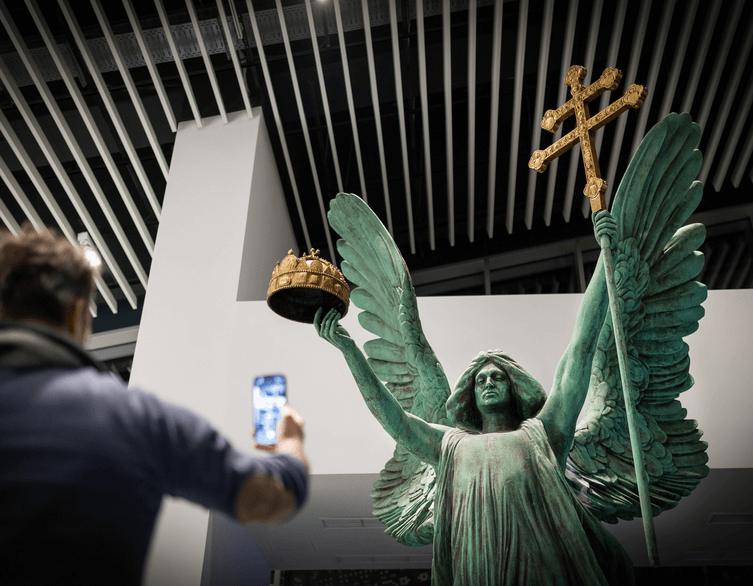
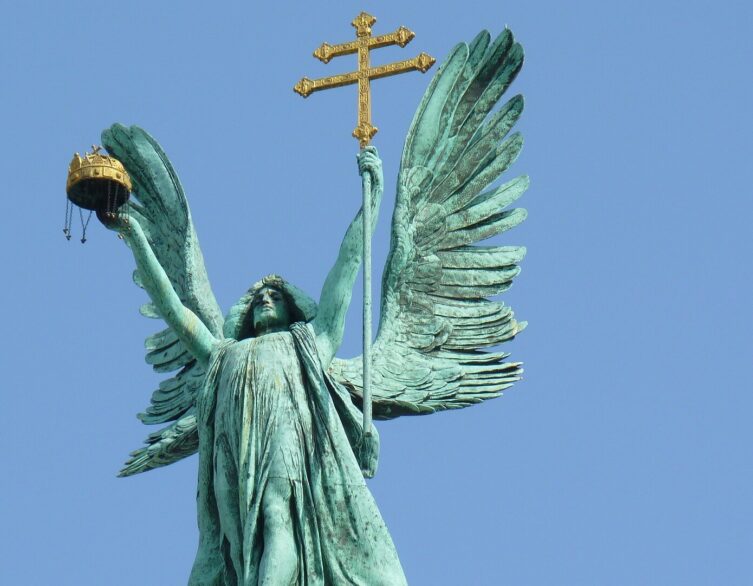
High above Heroes’ Square, for over 120 years, the bronze Archangel Gabriel has watched over Budapest from the top of a 36-metre Corinthian column. Millions of tourists have gazed up at him. Countless photographs have been taken. Yet almost no one knew that beneath the gleaming surface of one of Hungary’s most beloved national symbols, a slow and silent crisis had been building for decades — one that would eventually demand a daring rescue operation, and ultimately reveal a secret that had been hidden for over a century.
A Monument in Danger
The story begins not with a dramatic collapse, but with a quiet, creeping threat. When the Archangel Gabriel statue was cleaned and repatinated in 2021 ahead of the International Eucharistic Congress, conservators got their first real look at what was happening beneath the bronze surface — and what they found alarmed them.
Rainwater had been seeping through tiny cracks in the bronze casing for decades. Inside, the moisture created a permanently damp environment that was slowly but relentlessly eating away at the iron structure holding everything together. Combined with the effects of thermal expansion — the statue heating up and cooling down with every passing season — and the inevitable creep of corrosion, the internal framework had been silently weakening year after year.
The fastenings of the main bronze figure had reached a critical state. The decorative bronze ornaments of the Corinthian capital below the statue had loosened from their original fixings. And then came the discovery that sent a chill through the entire restoration team: two bronze leaf ornaments, each weighing around 20 to 25 kilograms, had already shifted completely out of position. Only the element directly beneath them had prevented them from falling. At 36 metres above the ground, a 25-kilogram bronze object breaking free would have been catastrophic. The intervention had come at the very last moment.
The Most Spectacular Operation in Budapest in Years
Removing the Archangel Gabriel from his post was no simple task. It required meticulous planning, Hungary’s largest mobile crane, and a massive scaffolding system constructed around the entire column by Layher Kft. In October 2024 — for the first time in 124 years — the angel was finally brought back down to earth.
Best deals of Budapest






The operation itself was a feat of engineering precision. The statue was dismantled in sections: Gabriel’s figure was lowered together with the upper half of the globe beneath his feet, while the Holy Crown and the double cross he holds were detached separately on-site. The Corinthian capital alone consisted of over one hundred individual elements, each one assigned a unique identification number and mapped on a detailed consignment chart to ensure every single piece could be returned to its exact original position. The elements were then transported by specialist vehicles to the Museum Complex Kft. restoration workshop — beginning a new chapter in the statue’s long history.
What the Workshop Revealed
It was only once the statue arrived at the workshop that the full scale of the damage became clear — and what the experts found was far worse than even their most pessimistic predictions.
The restoration team carried out 32 separate material analysis tests using the most advanced technology available: microscopic examinations, infrared imaging, and millimetre-precise 3D scanning that produced a complete digital model of every element. At one alarming point during the analysis, it seriously appeared that the bronze body had deteriorated so severely that significant portions of the statue would need to be recast entirely. For a moment, the prospect of losing the original 1897 work of sculptor György Zala seemed very real.
Fortunately, after deep and exhaustive material testing, the verdict came back: the original statue could be saved. It was a huge relief — but the scale of the work ahead remained daunting. Multiple internal steel fixings had snapped entirely. The bronze casing had deformed in several places. The decorative elements of the capital had come loose from their original fastenings. The restoration team now faced the task of rebuilding from the inside out, replacing corroded internal steel bolts with corrosion-protected fittings, repairing damaged bronze elements through welding, and individually sizing and shaping more than 40 bracket supports on the capital.
The 125-Year-Old Secret Hidden in the Pedestal
Then came the moment that no one had expected — a discovery straight out of an adventure story.
While excavating the statue’s spherical concrete pedestal, restorers found a shattered glass jar. Inside it: a tightly rolled paper document and eight metal coins. The time capsule had apparently been placed there at the monument’s inauguration in October 1901, and had remained completely undisturbed for 123 years.
The paper was recovered in a deeply damaged state — damp, heavily soiled, its surface covered in glass shards and concrete particles. Conservators at the Hungarian National Archives unrolled it millimetre by millimetre in a controlled high-humidity environment. When the scroll was finally fully opened, it measured 18.5 × 37.2 centimetres. But when they looked at it under normal light, there was nothing to see. The text had completely vanished.
What followed was a piece of extraordinary detective work. Researchers at the National Museum Restoration and Storage Centre (OMRRK) subjected the document to multispectral imaging — a technology that reveals text and markings invisible to the naked eye by capturing light beyond the visible spectrum. The results were extraordinary. Hidden writing began to emerge from the surface of the paper like a ghost stepping out of the past.
Using a combination of traditional archival research and artificial intelligence-assisted data analysis, the team compared the revealed text fragments with historical documents and signatures held at the Hungarian National Archives. Slowly, a 125-year-old message came back to life:
“On the twenty-third day of October, nineteen hundred and one, as the great column of the monument is completed with God’s help… in the presence of the undersigned.”
Among the signatures identified were those of Romy Béla (a ministerial councillor), Schickedanz Albert (the monument’s architect), and Aggházy Gyula — figures who had stood at the very ceremony where the stone was laid, and whose names had now resurfaced after more than a century of silence. The eight coins placed alongside the document are now on display at the Városliget Visitor Centre exhibition.
The Column Holds Its Own Mysteries
The drama didn’t end with the statue itself. While the restoration of the bronze figure was underway, attention turned to the nearly 30-metre stone column that has supported it since 1900. The column is built from a remarkably resilient material called travertine — a type of limestone formed by spring water deposits, long known for its strength and durability.
Professor Ákos Török of the Budapest University of Technology, leading the structural analysis of the column, reported that the structure is fundamentally stable, but requires careful assessment of how it responds to wind, temperature fluctuations, and the weight of the returning statue. The timeline for Gabriel’s homecoming depends largely on what these tests reveal: if no extensive structural intervention is needed, the archangel is expected to return to Heroes’ Square before the end of 2026.
A National Symbol Reborn
What began as a restoration project has turned into something far richer — a profound reconnection with Hungary’s history, told through bronze, stone, hidden documents, and ancient coins. The people who placed that time capsule in 1901 could never have imagined that their message would survive into the 21st century, decoded with artificial intelligence and multispectral cameras. And yet here it is: a direct line between two Budapests, separated by more than a century.
When Gabriel finally returns to his place above Heroes’ Square, he will do so not just restored, but truly reborn — stronger, better understood, and carrying with him secrets that no one knew he had been keeping all along.
Related news
Gabriel Archangel: A Celestial Guardian’s Temporary Descent
In a remarkable turn of events, one of Hungary’s most iconic symbols has temporarily left its lofty perch. The statue of Gabriel Archangel,...
Update – Archangel Gabriel’s Statue at Heroes’ Square Leaves Its Post For The First Time
In a city where history and art intertwine, Budapest is home to countless iconic landmarks that have stood the test of time. Today, we bring you...
Related events