Budapest Is Building Its Future: The Rákosrendező Masterplan Has a Winner
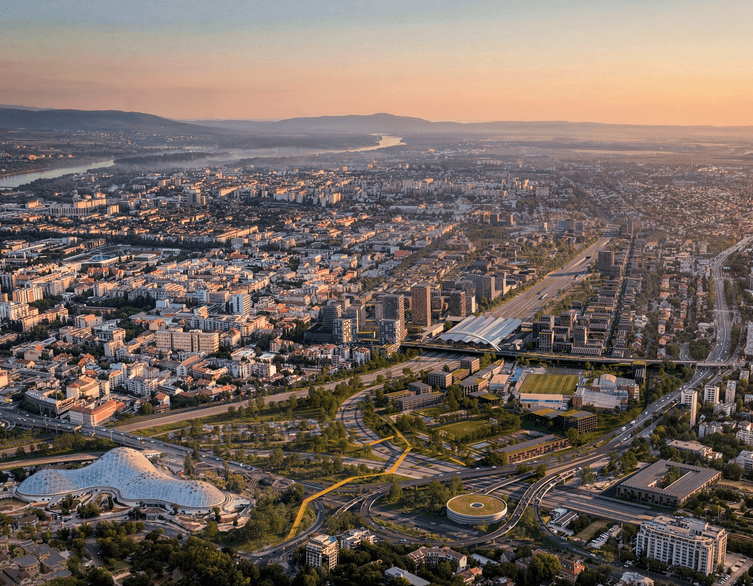
Budapest just took one of its most significant urban planning steps in decades. On March 30, 2026, the city announced the winner of the international masterplan competition for Rákosrendező — a vast, largely abandoned railway yard in northern Pest that is set to be transformed into one of Europe’s most ambitious new urban districts. This is not just a story about construction. It’s a story about what kind of city Budapest wants to become.
What Is Rákosrendező, and Why Does It Matter?
Rákosrendező sits on an 86-hectare brownfield site — a former railway yard that has lain largely neglected for decades, despite being located in a strategically valuable part of the capital. Over those thirty-odd years, nature quietly reclaimed much of the land, creating an unexpected stretch of green that locals have come to think of as the “lungs of northern Pest.” The site is well-connected by public transport, served by its own railway station and situated close to some of Budapest’s most dynamic residential districts.
For years, the fate of Rákosrendező was the subject of intense political controversy. A previous plan, championed by the national government, would have handed the site over to UAE investors to build a gleaming high-rise complex critics nicknamed “Mini Dubai” — a development that many felt was utterly at odds with Budapest’s architectural identity and the needs of its residents. The Budapest municipality ultimately blocked that plan and reclaimed the site for the city, successfully negotiating an agreement with the state on the costs of the necessary infrastructure investments. The city had effectively won back one of its most valuable assets — and the question then became what to do with it.
Best deals of Budapest






An International Competition for a World-Class District
Rather than commissioning a single firm behind closed doors, Budapest chose to open the process up entirely. The Budapest Capital Asset Management Centre (BFVK) launched an international urban and public space design competition, attracting entries from some of the best architectural and planning studios in Europe. The brief was ambitious: design a dense but liveable district with up to 10,000 apartments, a massive contiguous public park, a fully integrated cycling and pedestrian network, and a new intermodal transport hub capable of handling 60,000 passengers per day.
Fourteen entries were submitted, each offering a distinct vision for the site’s future. Fifty experts and seventeen jury members spent weeks analysing and evaluating the proposals before a winner was selected. The aim was never simply to find the best-looking plan — it was to find the best team, and the competition succeeded in attracting the interest of some of the finest urban planning professionals working internationally today. Budapest intends to draw on not just the winning entry but ideas from the other top-placed submissions as well.
Meet the Winning Team
The winning masterplan was produced by an outstanding international consortium of five studios, each bringing a distinct area of expertise to the table. The team comprises Coldefy et Associés Architectes Urbanistes (France), CITYFÖRSTER (Germany), Sporaarchitects (Hungary), Treibhaus Landschaftsarchitektur Hamburg (Germany), and Marko and Placemakers (Slovakia). Together, they represent exactly the kind of cross-border, multi-disciplinary collaboration that a project of this complexity demands — spanning urban design, architecture, landscape architecture, and placemaking across five European countries. This winning masterplan will now define the district’s final structure, built form, architectural character, green network, utility infrastructure, and the phasing of it all.
What the Winning Plan Envisions
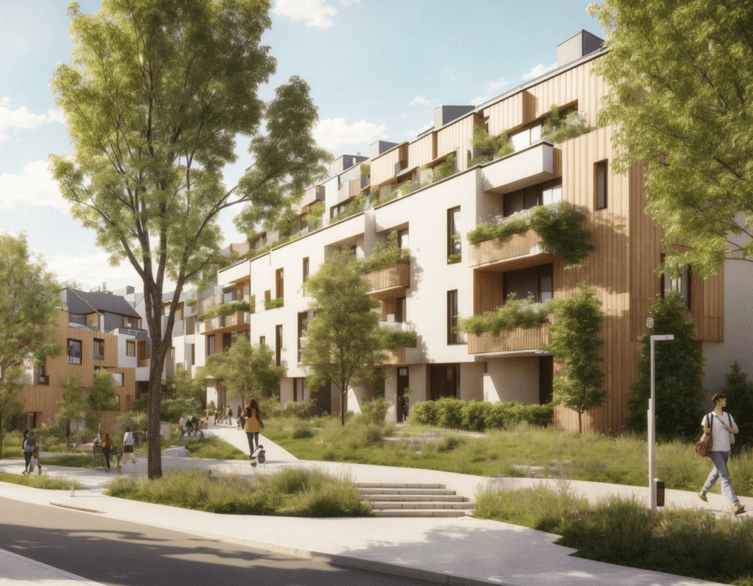
At its heart, the plan envisions not one homogeneous neighbourhood but six distinct sub-districts, each with its own character and identity, yet tightly connected by a thoughtfully designed network of public spaces, active ground-floor uses, and genuinely walkable streets. The jury particularly praised the way the design balances cohesion with variety — ensuring the new district feels like a real city neighbourhood rather than a sterile planned development built all at once.
Green infrastructure is central to the entire concept. The plan proposes three large parks and a north–south green corridor that will serve as the ecological and recreational backbone of the new district, complementing the spontaneous greenery that has grown on the site over the past three decades. A dedicated 15-hectare urban park is planned as the centrepiece, with an additional 10 hectares of smaller green spaces distributed throughout — bringing the total green surface to 25 hectares. Climate-adaptive solutions and water retention measures are built into the design from the ground up, making the district genuinely resilient to the increasingly hot and dry summers Budapest has been experiencing. The entire approach to mobility consistently prioritises pedestrians and cyclists, while sustainability is treated not as an add-on but as a founding principle running through every aspect of the plan.
The plan also applies the “15-minute city” principle, meaning that residents should be able to reach schools, kindergartens, care homes for the elderly, healthcare facilities, shops, and cultural venues entirely on foot or by bicycle within fifteen minutes from their front door. At least 20% of apartments are earmarked for subsidised affordable housing — a deliberate effort to ensure the new district doesn’t become an enclave for the wealthy but remains genuinely accessible to families of all backgrounds, young professionals, and older residents alike.
More Than Just Architecture
What makes this project genuinely notable — and worth knowing about even as a visitor — is the philosophy driving it. Budapest’s mayor Gergely Karácsony described the announcement as a historic milestone, noting that Budapest had not seen a project of this scale and ambition since the political transition of 1989–1990. The goal, he said, is to lay the foundation for a new golden age for Budapest — one that people will still remember in 150 years.
The project is framed explicitly as a response to two of the most pressing challenges facing the city: the housing crisis and climate change. Rákosrendező, in the mayor’s words, is partnership and professionalism over profit-chasing, and public interest over private gain — a transparent and regulated process that stands in deliberate contrast to what was previously proposed for the site. By building thousands of genuinely affordable homes in a green, well-connected new district, Budapest is hoping to slow the out-migration of young families to the suburbs and surrounding towns, while also future-proofing the city against the growing impacts of a changing climate.
What Happens Next
It’s important to note that the winning masterplan is not yet a final blueprint. The selected team will now spend the coming months refining their proposal in close collaboration with the jury’s technical recommendations before the comprehensive plan is formally adopted. The entire development is expected to unfold over roughly 30 years — which means patience will be required. That said, the city has made clear that it wants to open as much of the Rákosrendező area as possible to Budapest residents in the near term, even before large-scale construction begins.
Why Tourists Should Pay Attention
As a visitor to Budapest, you’re experiencing a city in the middle of a fascinating transition. The Rákosrendező project offers a glimpse of the direction Budapest is heading — towards a greener, more sustainable, more liveable urban future. When the first parks and public spaces begin to open on the site in the coming years, they will add yet another reason to explore the lesser-known northern and eastern parts of the city beyond the tourist trail. For now, the story of how Budapest fought to reclaim this land, rejected a glittering but soulless megaproject, and chose instead to build a genuinely human-scale neighbourhood is one of the most compelling chapters in the city’s recent history — and one well worth knowing as you walk its streets.
Related news
Budapest’s Rákosrendező: A Bold Vision for Sustainable Urban Living Takes Shape
Budapest is embarking on one of its most ambitious urban transformations in decades, and the world’s leading architecture firms are taking...
Rákosrendező: A Turning Point in Budapest’s Urban Development
In a significant move that could reshape the future of Budapest, the city’s General Assembly has voted to exercise its pre-emption right to...