Airbnb Ban in Budapest? What Foreign Tourists Need to Know About the New Rules
If you’re planning a trip to Budapest and were thinking of booking a cozy apartment in the city center, you’ve probably noticed some big changes in the local short‑term rental scene. In early 2026, Budapest’s 6th district (Terézváros) introduced a strict new rule: a complete ban on short‑term rentals in private apartments, effectively making most Airbnb‑style listings illegal in this popular part of town. But the story is more complicated than a simple “no more apartments” – and for tourists, it’s important to understand what this really means for your stay.
What Exactly Changed in Budapest’s 6th District
The heart of the change is in Terézváros, the district that covers much of the inner city between the Grand Boulevard and the Danube, including areas like Oktogon, Andrássy Avenue, and the Opera House. From 1 January 2026, the local government banned private individuals from renting out their apartments for short stays (like a few nights for tourists) in this district.
This means that if you’re looking at a listing for a one‑bedroom flat in Terézváros, it’s no longer allowed to operate as a classic Airbnb unless it’s officially registered as a hotel, guesthouse, or hostel. The goal, according to the district, is to protect housing for locals and reduce the pressure on residential buildings from constant tourist traffic.
However, this ban doesn’t mean that short‑term rentals have disappeared from the area. Instead, they’re changing shape. Big operators who own many apartments are converting entire buildings or floors into licensed guesthouses, hostels, or small hotels. So while the classic “one apartment, one host” Airbnb model is being pushed out, you’ll still find plenty of short‑term accommodation – it just looks more like a proper hotel or hostel now.
Best deals of Budapest











How This Affects Tourists
For foreign visitors, the main practical impact is that the type of apartment you can book in the city center is shifting. In Terézváros, you’ll see fewer private flats and more professionally run guesthouses, boutique hotels, and hostels that operate under proper tourism licenses.
This isn’t necessarily a bad thing. Licensed guesthouses and small hotels often mean:
- Clearer rules and standards (cleanliness, safety, noise, etc.).
- More reliable check‑in and support (a reception desk or manager instead of a host who might not be on site).
- Easier access to tourist information, luggage storage, and sometimes breakfast or other services.
At the same time, some of the charm of staying in a real local apartment – with a host who can give you personal tips and a more “homey” feel – is becoming harder to find in the very center. If that kind of experience is important to you, it’s worth looking slightly outside the strictest zones, in neighboring districts like the 7th, 8th, or 9th, where short‑term rentals are still allowed under certain conditions.
Where You Can Still Book Apartments in Budapest
Budapest is a big city, and the Airbnb‑style ban only applies to the 6th district. In other central districts, you can still book private apartments, but with some local rules:
- In several districts, there’s a limit on how many days per year an apartment can be rented out (often around 180 days).
- Many listings are now clearly marked as “guesthouse” or “hostel” rather than a private home, to stay on the right side of the law.
- Some hosts are moving to nearby areas like the 7th (Erzsébetváros), 8th (Józsefváros), or 9th (Ferencváros) districts, where the rules are a bit more flexible.
So if you’re searching for a place to stay, don’t worry – there are still tons of great options. Just keep in mind that in the very center, you’re more likely to end up in a small hotel or guesthouse than in a classic private apartment.
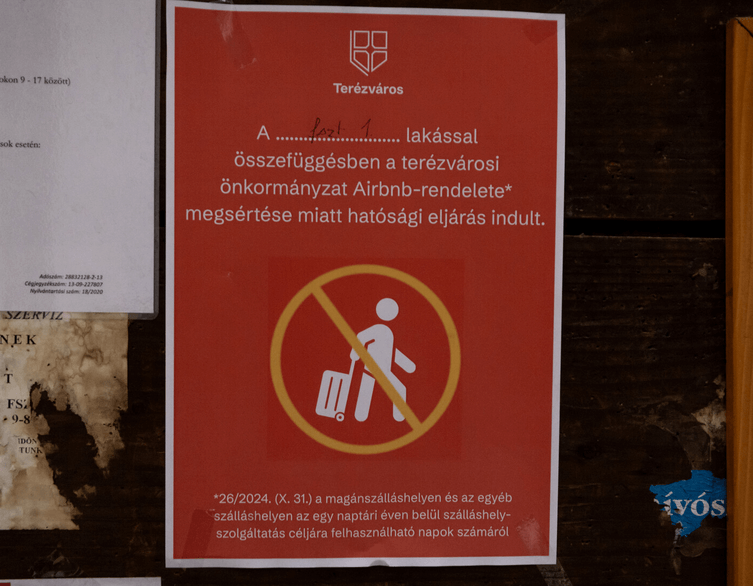
A Practical Tip: The Red Sign on the Door
If you’re walking around Terézváros and see a red sign posted on an apartment door, that’s a clear signal: the place is under official procedure because of the short‑term rental ban. These signs are placed by the district authorities when they start an enforcement action against an unlicensed short‑term rental.
For tourists, this means that any apartment with that red notice is not legally allowed to operate as a tourist rental, and booking there could be risky. It’s much safer to choose a place that’s clearly a licensed guesthouse, hotel, or hostel, or to look for apartments in districts where short‑term rentals are still permitted under local rules.
Why the Ban Exists – and What’s Being Proposed Instead
The local government argues that the ban is needed to protect housing for locals and keep residential neighborhoods livable. In recent years, many central Budapest buildings have been turned almost entirely into short‑term rentals, making it harder for ordinary people to find long‑term homes in the city center.
At the same time, the Hungarian association of apartment hosts is pushing back. They argue that a total ban is too harsh, especially for small operators – families or individuals who rent out one or two apartments to help make ends meet. Instead, they’re proposing a different solution: significantly increasing the tourism development contribution (a kind of tourism tax) that short‑term rentals pay, and using that extra money to help solve housing problems for young people and public sector workers.
This debate is still ongoing, and it’s possible that other Budapest districts will follow Terézváros with stricter rules. For now, though, the city as a whole still offers a wide range of accommodation, from luxury hotels and design guesthouses to hostels and private apartments in less central areas.
Tips for Booking Your Stay in 2026
To make sure your Budapest trip goes smoothly, here are a few practical tips:
- If you want to stay in the very center (around Andrássy Avenue, the Opera, or Oktogon), focus on licensed guesthouses, small hotels, and hostels rather than private apartments in Terézváros.
- If you prefer a more local, apartment‑style experience, look in districts like the 7th (Jewish Quarter), 8th, or 9th, where short‑term rentals are still allowed under local rules.
- Always check that your accommodation has a clear address and a proper contact – this is especially important if something goes wrong with your booking or stay.
- Consider staying near a metro or tram line. Even if you’re not right on the Grand Boulevard, being close to public transport makes it easy to reach all the main sights.
The Big Picture: Budapest Is Still Very Tourist‑Friendly
Despite the new rules, Budapest remains an incredibly welcoming city for tourists. The ban in Terézváros is really about managing the balance between tourism and local life, not about pushing visitors away. In fact, the city is investing heavily in tourism infrastructure, from new hotels and guesthouses to better public transport and cultural events.
So while the way you book your stay might look a bit different in 2026, the experience of exploring Budapest’s beautiful streets, thermal baths, ruin bars, and Danube views is still as magical as ever. With a little planning, you can find a comfortable, well‑located place to stay and enjoy everything this vibrant capital has to offer.
Related news
How Budapest’s Airbnb Rules Are Changing – What Tourists Need To Know
Budapest is famous for its romantic riverside views, ruin bars and grand cafés – but for many visitors, short‑term rentals like Airbnb have...

Airbnb Ban Comes into Effect in Budapest’s District VI: What Tourists Need to Know
As of January 1, 2026, the central district of Terézváros — one of Budapest’s busiest and most popular areas among tourists...
Budapest’s Airbnb Ban: A Controversial Move to Preserve Residential Life
In a bold move to tackle the growing concerns of “touristification” and the housing crisis, Budapest’s 6th district, Terézváros,...