The Concert That Keeps Growing: Budapest’s System-Breaking Grand Concert at Heroes’ Square
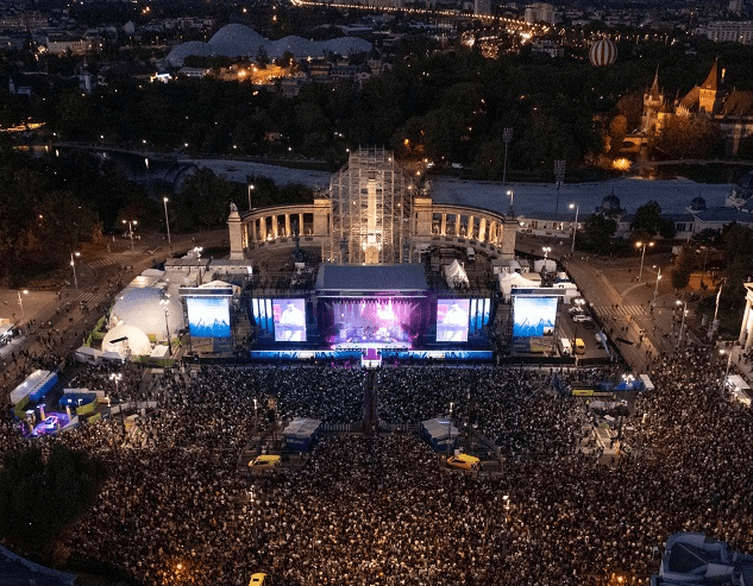
If you happen to be in Budapest on the evening of Friday, April 10, 2026, you are about to witness something that goes well beyond an ordinary open-air music event. The System-Breaking Grand Concert — Rendszerbontó Nagykoncert in Hungarian — is a massive, free outdoor concert taking place at Heroes’ Square, just two days before Hungary’s parliamentary elections. What began as an ambitious idea with an uncertain future has rapidly snowballed into one of the most talked-about cultural events Hungary has seen in a generation: the lineup keeps growing, the funding has already surpassed its initial goals, and the crowd expected to turn up on April 10th could number in the hundreds of thousands.
From Idea to Phenomenon
The concert is organised by the Civic Resistance movement, a Hungarian civil society initiative co-founded by public intellectual and cultural critic Róbert Puzsér and presenter Tóth Jakab, who will also host the evening. The movement describes its mission as channelling popular civic discontent through the power of culture, and in their own words: “What is culture today will be politics tomorrow, and history teaches us that the pen is mightier than the sword.” The concert, they explain, is designed to give voice to sixteen years of accumulated frustration through music — with each performer taking the stage to perform a single system-critical song.
When the event was first announced, the organisers were immediately transparent about the financial challenge: they had no corporate sponsors, no state support, and no ticket revenue. Every forint needed to build the stage, install the sound system, and erect the LED screens would have to come from the public. Donations were directed through the Tudatos Választókért Foundation, and what happened next surprised even the most optimistic organisers. Within just ten days of the announcement, more than ten thousand individual donors had contributed a combined total of 46 million Hungarian forints — enough to fully secure the venue, the professional sound infrastructure, and a concert experience for the roughly 80,000 people that Heroes’ Square can comfortably hold.
The Lineup That Keeps Expanding
Perhaps the most striking aspect of the concert’s story is how the lineup has grown in waves, with new names being added in batches every few days as more and more artists chose to join the cause. The first announcement already included some of Hungary’s biggest names, but the roster has since expanded dramatically through multiple rounds of additions — each one generating fresh media coverage and a new surge of public excitement.
The concert now features more than forty Hungarian artists spanning virtually every genre. Azahriah — widely regarded as one of the biggest and most exciting young music stars in Hungary right now — was among the first confirmed performers, alongside indie rock favourites Ivan and the Parazol. The legendary Quimby, whose decades-long career has made them one of the most beloved bands in the country, will also take the stage, as will the iconic post-punk veterans Európa Kiadó and the psychedelic institution Anima Sound System — names that carry enormous weight for older Hungarian audiences. The arrival of Beton.Hofi and Krúbi cemented the concert’s credentials across the hip-hop world, while Carson Coma members Héra Barnabás and Bóna Zsombor brought the alternative rock fanbase on board. Folk, cabaret, and spoken word are represented by Laár András and Kardos-Horváth János. Further additions — Dzsúdló, Galaxisok, Elefánt, Funktasztikus, Felső Tízezer, Co Lee, Killakikitt, Sickratman, Tha Patkányz, NKS, Saiid, HRflow, G Ras, Peety, Bankrupt, Filo, Chandler B., Detto, Fucky & Fekete Kobra, Nyers, Mudfield, Bongor, Kozmosz, Sisi, Mehringer Marci, Központi Hatalom, Keleti András, Füstös, NB feat. LoT, Brumiko, Imre Fia Imre, Puszi Együttes, Pajor Tamás, 6363, Molnár Tamás, Dé:Nash, Hétköznapi Csalódások, and Mikee Mykanic — have since completed the roster.
Best deals of Budapest






Not a single one of them is being paid. Every artist confirmed their participation voluntarily and for free — a detail that has been widely noted in Hungarian media as a remarkable statement of collective solidarity rarely seen on this scale.
Going Beyond the Square
With the basic costs covered and public enthusiasm showing no signs of slowing, the organisers announced an ambitious expansion plan. Heroes’ Square itself holds around 80,000 people, but the volume of people signalling their intention to attend — through social media, event RSVPs, and direct messages to the organisers — made it clear that demand would far exceed that number. The team is now working to extend the concert experience outward along two of Budapest’s most spectacular thoroughfares: Andrássy Avenue, the grand UNESCO-listed boulevard lined with neoclassical palaces, and Dózsa György Road. Achieving this requires additional stages, more LED screens, and extended sound systems — all of which depend on continued crowdfunding support in the weeks leading up to the event. The stated ambition is explicit: to create not just a concert, but a genuinely historic shared presence where not tens of thousands but potentially hundreds of thousands of people stand together in the same city space at the same moment.
A Venue Steeped in History
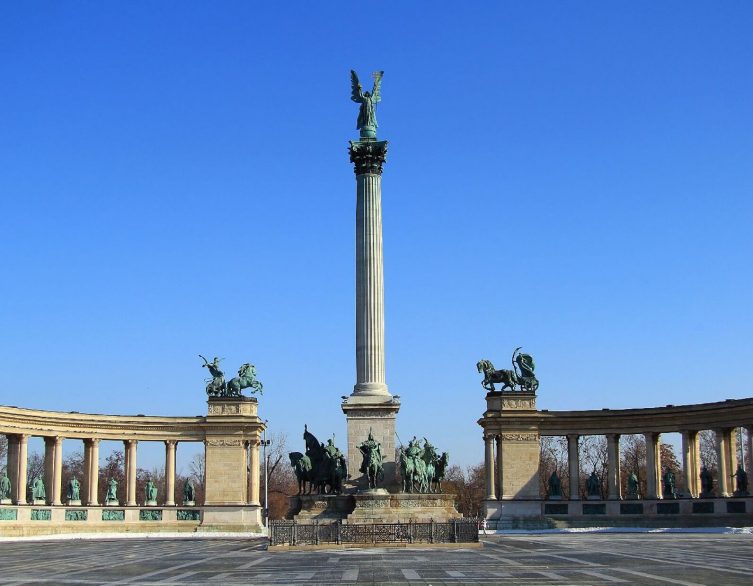
The choice of Heroes’ Square as the venue is loaded with meaning that every visitor to Budapest can appreciate. Built in 1896 to mark the thousand-year anniversary of the Hungarian conquest of the Carpathian Basin, the square is anchored by a soaring 36-metre column topped by the Archangel Gabriel, flanked by two sweeping colonnades featuring statues of Hungary’s most revered historical figures — from King Stephen I, the founder of the Christian Hungarian state, to the revolutionary hero Lajos Kossuth. The square is a UNESCO World Heritage Site and one of the most visually dramatic public spaces in Central Europe.
It has historically been the stage for Hungary’s most defining public moments. On June 16, 1989 — in one of the pivotal scenes of the fall of communism in Central Europe — hundreds of thousands of people gathered here for the reburial of Imre Nagy and the martyrs of the 1956 revolution, in a ceremony that effectively announced the end of one-party rule. That history is not lost on the organisers, who have been deliberate and precise about their choice of location.
Getting There and What to Expect
The concert runs from 5:00 PM to 10:00 PM, admission is completely free, and no ticket or registration is required — simply show up. Heroes’ Square is one of the easiest locations in Budapest to reach by public transport. Metro Line 1, the iconic yellow line and one of the oldest underground railways in Europe, stops directly at Hősök tere station just steps from the square. Trams and buses also serve the area from multiple directions, and Andrássy Avenue offers a magnificent 20-minute walk from the city centre at Deák Ferenc Square.
Even for visitors who are in Budapest purely for tourism and have no particular stake in Hungarian politics, the prospect of standing at one of Europe’s most beautiful squares, surrounded by potentially hundreds of thousands of people, while a parade of the country’s best-loved musicians perform one after another under the open sky — that is an experience worth rearranging a travel itinerary for. Heroes’ Square is flanked by the Museum of Fine Arts on one side and the Hall of Art on the other, with City Park, Széchenyi Thermal Bath, and Vajdahunyad Castle all just a few minutes’ walk away. On the evening of April 10th, all roads in Budapest will lead here.
Related news
Related events
Related attractions