Budapest’s Citadella Is Finally Back — And It’s Better Than Ever
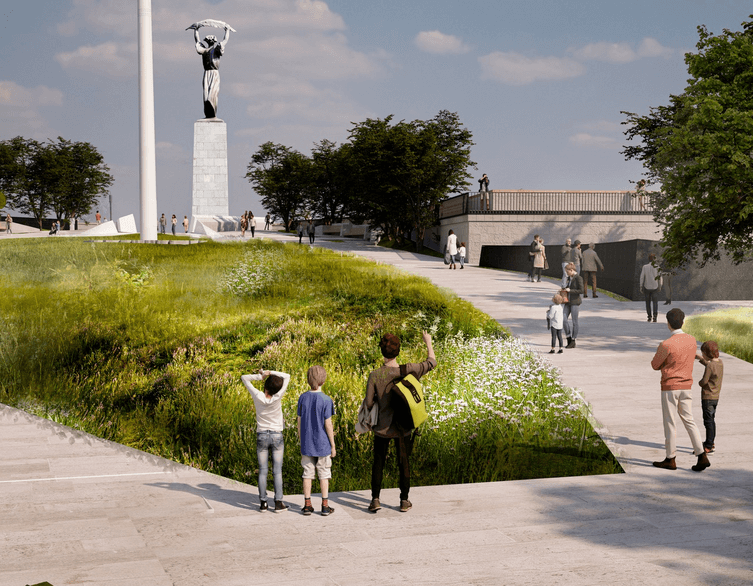
There are moments in a city’s life when something long dormant suddenly wakes up and reminds everyone why it mattered in the first place. Budapest is having one of those moments right now. After years behind scaffolding and construction fences, the Citadella — one of the most recognizable silhouettes on the Budapest skyline — is reopening on March 28, 2026. And if you thought it was just a quick spruce-up, think again. What’s coming back is something entirely new.
A Fortress That Refused to Be Forgotten
Perched on top of Gellért Hill, the Citadella has loomed over Budapest for over 170 years. It was built from 1850 onward by the Habsburg imperial army, constructed on the ruins of an old observatory, and completed in 1854 — a deliberate show of military dominance following the brutal suppression of the 1848–49 Hungarian Revolution. The cannons pointed not outward at foreign enemies, but downward at the city itself. Budapest’s own people looked up at it with a mixture of awe and resentment.
The military eventually left in the late 19th century, and for decades the fortress drifted through various identities — a partially visited tourist attraction, a place with a hotel and a restaurant that never quite lived up to its spectacular setting. Parts of it fell into disrepair. It was loved for its views, tolerated for its condition, and widely felt to be wasted potential. Locals argued for years about what to do with it, some even calling for it to be demolished. None of the plans ever came to fruition.
Then, in 2020, the excavators moved in.
Six Years in the Making
The transformation that followed was no ordinary renovation. As part of the National Hauszmann Program — the same state initiative behind the reconstruction of the Royal Palace and the surrounding Buda Castle District — the Citadella was reimagined from the ground up. Archaeological excavations first, then full-scale construction from 2021, all of it a state investment managed by Várkapitányság Zrt.
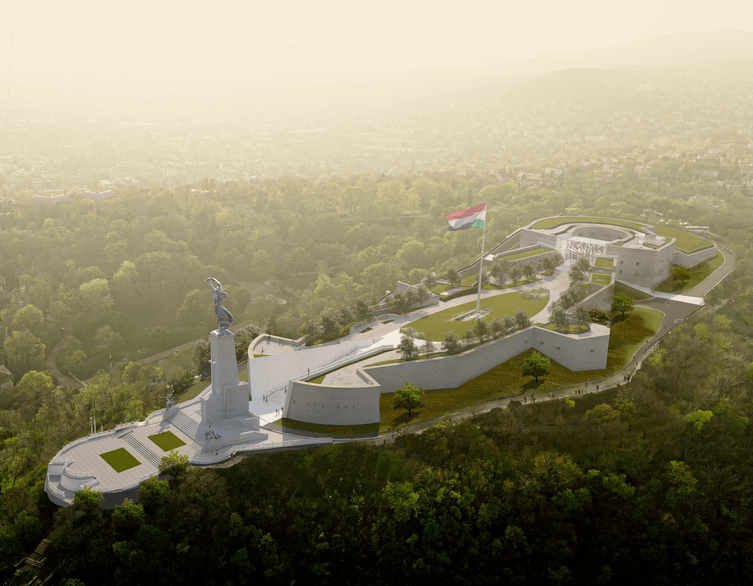
The most symbolic change? The fortress was literally opened up. The old Citadella had a single entrance and felt closed off, almost hostile to visitors. The new one has been cut through at three points, creating open passageways that invite people in rather than keeping them out. One of the most dramatic new approaches is a long, sweeping, snow-white staircase that rises up from the Liberty Statue side of the hill — a grand entrance worthy of the view that awaits at the top.
The total green area created or renovated around the site comes to an impressive 20,000 square meters, and lifts have been installed to make the whole site fully accessible to everyone.
Best deals of Budapest







Step Inside: What’s Waiting for You
Walking through the gates of the newly opened Citadella, the first thing that hits you is the park. Right in the center of the fortress, where military drills once took place, there is now a 6,000 square meter public park — and it’s free to enter during opening hours, every single day of the year. It’s been planted with flower meadows, roses, lavender, climbing plants, and even grapevines, with the planting scheme carefully designed to offer a different look in every season. Come in spring for the blossoms, in summer for the full green canopy, in autumn for warm colors, in winter for the clean architectural lines.
At the heart of the park stands a 36-meter mast flying a 72 square meter national flag — Hungary’s largest national flag, no less. It’s an unmistakable statement, visible from large parts of the city below.
Around the park, the former courtyard now houses a café, an ice cream shop, and a gift shop, so you can easily spend a full afternoon here without rushing. And in the former rondella courtyard, a beautiful reflective pool has been created, with an eternal flame burning at its center — a quietly powerful symbol of memory and freedom.
The View You’ve Been Waiting For
Let’s be honest: a big reason people have always climbed Gellért Hill is the view. The renovated Citadella delivers on this in a serious way. There are now multiple dedicated viewpoints built into the fortress walls, each offering a different slice of Budapest:
- The northern bastion frames Elizabeth Bridge and Margaret Island
- The eastern bastion looks out toward Liberty Bridge and the sweeping curve of the Danube
- The southern bastion gives you views toward the Kelenföld district
And then there’s the crown jewel: the Tetőkert 360 rooftop garden terrace, which does exactly what it says — a full 360-degree panorama of the entire capital from the very top of the fortress. There’s also the Rondella terrace, facing directly toward the Royal Palace (Buda Castle), giving you one of the most postcard-perfect views in the city.
The Bastion of Freedom — A History Exhibition Unlike Any Other
The Citadella’s headline attraction is a permanent exhibition called A Szabadság Bástyája — The Bastion of Freedom — and it’s housed in the old cannon tower, the rondella, across a staggering 1,700+ square meters of exhibition space. This is not your typical “display case and information panel” history museum. It’s cinematic, immersive, and built to make you feel something.
The exhibition covers 13 centuries of Hungarian history, from the Magyar conquest of the Carpathian Basin in the 9th century all the way through to the fall of communism and the democratic transition of 1989. That’s a lot of ground to cover — and the curators have found an inspired way to do it.
Meet Your Guide: Emese
The narrator leading you through this entire journey is Emese — the mother of Álmos, the legendary founding ancestor of the Hungarian ruling dynasty, whose dream is said to have foretold the Magyar migration westward. In the exhibition, Emese recounts 1,300 years of history as if it were her own unfolding vision. It’s an unusual, poetic choice, and it gives the whole experience a mythological depth that a conventional audio guide simply couldn’t achieve.
Room by Room: What You’ll See
Each room of the exhibition is a world unto itself. A few standout moments:
In the medieval section, a striking installation fills the room with the contours of historical Hungary — the vast Carpathian Basin territory of the Kingdom of Hungary, rendered in a way that makes the scale of medieval ambition viscerally real.
In another room, King Matthias Corvinus appears on a white horse in a monumental painting, surrounded by decor evoking Renaissance architecture — a reminder that 15th-century Hungary was one of the cultural powerhouses of Europe.
The 1848–49 Revolution and War of Independence is given the full treatment, with the great figures of that era gathered together. Among them is Mária Lebstück, also known as Lieutenant Maria — a young woman who disguised herself as a man and fought in some of the fiercest battles of the war. Her inclusion here is long overdue recognition.
The 1956 uprising is evoked through the Corvin Passage, one of the most famous flashpoints of the revolution, with the Russian-language inscription “Пошли домой!” (“Go home!”) painted on the wall — a moment that will stop you in your tracks.
The Central Idea
The philosophical thread running through the entire exhibition is the hill itself. As the curators put it: “whoever controlled the hill, controlled the country.” Over the centuries, a cross marked Christian Hungary, then a mosque marked Ottoman occupation, then a Habsburg fortress, then a Soviet monument — each one a signal of who held power. The exhibition uses the Citadella’s own layered history as a lens through which to understand Hungary’s story. It’s a clever and genuinely moving concept.
The Liberty Statue in a New Light
Standing on the eastern wall of the Citadella, gazing out over the city, is the Liberty Statue — one of Budapest’s most beloved and most debated monuments. Designed by sculptor Zsigmond Kisfaludi Strobl, it was unveiled in 1947 as a tribute to the Soviet liberation of Hungary in 1945. After the 1989 transition, the Soviet-era symbols were removed, but the statue itself remained, becoming simply one of the most photographed landmarks in the city.
With the fortress walls now open and the freedom-themed exhibition at its core, the Liberty Statue has been consciously woven into the Citadella’s new narrative — standing not as a relic of occupation, but as part of a broader, more complex story about freedom and the struggle to achieve it. It’s a recontextualization that will spark conversation, and that’s no bad thing.
Also worth noting for the detail-obsessed: embedded in the courtyard near the Liberty Statue side is a geodetic main reference point — a bronze strip set in a circular metal casing in the ground. It may sound technical, but it marks the exact reference point from which Hungary’s entire geographical measurement network was historically calculated. The original point stood near the cannon tower, but was relocated during construction to the spot where the 1848 observatory once stood before it was demolished to build the fortress. History is literally underfoot.
Opening Weekend: How to Make the Most of It
The Citadella opens officially on March 28, 2026. The public park, viewpoints, café, and gift shop are all free to enter during opening hours from that day onward — no ticket, no registration needed.
Then comes the opening weekend proper: from March 29 to 31, The Bastion of Freedom exhibition and the Tetőkert 360 rooftop terrace are free to visit — but demand has been enormous. Pre-registered time slots have already filled up quickly. However, a limited number of free walk-in tickets will be available on the day at the entrance, so if you’re in Budapest that weekend, it’s absolutely worth turning up early and trying your luck.
From April 1, tickets for the exhibition go on sale both online and at the site entrance.
Why This Matters
Budapest has no shortage of historic landmarks, but the Citadella’s reopening feels different. This isn’t just a restored building — it’s a completely rethought public space, one that has taken a fortress that once symbolized oppression and turned it into somewhere open, welcoming, and genuinely thought-provoking. The combination of free parkland, spectacular panoramas, accessible design, and a world-class exhibition makes it one of the most well-rounded new attractions the city has seen in years.
If you’re visiting Budapest this spring, March 28 is your date. Get up that hill.
Related news
Citadella Reopens Soon: Electric Buses Transform Buda Tours in Budapest
Budapest’s Buda side is gearing up for smoother adventures with the Citadella reopening soon and eco-friendly buses replacing big tour coaches....
Budapest’s Citadella Returns: The Untold Story Behind 11 Years of Closure
One of Budapest’s most iconic yet mysterious landmarks is finally returning to the public after more than a decade in seclusion. The Citadella,...
Budapest’s Citadella Set for a Green Transformation by 2026
The iconic Citadella fortress in Budapest is undergoing a major renovation that promises to transform it into a greener, more accessible urban oasis...
Related events