Budapest’s Nightlife Under Pressure: What Tourists Need to Know About the Club Closures
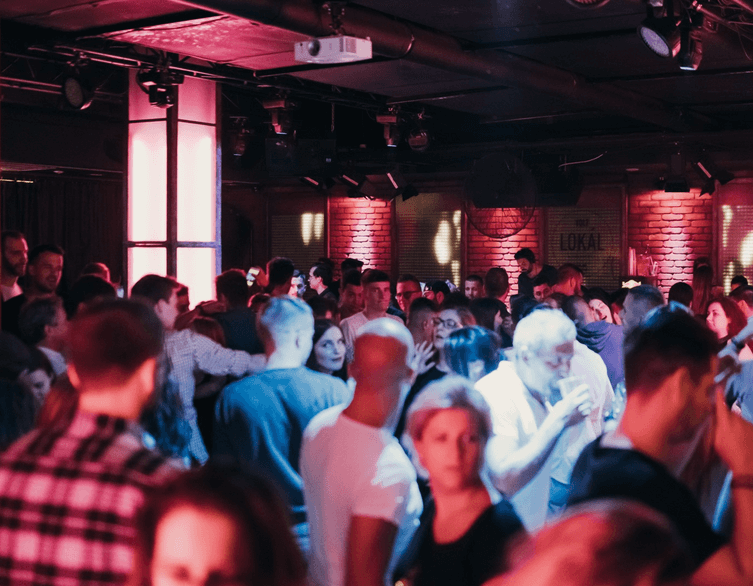
Budapest has long been celebrated as one of Europe’s great nightlife cities. From the world-famous ruin bars of the Jewish Quarter to underground techno clubs and grand concert venues, the city has built a reputation for vibrant, creative nocturnal culture that draws visitors from all over the world. But in early 2026, that culture found itself at the centre of a heated political and social debate — one that spilled into the streets in the form of music, protest, and a community refusing to go quietly.
A Closure That Shook the Scene
On the morning of March 4, 2026, police ordered the closure of Turbina Cultural Center, a beloved arts hub in Budapest’s 8th District, for a period of one month. The reason given was a verbal allegation made in a separate legal procedure — a claim that an illegal substance had been purchased at the venue. Notably, police had conducted weeks of undercover surveillance at Turbina beforehand, during which no violations were identified and no action was taken. Despite this, the closure was enforced almost overnight, stunning Turbina’s management and the wider cultural community.
Turbina’s owner, Papp László, told Hungarian outlet Telex that they had never been formally notified of any drug-related activity at the venue, and that their security team would have intervened immediately had anything suspicious been detected. The management filed an appeal arguing that the decision rested on weak, indirect evidence — specifically, the testimonies of individuals who may have had their own reasons to deflect responsibility — and is also exploring legal action for defamation and reputational damage.
Turbina is not just a nightclub. Founded in 2021, it is a multifunctional cultural space hosting club nights, film screenings, workshops, exhibitions, science symposia, and community events, employing over 100 people. Its sudden closure meant not only lost revenue but a month of acute uncertainty for everyone whose livelihood depends on the venue — from security staff to artists and freelancers.
A Pattern of Closures: Eight Venues and Counting
What made the situation particularly alarming was that Turbina was not an isolated case. It was in fact the eighth Budapest venue to be forcibly closed under Hungary’s revised drug legislation since December 2025. The law in question — a reinforced version of Act LXXV of 1999 — grants police the power to close any establishment deemed connected to drug trafficking or facilitation for up to three months, and potentially up to a full year. The threshold for “connection” is breathtakingly broad: a claim made in a separate legal procedure, not necessarily involving a confirmed incident inside the venue, can be sufficient to trigger a shutdown.
Earlier in 2026, Arzenál in Ferencváros was ordered shut on February 27, and Symbol Event Hall in Óbuda was closed for two months on February 19 following what authorities described as an international drug trafficking investigation involving a joint Hungarian-Polish operation. And in November 2025, a mass raid at DOJO club saw 211 young people searched, 49 detained — and just 16 testing positive for drug use, a strike rate that speaks volumes about the proportionality of these operations.
The legislation underpinning all of this traces back to April 2025, when the Hungarian government introduced what was widely described as the country’s strictest-ever drug laws. A constitutional amendment was passed embedding a blanket ban on drugs — including the vaguely worded prohibition of drug “promotion” — directly into Hungary’s Fundamental Law. Drug possession, even of a single joint, now carries a potential criminal sentence of up to two years in prison.
The Protests: Taking It to the Streets
The response from Budapest’s cultural community has been both swift and powerful, unfolding in three distinct waves of public action.
The first major demonstration took place in late November 2025, when the raid on DOJO triggered a protest in front of the Hungarian Parliament on Kossuth Square. Known as Dance for Freedom (Tánc a Szabadságért), it brought together clubbers, musicians, venue operators, and civil society organisations demanding a rational drug policy and an end to what they saw as the systematic harassment of nightlife culture. It was one of the most striking acts of cultural defiance the city had seen in years.
Best deals of Budapest







A second wave of protest came in late February 2026 following the closure of Arzenál and Symbol, when demonstrators gathered again at Kossuth Square, the symbolic heart of Hungarian civic life, to voice their opposition to the escalating crackdowns. By this point, the sense of unease across the entire cultural sector had hardened into something more urgent.
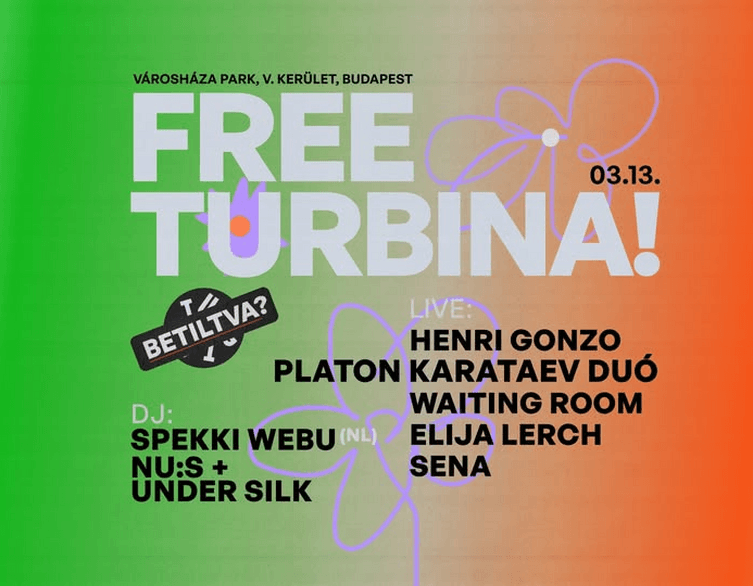
The third and most visible moment came on Friday, March 13, 2026, when thousands of people filled City Hall Park (Városháza Park) in the heart of central Budapest for the Free Turbina concert-protest. Running from 4:00 PM to 10:00 PM and free to attend, the event was organised around live music and set a tone that was warm, inclusive, and defiant without being aggressive. Performers took to the stage not just in support of one venue, but in defence of a whole way of life that Budapest has built and nurtured over decades. The park sits just a short walk from Deák Ferenc Square metro station, and the turnout underlined just how broadly and deeply these closures have resonated across the city.
The City Leadership Pushes Back
Budapest’s Lord Mayor, Gergely Karácsony, voiced his support publicly in the lead-up to the March 13 protest, writing that while drug use is indeed a problem for the city, long-term solutions cannot be achieved without reducing demand — and that requires properly funded healthcare and social services, not venue closures. He argued that the government’s approach amounts to little more than performative politics, imposing enormous burdens on nightlife businesses while having virtually zero impact on the actual distributors of illegal substances.
Rights advocates have gone further, pointing out that Hungary has no functioning national drug strategy — the last one expired in 2020 and has not been renewed. State funding for drug services has reportedly collapsed by an estimated 90% since 2010, and Budapest’s needle exchanges were shut in 2022. The infrastructure of harm reduction, the evidence-based foundation of any genuine public health approach to drug policy, has been systematically dismantled. What has replaced it, critics argue, is spectacle: dramatic, visible crackdowns that generate headlines but leave the underlying social problem entirely untouched.
The Budapest Safe Nightlife working group, established in 2025, represents a more constructive alternative. Bringing together local district representatives, venue operators, and harm-reduction professionals working in the field, the group has developed online training resources to help venue staff handle drug-related situations effectively — a practical, collaborative approach standing in stark contrast to the blunt instrument of closure orders.
What the Venues Are Saying
Akvárium Klub, one of Budapest’s most prominent concert venues located on Elizabeth Square in the city centre, released a measured but clear public statement addressing the crisis. The club confirmed that its programme continues to run as planned and that it has been offering its stage to productions and organisers left without a venue due to the closures of partner clubs. But it went further, articulating what many in the industry feel: venue operators have no effective tools to prevent drug use on their premises, and no club or concert hall knowingly tolerates or assists in drug-related activity.
Perhaps most powerfully, Akvárium pushed back against the narrative being cultivated in some quarters of the media and government — that clubs and concert venues are somehow dangerous or criminal places. The opposite, they argued, is the truth. These are controlled environments with strict security, professional staff, and carefully managed entry systems. Statistically, guests are far safer inside a well-run venue than they are out on the streets or in unregulated spaces.
Budapest Park, another major concert venue and one of the city’s most prominent outdoor stages, added its voice with a stark warning: international artists, promoters, and tourists are already paying attention. Tourism and the live music industry are highly sensitive to signals like these, and if Budapest develops a reputation for hostile or unpredictable cultural regulation, visitors and performers will simply choose other cities. Amsterdam was cited as a positive model — a city where close cooperation between authorities and cultural venues has produced a nightlife scene that is both genuinely safe and creatively thriving.
What This Means for Visitors
If you’re travelling to Budapest and planning to experience its legendary nightlife, the good news is that most major venues — including Akvárium Klub, Budapest Park, and the famous ruin bars of the Jewish Quarter — remain open and operating. The situation is fluid, however, and it is worth checking a venue’s social media or website before heading out, as the current legal framework means closures can happen quickly and without much public warning.
Beyond the practical advice, there is something worth understanding as a visitor: Budapest’s nightlife is not merely entertainment. It is a living part of the city’s identity — a space where music, art, community, and creativity intersect, and where a great deal of the city’s cultural energy is generated. The debate currently unfolding is about what kind of city Budapest wants to be, and the overwhelming response from Budapestians themselves — on Kossuth Square in November, in front of Parliament in February, and at City Hall Park in March — has been one of fierce pride in their cultural life and a clear refusal to see it dismantled without a fight. When you step into a Budapest club or concert venue, you are stepping into something that the city’s residents are actively and loudly defending. That makes the experience all the more worth having.
Related news
Free Turbina: Budapest’s Cultural Community Fights Back
Budapest has always been a city that pulses with creative energy — from its ruin bars and underground art spaces to its world-class concert halls...

Budapest Nightlife Update: What Tourists Should Know About Recent Club Closures
If you’re coming to Budapest for its famous nightlife, you’ve probably heard the same promise from friends, bloggers, and taxi drivers: this...