Budapest’s Most Spectacular Free Exhibition: The World’s Most Expensive Zsolnay Ceramics Are on Display Right Now
If you’re visiting Budapest this spring and looking for a cultural experience that is both completely free and genuinely jaw-dropping, look no further than Falk Miksa Street. Tucked into one of the city’s most celebrated gallery districts, the Virág Judit Gallery is currently hosting what many are calling the finest Zsolnay exhibition Budapest has seen in years — and it’s open to everyone until April 19, 2026.
A Street Worth Finding
Falk Miksa Street, often nicknamed “the street of galleries,” runs parallel to the Danube in Budapest’s 5th district, just a short walk from the Hungarian Parliament building. It is the go-to address for anyone interested in fine art, antiques, and collectibles, lined with prestigious galleries, auction houses, and boutique dealers selling everything from Baroque furniture to Art Nouveau jewellery. In this already exceptional setting, the Virág Judit Gallery at number 30 stands out as one of the most respected names in Hungarian fine art commerce. Right now, it is also home to something truly extraordinary.
Best deals of Budapest









Three Decades of Passion, Finally Unveiled
For the first time ever, the general public can step inside and admire the private Zsolnay collection assembled over thirty years by gallery co-owners Judit Virág and her husband, István Törő. The exhibition presents over 120 Art Nouveau masterpieces selected from a private collection that numbers several hundred pieces. Törő began collecting Zsolnay ceramics in the early 1990s, after years spent acquiring paintings and coins, and what started as a personal passion gradually evolved into one of the most significant Zsolnay collections in the world.
As Törő himself puts it with characteristic candour: “Two things I have regretted: the ceramics I didn’t buy, and the ones I later sold.” His collecting journey took him across Europe and the Americas, acquiring pieces from major private collections in Vienna, New York, and beyond, and actively buying from European and American auction markets from the 2000s onward. The result is a collection that showcases the Zsolnay factory’s Art Nouveau period at its absolute peak.
What Is Zsolnay, and Why Does It Matter?
To understand why this exhibition is generating such excitement, it helps to know a little about the Zsolnay story. The Zsolnay Porcelain Factory was founded in Pécs, southern Hungary, in 1853, and underwent a transformative shift when Vilmos Zsolnay took over leadership in the 1860s. Under his direction, the factory pivoted away from everyday stoneware toward highly artistic ceramics, experimenting with innovative glazes and sculptural techniques that would soon make the Zsolnay name famous across Europe and beyond.
The factory’s crowning technical achievement was the development of the eosin glaze — an iridescent, metallic-shimmering surface finish that remains extraordinarily difficult to reproduce even today. Every single piece catches the light differently; no two are ever exactly alike. This, combined with the fact that the finest Zsolnay pieces were produced in tiny quantities or as unique works during the Art Nouveau era, makes surviving examples genuinely rare. Ceramics are fragile by nature, and many pieces were simply lost to time, which means that what has survived is automatically scarce and precious.
The factory also played a starring role at the great world’s fairs of the late 19th and early 20th centuries, where its showpiece ceramics were received as sensations by international audiences. Those exhibition pieces are now among the most coveted items on the global art market.
From Pennies to Six Figures: The Market Boom
The story of how Zsolnay ceramics went from being virtually overlooked to commanding stratospheric prices at auction is a fascinating one. In the 1970s and 80s, collectors in Hungary began rediscovering Art Nouveau, but demand at home was still modest, and many of the finest pieces quietly migrated to Western Europe and North America where collectors were willing to pay for them.
The tide turned decisively in the early 2000s, when a new generation of affluent Hungarian collectors entered the market and began repatriating masterworks back to Hungary. Today, Törő estimates that roughly 70 percent of the great Zsolnay collections are once again held in Hungary. The Virág Judit Gallery played an active role in this shift: in 2018, it organised the world’s first auction dedicated exclusively to Zsolnay ceramics, a milestone that attracted bidders from across Europe and from overseas. By 2025, top pieces were regularly exceeding 100,000 US dollars at auction, with several works finding buyers above 20 million Hungarian forints — including a monumental jardinière that sold for 26 million forints. As Törő notes, finding truly outstanding quality on the open market is becoming harder by the year.
The reasons for this appreciation are not hard to identify. Technical innovation, artistic quality, historical significance, world fair prestige, and a self-reinforcing auction market all feed into each other. The more expensive Zsolnay becomes, the more desirable it is — a virtuous cycle for collectors fortunate enough to have acquired early.
The Star of the Show: A Lost Masterpiece Found in a Restaurant
Among all the treasures on display, one object commands the room before a single word of explanation is read. Greeting visitors right at the entrance is a monumental ceramic picture depicting the Virgin Mary with the infant Jesus — a work so large and so striking that it stops people in their tracks the moment they walk in.
What makes this piece almost unbelievably special is its origin story. The ceramic was designed by János Vaszary (1867–1939), one of the most celebrated Hungarian painters of the turn of the 20th century, and produced at the Zsolnay factory in Pécs in 1902. Shortly after its creation, it disappeared entirely from the historical record — until it turned up, inexplicably, in a restaurant in Szentendre, the charming artists’ town just north of Budapest on the Danube Bend. Nobody knows how it ended up there, or when.
István Törő spent considerable time and effort negotiating for the piece, eventually acquiring it and having it professionally restored for future generations. Given that Vaszary’s major paintings regularly fetch between 100 and 200 million forints at major Hungarian auctions, the art historical significance of this ceramic — a unique object, the only one of its kind — is simply incalculable.
Roses, Desire, and a Sculpture That Scandalized Society
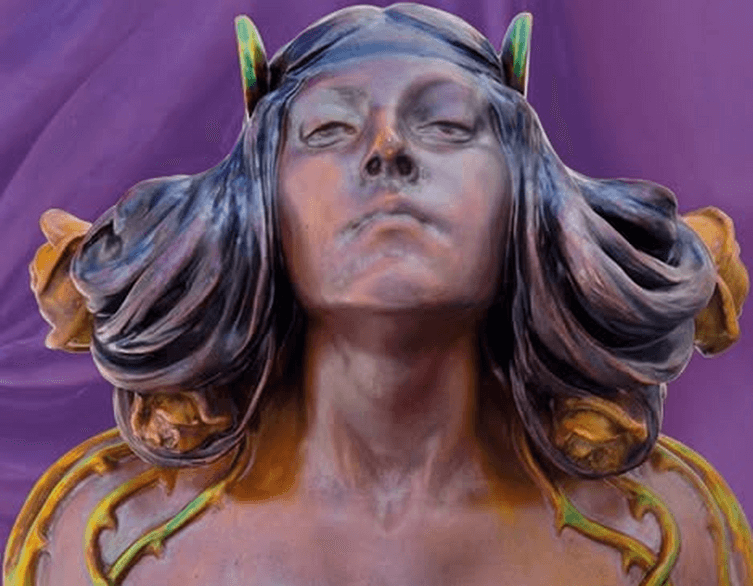
Another highlight that visitors consistently mention is a small but extraordinarily powerful sculpture called Scent of Roses (Rózsaillat). Designed by Sándor Apáti Abt and exhibited at the 1900 Paris World’s Fair, this erotic bust caused genuine shock at the time with its unabashed sensuality. The rose, as a symbol of love’s beauty, intoxicating fragrance, and painful thorns, is rendered here as a meditation on passion and suffering alike. It is, as collectors who dream of owning it will tell you, the kind of object that genuinely belongs in the canon of Art Nouveau sculpture — not merely decorative craft, but fine art at its most daring.
Tulip Vases, World’s Fair Giants, and a Forgotten Genius
The exhibition is rich enough that every visitor will find their own personal favourite. Twelve elegant tulip vases from the late 1890s — early, rare pieces dating from 1897 to 1899 — captivate audiences with their airy, colourful forms and their air of mystery, since the identity of their designers remains unknown. The variety of shapes and the breathtakingly bold decorative solutions make them crowd-pleasers every single time.
Also on display is the enormous exhibition vase originally presented at the Milan World’s Fair, a piece that encapsulates exactly why Zsolnay became a global name in the first place. These were the factory’s calling cards to the world — crafted to astonish, to demonstrate that a factory in provincial Pécs, Hungary, was competing at the very highest level of international decorative art.
And then there is the story of Klein Ármin, a name almost no one recognises today. Born in 1855 in Veszprém, Klein studied at the Vienna School of Applied Arts and arrived at the Zsolnay factory in 1876, where he worked simultaneously as a sculptor, modeller, and decorative designer. His most famous work, Peasant Wedding, was a multi-figure bas-relief composition that the factory reproduced in hundreds of copies — a work that contemporary critics praised extravagantly, noting that if Klein had been French, he would already have been world-famous. He died in 1883 at the age of just 28, leaving a widow and child, largely unnoticed by the press. The gallery’s exhibition brings his story into the light alongside the objects his hands helped shape, a quiet act of historical justice.
Practical Information for Visitors
The exhibition runs until April 19, 2026, open every day from 10 a.m. to 6 p.m., and entry is completely free. The Virág Judit Gallery is located at 30 Falk Miksa Street, Budapest 1055, in the heart of the city’s celebrated antiques and gallery district, easily reachable on foot from the Parliament building and the banks of the Danube. Please note that the gallery is closed on select public holidays, including April 12, so it is worth checking ahead before you visit. Whether you are a seasoned collector, a lover of Art Nouveau, or simply a curious traveller looking for a genuinely memorable hour in Budapest, this exhibition offers something rare: world-class art, for free, with a story behind every single piece.
Follow Budappest.com on Facebook
Related events
Related attractions