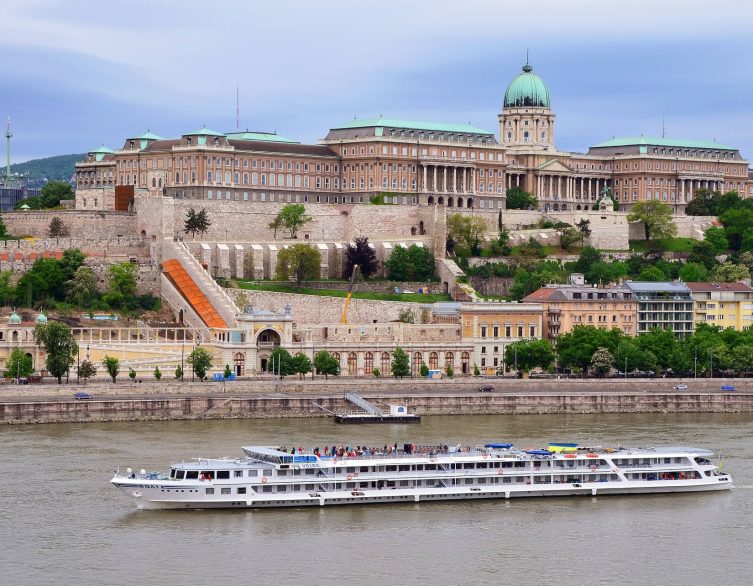
Budapest in Bloom: The Magical Cherry Blossom Story You Never Knew
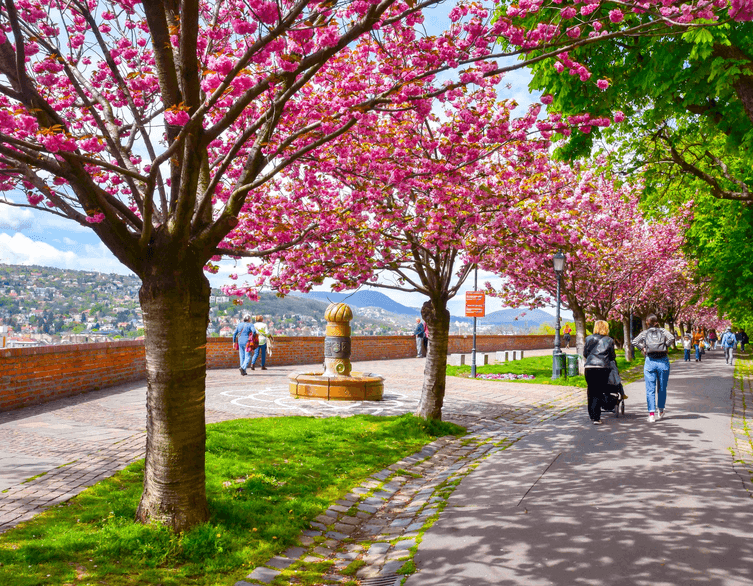
Every spring, something extraordinary happens on a quiet promenade tucked behind Buda Castle. Hundreds of Japanese ornamental cherry trees burst into cascading waves of deep pink blossoms, transforming a simple walkway into one of the most breathtaking sights in Central Europe. But the story of Budapest’s cherry blossoms is more than just a seasonal spectacle — it’s a tale of diplomatic warmth, a forgotten gift, and a connection between two cultures separated by thousands of miles.
The Pink Tunnel of Tóth Árpád Promenade
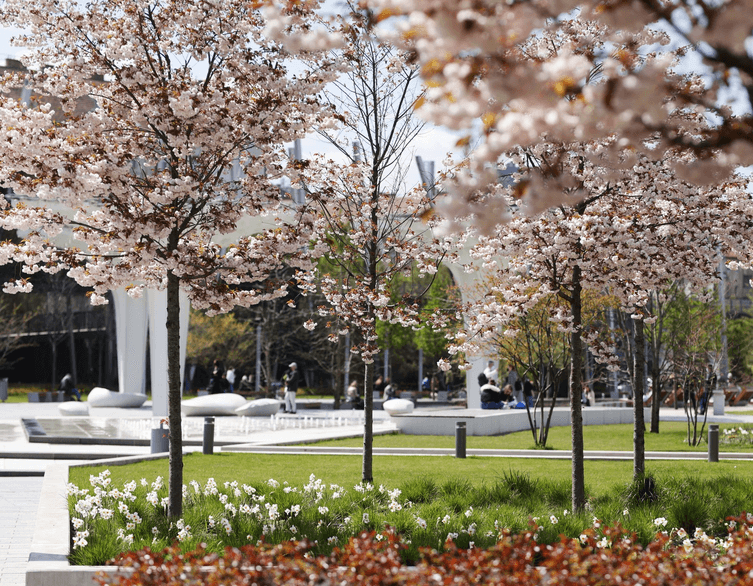
If you only have one hour in Budapest this spring, spend it on Tóth Árpád Promenade in the Castle District. Stretching along the western walls of Buda Castle, this elegant pedestrian walkway is lined on both sides with hundreds of Prunus serrulata ‘Kanzan’ trees — the Japanese double-flowered ornamental cherry, famous for its extravagant, powder-puff blooms. When they reach peak bloom, the trees form what locals and visitors alike call the “Pink Tunnel”: a continuous, glowing canopy of blossoms so dense that the light filtering through turns everything a soft, dreamlike pink.
Best deals of Budapest









Walking beneath the canopy feels almost surreal. On one side, the grand stone walls and elegant facades of the Castle District rise above you; on the other, the panoramic views stretch across the Buda Hills and the rolling residential neighbourhoods beyond. The ground itself becomes carpeted in fallen petals, like a scene from a Japanese woodblock print — which, as it turns out, is not entirely a coincidence.
A Royal Visit That Changed History
The cherry trees of Budapest owe their existence to a story that begins in the bitter cold of January 1931, when Prince Nobuhito Takamatsu of the Japanese Imperial family arrived in Budapest with his new bride, Princess Kikuko. The young couple was on a European honeymoon tour, combining a diplomatic mission with what should have been a romantic journey — though by all accounts, the trip was more of an ordeal than a fairy tale. Across Europe, they were often treated as exotic curiosities or received with political coldness due to Japan’s close ties with Germany at the time.
Budapest, however, was a different story entirely. Hungary extended a genuinely warm welcome to the couple, driven in part by its own diplomatic interests — Hungary was keen to forge new eastern alliances in the aftermath of the Trianon Treaty, and the then-fashionable theory of “Turanism” (the idea that Hungarians and Japanese shared distant linguistic and cultural kinship as agglutinative language speakers) gave the meeting a particularly friendly intellectual flavour. The official visits went splendidly, but what truly charmed the young royals was the city itself and its people.
During a stroll along the Danube promenade, the Imperial couple was allowed to blend quietly into the crowd — a remarkable gesture, considering that at the time only a handful of Japanese people lived in Budapest. Passersby chatted with them and vendors sold them goods without fuss or ceremony. Princess Kikuko was so moved by the city’s cool, wintry beauty that she composed a poem comparing the falling snowflakes to flower petals — “the silver flower on the branch… perhaps this is the most beautiful of all?” It was a fleeting, genuine moment of human connection amid all the stiff formality of a royal tour.
The Gift That Grew Into a Legend
After the two-and-a-half-day visit, the couple departed for Vienna with a warm letter of thanks. But the gesture that would echo through the decades came from Tomoyoshi Sumioka, president of the Japan–Hungary Friendship Society. In gratitude for the exceptional hospitality shown to the prince and princess, Sumioka sent 50 cherry tree saplings to Hungary, accompanied by a letter that was as poetic as it was heartfelt:
“I have the honour of presenting fifty cherry trees to the noble and chivalrous Hungarian nation. I would be very happy if, two or three years from now, these trees were to stand in full bloom on the banks of the Danube… I offer this small gift as though I were marrying off my beloved daughter to her betrothed…”
Had Hungary followed Sumioka’s wish, the Danube riverbank would today be lined with cherry blossoms in spring — a vision almost too beautiful to imagine. Fate, however, had other plans. The 50 saplings were divided: 25 went to the Buda Arboretum and 25 to the Japanese Garden in Zugló. Whether this was the better decision for the city’s development is open to debate — and there’s also the sobering thought that trees planted along the elegant Danube Promenade in 1931 would have faced the catastrophic bombardments of World War II just over a decade later, when that very same riverbank was reduced to ruins and its grand hotels burned for days.
A Living Legacy in the City Today
The descendants of those original imperial gift trees still grow in Budapest. At the Japanese Garden in Zugló, one of the most serene and little-known corners of the city, a cherry tree whose lineage traces directly back to the 1931 royal gift still stands. At the Buda Arboretum, too, the legacy of that diplomatic gesture lives on quietly, season after season.
But it is Tóth Árpád Promenade — planted with ‘Kanzan’ ornamental cherries by Budapest’s city parks authority, FŐKERT — that has become the undisputed centrepiece of Budapest’s spring. According to FŐKERT, the trees reached full, spectacular bloom right around Easter 2026, their buds, petals, and flowers appearing almost simultaneously in a rush of colour, fragrance, and the gentle hum of bees. The blossoms typically last only one to two weeks, which only adds to their appeal.
How to Make the Most of Cherry Blossom Season
The bloom is, by nature, fleeting — so timing matters. Cherry blossom season in Budapest generally falls between late March and mid-April, with peak bloom usually around the first week of April. The promenade is busiest during midday and on weekends, so the best strategy is to arrive early in the morning, when the light is soft on the Buda side and the crowds are still thin. Bring a camera (or just your phone), walk slowly, and don’t rush — the promenade is not long, but it rewards the unhurried visitor.
After the promenade, it’s worth exploring the wider Castle District, where stray cherry trees bloom in hidden courtyards and against ancient stone walls. From there, the short walk to Fisherman’s Bastion and Matthias Church offers some of the most iconic views in Budapest, framed in spring by lingering petals drifting on the breeze. If you have more time, seek out the Japanese Garden in Zugló — a true hidden gem, with its torii gate, stone lanterns, and little bridges over a still lake — where you can stand beside a tree whose roots reach all the way back to a royal honeymoon in a snowy January, nearly a century ago.
Budapest’s cherry blossoms last only days. But the story behind them has been quietly growing for almost a hundred years.
Follow Budappest.com on Facebook
Related news
Budapest in Bloom: The Ultimate Guide to Japanese-Themed Spring Experiences for Tourists in 2026
Spring in Budapest is a quietly spectacular thing. One morning you’re bracing against a March chill, and the next, the city’s parks and...
Budapest in Bloom: Your Complete Guide to Cherry Blossom Season in the Hungarian Capital
Spring arrives in Budapest like a quiet revolution. One morning you’re zipping up your jacket against a sharp March chill, and the next, the...
Budapest in Bloom: Discovering the Almond Trees of Gellért Hill
As winter fades and spring gently takes hold, Budapest awakens to a charming spectacle: the blossoming almond trees of Gellért Hill. Every year,...
Related attractions