Aurora Borealis in Budapest 2026: A Rare Northern Lights Spectacle Over Hungary
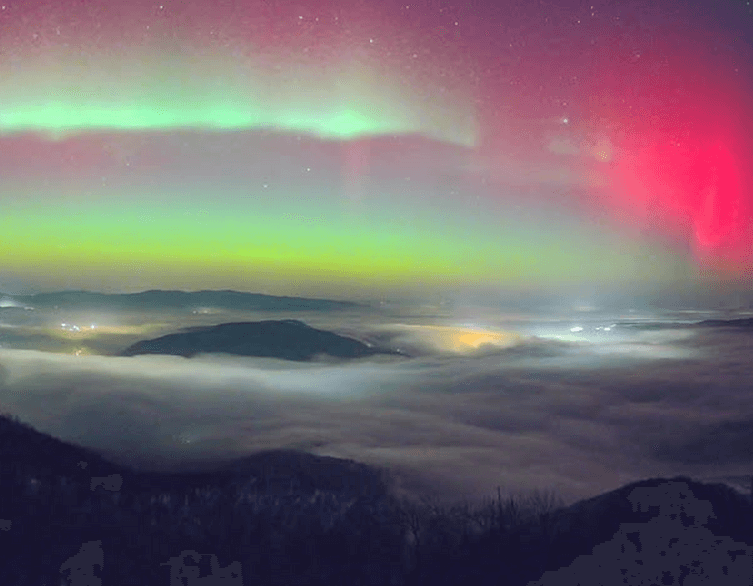
Anyone gazing up at Hungary’s night sky this week might have believed they’d traveled north to Iceland or Norway. But on Monday evening, the unthinkable happened — the aurora borealis lit up the Hungarian sky, painting it in waves of pink, red, and shimmering green. This extraordinary Northern Lights event over Budapest and Lake Balaton in January 2026 was visible to thousands, a once-in-a-generation sight that turned an ordinary winter night into a cosmic display of color.
A Storm From the Sun Lights Up Europe
According to meteorologists from the National Weather Service and the U.S. Space Weather Prediction Center (NOAA SWPC), the dazzling light show was triggered by a powerful solar flare from sunspot group 4341. The flare, measuring X1.9 on the solar scale, was followed by a massive coronal mass ejection (CME) — a burst of highly charged particles that raced across space before colliding with Earth’s magnetic field.
When the wave of solar energy reached our planet on Monday evening, it sparked a G4-class geomagnetic storm, one of the strongest in more than two decades. To put that in perspective, similar solar activity last produced visible auroras in Central Europe back in October 2003.
Best deals of Budapest












Hungary’s Sky Turns Pink and Green
Around 8 p.m., the first reports poured in: the night sky above the Danube Bend and Lake Balaton began glowing rose-pink, transitioning to vivid green bands just half an hour later. Cameras in places like Prédikálószék, Balatonfenyves, Dobogókő, and Füzér captured breathtaking images — the snow-covered hills shining beneath ethereal light beams while fog rolled through the valleys below.
Arora borealis lit up the Hungarian sky
The best of sightings from all over Hungary
By 8:38 p.m., Hungary’s skies were fully illuminated by the aurora borealis, with intensity strong enough to reflect off the frozen surface of Lake Balaton. Even as fog blanketed the lowlands, the higher elevations and clear southern shores offered postcard-perfect views.
For travelers lucky enough to witness it, it was an unforgettable moment — the northern lights dancing over wineries, castles, and winter lakes rather than Arctic tundra. Locals described it as surreal, with many saying they’d never seen colors so bright or skies so alive.
Why the Aurora Borealis Reached Hungary
Under normal conditions, auroras appear near the Arctic Circle, in places like Norway, Finland, and Canada. But during severe solar storms like this 2026 geomagnetic event, the Earth’s magnetic field becomes highly disturbed, allowing charged particles to penetrate far closer to the equator.
These particles collide with atoms in Earth’s atmosphere — particularly oxygen — releasing light energy. The color of the aurora depends on altitude: pink and red hues form over 300 kilometers high, while the classic green glow comes from oxygen atoms excited at altitudes between 100 and 300 kilometers. In Hungary, both colors appeared, confirming the exceptional strength of this geomagnetic storm.
The Best Places to See the Northern Lights in Hungary
Although rare, Hungary does occasionally get glimpses of the aurora during major solar storms. Clear, dark skies and elevated spots away from city lights offer the best chance to see it. Scenic areas like the Danube Bend, Dobogókő lookout, Balaton uplands, and Prédikálószék peak were among the top vantage points during this year’s display.
Even in Budapest, sharp-eyed skywatchers caught faint pink streaks above the Citadel and Normafa hills when clouds cleared briefly. Webcams broadcast the phenomenon live across the country, making it accessible to viewers near and far.
A Night to Remember — and a Sign of More to Come
Astronomers note that solar activity follows roughly an 11-year cycle, with 2026 marking one of its most active peaks. That means Hungary and Central Europe could see more aurora sightings in the coming months, especially during clear winter nights.
For travelers planning a visit, this makes early 2026 an even more exciting time to experience the region’s natural wonders. Imagine soaking in one of Budapest’s warm thermal baths under an aurora-streaked sky — an experience that feels almost otherworldly in the heart of Europe.
So while the aurora borealis might usually belong to the Arctic north, Hungary briefly claimed it for itself this week, giving both locals and visitors a memory they’ll never forget. If the solar winds keep dancing across our skies, the aurora borealis in Budapest 2026 will be remembered as one of the city’s most magical winter moments.