Budapest Is Losing One of Its Most Iconic Nighttime Landmarks — And Nobody Seems to Care Enough to Stop It
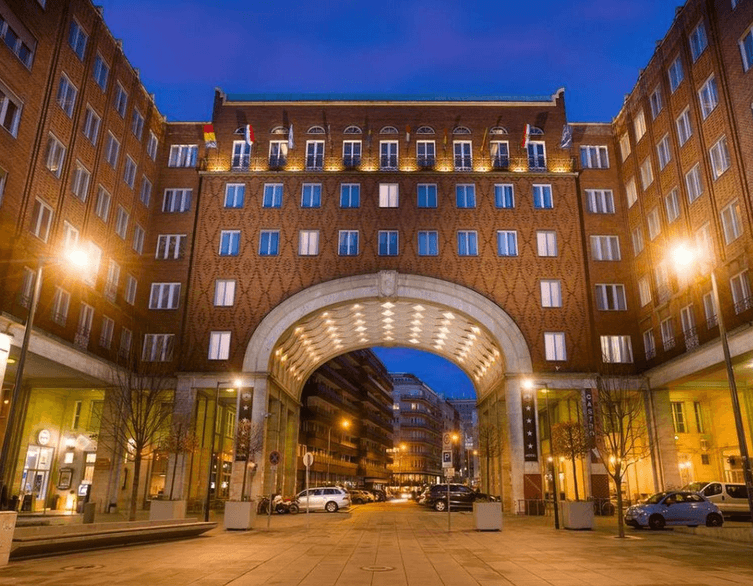
If you’ve ever walked through the inner city of Budapest after dark and found yourself pausing to look up at the illuminated archway on Madách Square, you already understand what’s at stake. That glowing brick arch — part of a remarkable architectural complex that has framed this corner of the city since 1939 — may soon go dark. And the story of why tells you quite a lot about how Budapest is slowly, quietly losing pieces of itself.
The Arch That Was Never Meant to Stand Alone
To understand what Madách Square’s archway means to Budapest, you need to go back to the ambitions of early 20th-century city planners. The Madách Houses — an eleven-building complex designed by professor Gyula Wälder with the assistance of architects Tibor Hübner, István Janáky, Gedeon Gerlóczy, Béla Málnai, and Andor Wellisch — were completed in 1939. The original vision was bold: the complex was to serve as the grand gateway to a brand new boulevard, the so-called Elizabeth Boulevard, which would have cut a sweeping path from the inner city all the way to City Park, lined with shops and civic life.
History had other plans. First the Great Depression slowed progress, then the Second World War brought it to a halt entirely. Postwar poverty and eventually heritage protection considerations meant the boulevard was quietly shelved and never built. The Madách Houses remained as a gateway to nowhere — except that over the decades, they became something in their own right: one of Budapest’s most distinctive and beloved architectural landmarks.
What Makes This Building So Special
The complex is a fascinating architectural hybrid, blending Oriental and Dutch influences into a striking whole built from clinker brick. Its central block spans the roadway in a triumphal arch style, framing the view beneath it like a picture. The red-hued facades, U-shaped arcade, neo-Baroque wrought iron balcony railings, and Art Deco parapet give Madách Square a character found nowhere else in the city. The building is listed as a protected heritage monument, which makes what is now unfolding around its lighting all the more difficult to understand.
Best deals of Budapest







The illumination of that archway has long been more than just street lighting. It acts as the gateway to Erzsébetváros — Budapest’s 7th District — and is a defining element of the inner city’s nighttime skyline. For tourists walking the evening streets between the ruin bars of the Jewish Quarter and the Grand Boulevard, it is one of those sights that makes Budapest feel like a city that takes its own beauty seriously.
A Bureaucratic Standoff with a Familiar Result
So what is actually happening? According to Budapest Public Utilities (BKM), the electrical switchboxes that power the arch lighting are located inside the building itself — on private property. As the building undergoes renovation, the company says it can no longer guarantee long-term access to that infrastructure, making the current system unsustainable. Their proposed solution: replace the arch lighting with standard street lamps mounted on conventional poles.
The building’s owner, Budapest Real Estate Utilization and Development Company (Budapesti Ingatlan Nyrt.), tells a considerably different story. Following the initial reporting on this matter, the company came forward to clarify that they had in fact proposed a fully costed, detailed solution that would have maintained the existing lighting system — keeping the switchboxes inside the building while granting the utilities company secure access for maintenance. They say the Metropolitan Municipality and BKM ultimately made their decision without involving the property owner, and that they find the outcome deeply unfavourable. The company has been clear that it is committed to preserving the distinctive character of the square and believes that conventional pole-mounted lamps would cause genuine damage to the cityscape. Notably, their proposed alternative was also described as the least expensive option available.
BKM, for its part, has noted that if the property owner chooses to restore the arch lighting at their own expense from inside the building, the lights could technically be switched back on. That is, in effect, an invitation for a private company to fund what has until now been public infrastructure — a position that many locals have found difficult to accept.
A Pattern That Should Worry Every Visitor to Budapest
For tourists who love Budapest precisely because of its atmospheric streets, rich architectural heritage, and the particular magic of the city at night, this story is worth paying attention to. The Madách arch situation is not an isolated incident. It fits into a broader and dispiriting pattern of Budapest’s public lighting being scaled back, left unrepaired, or quietly replaced with cheaper, less characterful alternatives.
The darkened arcades along Rákóczi Road and the Grand Boulevard have been a source of complaint from locals for years. Decorative lighting across the city has been cut short by hours in the evening. The ornamental waterfall on Gellért Hill has sat unlit for extended periods. Underpasses across the city grow steadily darker. Each individual decision might seem minor on its own, but the cumulative effect is a city that looks noticeably less impressive after dark than it did a decade ago — and that matters enormously for a destination whose nighttime atmosphere is one of its greatest draws.
What Comes Next
As of April 9, 2026, the dispute remains unresolved. The Metropolitan Municipality and BKM have made their preference clear, while the property owner maintains that the decision was made without their meaningful participation and will cause lasting harm to the square’s visual identity. The public conversation this story has sparked has been notable — local residents and architectural observers have voiced their concern, with one resident describing the arch light as a visual element so deeply tied to Budapest that its loss would go far beyond a simple question of street lighting.
Whether the pressure of public opinion will lead to a rethink remains to be seen. If you are visiting Budapest in the near future and want to see the archway at Madách Square glowing warmly against the night sky, it is worth making the walk sooner rather than later. Some things, once lost, have a way of staying lost.
Follow Budappest.com on Facebook