Budapest Is Changing the Way It Collects Bottles — Here’s What Tourists Need to Know
If you’ve bought a bottle of water, a soft drink, or a can of beer anywhere in Budapest, you may have spotted a small extra charge on your receipt — 50 Hungarian forints. That’s Hungary’s deposit-return system at work, and as a visitor, it’s worth knowing how it works, because you can claim that money back before you leave town. What’s more, the system is about to get a significant upgrade, with faster machines and new collection points set to transform the experience for everyone.
The Basics: How the Deposit System Works
Hungary launched its nationwide deposit-return system on 1 January 2024, managed by MOHU, a company operating under a long-term national concession. Every time you buy an eligible drink — a plastic bottle, a glass bottle, or an aluminium can between 100ml and 3 litres — you pay an extra 50 forints as a deposit. Return the empty container, and you get that money back. It’s essentially borrowing the bottle rather than buying it, and the idea has caught on with remarkable speed.
By the end of 2025, Hungary’s return rate had climbed to around 90%, placing it firmly among the best-performing deposit schemes in Europe — all the more impressive given that many other countries have been running similar systems for ten to fifteen years. Last year alone, Hungarians returned 3 billion bottles and cans, generating 150 billion forints in returned deposits. Budapest, as the country’s largest city, sits at the heart of this success story.
Best deals of Budapest









How to Return Your Bottles Right Now
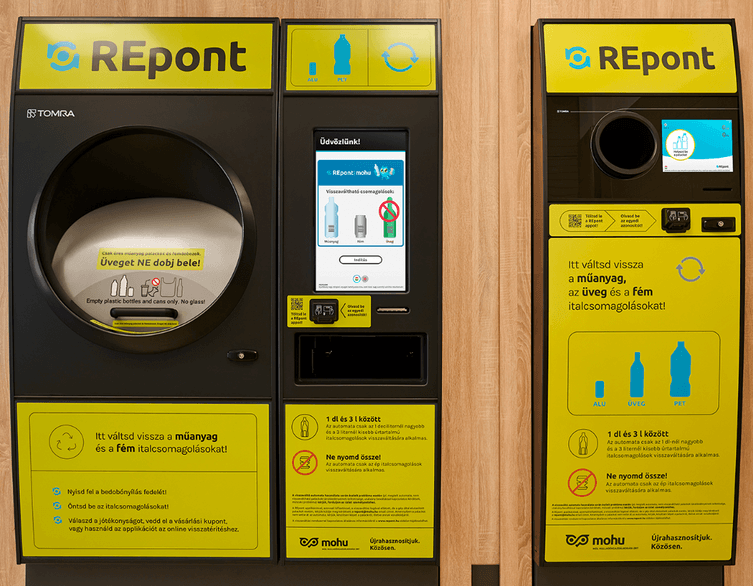
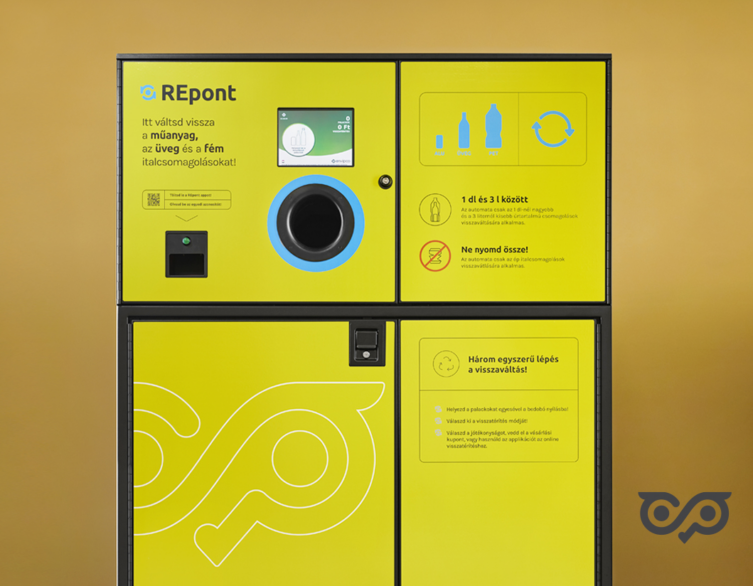
The most common way to return bottles in Budapest is through reverse vending machines found in supermarkets and larger grocery stores. Any store with a sales area over 400 square metres — think Tesco, Spar, Aldi, Lidl, or CBA — is legally required to have one on site. You insert your bottles and cans one at a time, the machine reads the barcode, confirms eligibility, and prints a voucher for the total deposit amount. You can spend that voucher in the store — which about 80% of people do — or simply ask for cash at the till. As a tourist with no more shopping to do, the cash option is usually the most practical choice.
Smaller shops and petrol stations may offer manual return points, where a staff member processes your containers by hand. These are slightly less common in the city centre but are a useful fallback if a machine is full or out of order. In that case, store staff are legally obliged to accept your bottles manually regardless.
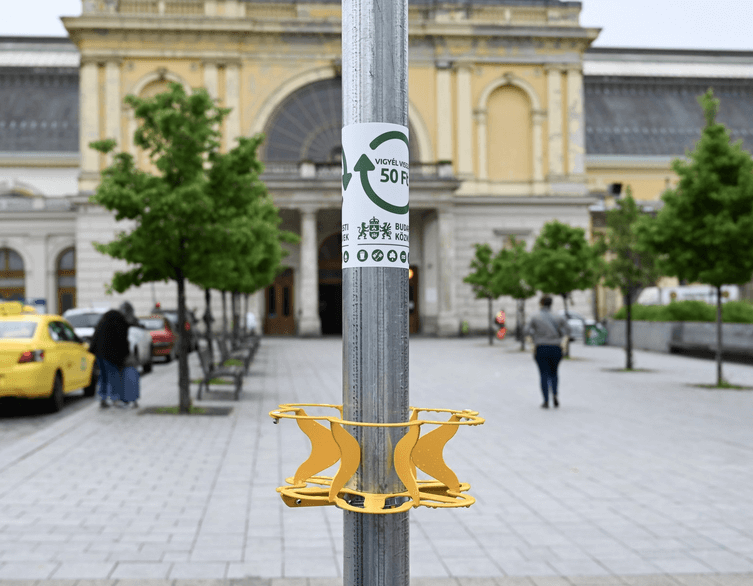
A more informal but rather charming alternative has also appeared around Budapest’s streets: bright yellow bottle holders fixed to lamp posts above litter bins, introduced as a city pilot scheme in May 2025. If you simply don’t want to bother with the machine, you can drop your empty bottle into one of these holders and a local collector will pick it up. It’s a small, community-minded solution to a very urban problem, and a telling sign of just how embedded the deposit system has become in everyday Budapest life.
What Can Be Returned — and What Can’t
The system covers single-use plastic PET bottles, glass bottles, and aluminium cans for ready-to-drink beverages. Eligible packaging carries a special REpont label or QR code — if you don’t see that marking on your container, the machine won’t accept it. Milk and milk-based drinks, yoghurt containers, and preserving jars are currently excluded, though dairy-adjacent beverages like iced coffee are being considered for future inclusion. A simple rule of thumb: check for the REpont logo when you buy your drink, and you’ll know you can get your deposit back later.
The Big Change: Bulk-Feed Machines Are Arriving
Here is where things get genuinely exciting. The traditional one-by-one reverse vending machine is about to be joined — and in busy locations eventually replaced — by a new generation of bulk-feed machines that can process up to 100 bottles per minute. Instead of inserting containers individually, you simply pour them in all at once. The machine automatically identifies, sorts, and compacts them as they arrive, making the whole process dramatically faster for everyone in the queue behind you.
The first bulk-feed machine in Budapest went live in late 2025, and there are now nine units operating across Hungary. MOHU has stated that the goal is to have at least one of these machines in every county in the country. The average return per visit in Hungary is already 25 bottles, so the appetite for faster, higher-capacity machines is clearly there.
Coming to Public Spaces — Eventually
Perhaps the most ambitious part of the plan is placing bulk-feed machines outdoors, in public spaces, completely independent of any shop. MOHU is actively exploring this possibility, and the concept has clear appeal: if you have a bag of bottles and don’t want to go into a supermarket, a street-side machine would be a genuinely convenient alternative.
The rollout won’t happen overnight, however. The smallest outdoor bulk-feed unit measures three by four metres, and the largest stretches to three by ten metres, so finding suitable locations requires careful negotiation with local councils and communities. The first candidates are likely to be waste collection yards, where the necessary infrastructure — power, internet, storage space, and logistics — is already in place. From there, MOHU plans to evaluate how well the machines perform before expanding further. As Csaba László Bozóki, MOHU’s waste management director, put it: the plan is to place one or two units, see how they work in practice, and grow from there. Several Budapest district councils are already in early discussions with the company about potential sites.
A Few Practical Tips for Visitors
Returning your bottles in Budapest is quick once you know the routine. Keep your containers uncrushed, as the machine needs to read the barcode clearly. Make sure the cap is on — the system requires intact packaging. The busiest return times are Fridays and Saturdays, so if you prefer a shorter queue, a mid-week visit to the machine will serve you better. And if the machine is full or displaying an error, don’t walk away — ask a staff member, who is required to handle your return manually. With over 5,200 return points across Hungary and nearly 3,800 machine-equipped locations, finding somewhere to return your bottles in Budapest should never take more than a few minutes.
Related news
Budapest’s 2026 Bulk Waste Collection Schedule: A Tourist’s Guide to the City’s Annual Cleanup Event
If you’re visiting Budapest in early 2026 and notice streets lined with old furniture, mattresses, and household items, don’t worry—it’s...
Budapest’s Bottle Revolution: Recycle On The Go
A Fresh Face for Recycling in Budapest If you’re strolling through Budapest this spring, you might spot something new and surprisingly stylish...
The New Waste Collection System in Budapest: The End Of An Era?
The recent restructuring of waste collection services in Budapest by MOHU will make it literally harder to get rid of accumulated junk in homes....
Getting Cash for Returned Bottles in Budapest: A Little-Known Trick
Hey there! Did you know that you can get cold, hard cash for returning your bottles and cans? That’s right, you don’t have to settle...