Budapest Erupts in Joy: Hungary’s Historic Election Ends Orban Era
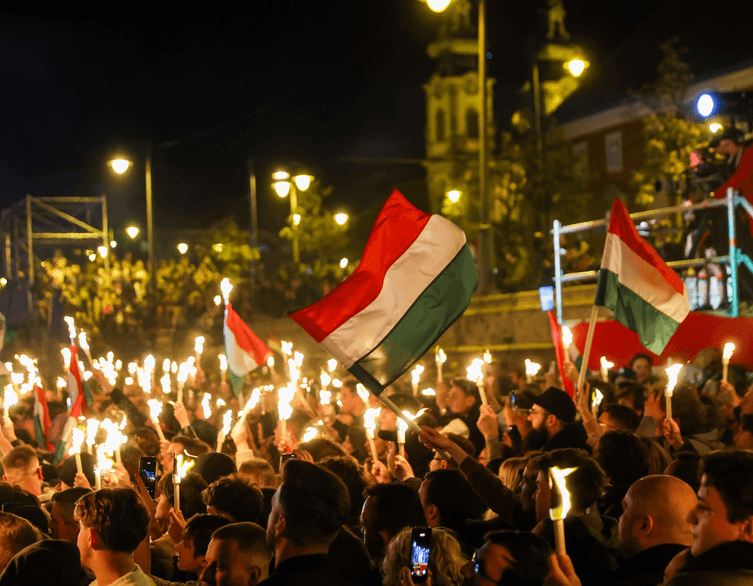
If you happened to be in Budapest last night — or if you’re arriving in the city today — you may have noticed something extraordinary in the air. The streets were alive, the Danube embankment was packed, and the sound of car horns, champagne corks, and jubilant chanting echoed through the Hungarian capital well past midnight. Sunday, April 12, 2026, will go down as one of the most transformative nights in modern Hungarian history.
A Political Earthquake Shakes Hungary
After 16 years of uninterrupted rule by Viktor Orbán and his Fidesz party, Hungary voted decisively for change. The centre-right, pro-European opposition party Tisza, led by the charismatic Péter Magyar, scored a landslide victory in the country’s parliamentary election — one that left even the most seasoned political observers stunned by its sheer scale.
Best deals of Budapest






The writing had been on the wall for weeks. The final pre-election polls painted a remarkably consistent picture: the last survey by Minerva Intézet, published on April 10, gave Tisza 50.8% to Fidesz’s 41.1%, while Atlas Intel’s final poll had Tisza even further ahead at 52.1% against Fidesz’s 39.3%. Magyar himself outpaced Orbán in personal approval ratings too — 54.7% of respondents considered him the most fit to serve as Prime Minister, compared to just 40.8% for the incumbent. The polls had been pointing in one direction for months, yet nothing quite prepared the country for how decisive the final margin would be.
When the National Election Office began releasing preliminary results just after 8 PM, the initial trickle of rural votes briefly showed Fidesz ahead, sending a ripple of anxiety through Tisza’s supporters. But as Budapest’s votes came in — the capital being traditionally the last and largest bloc to be counted — the picture shifted dramatically. With 29% of votes counted, Tisza was already at 50% to Fidesz’s 41%. By the time 45.7% of votes had been tallied, Tisza held 51.98% of the national list vote to Fidesz’s 39.38%, with the far-right Mi Hazánk trailing at 6.07%. The final preliminary returns confirmed that Tisza had won 138 seats in the 199-member Parliament — well above the two-thirds supermajority threshold — while Fidesz was projected to lose over half of its seats. Orbán conceded defeat on election night and congratulated Magyar, drawing the curtain on one of the EU’s most controversial governments.
The turnout figures told their own story. A remarkable 80% of eligible voters cast their ballots, a record-breaking number that underlined just how much this election mattered to the Hungarian people. For many, it was not merely a vote for a new government — it was a vote for Europe, for democracy, and for a future they had been hoping for through four consecutive Fidesz election wins.
The Celebration That Took Over Budapest
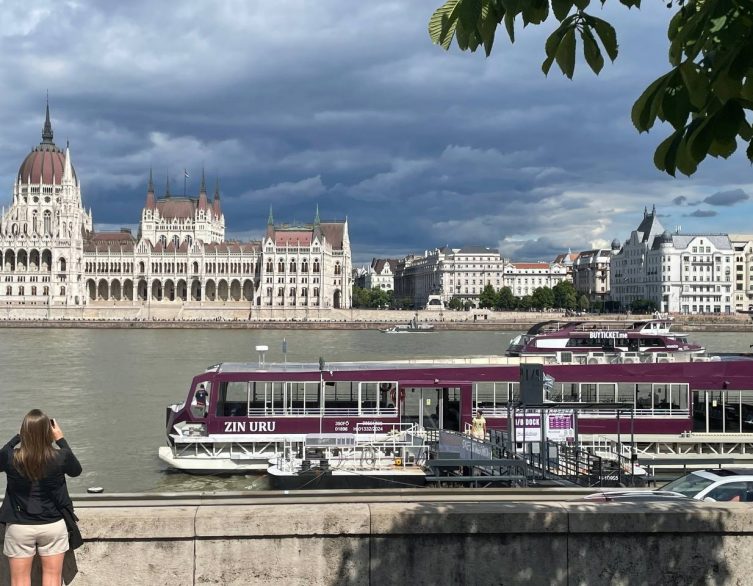
By the time the results became clear on Sunday evening, the heart of Budapest had already transformed. Batthyány Square, the elegant riverside piazza on the Buda side of the city facing the illuminated Parliament building directly across the Danube, was Tisza’s chosen venue for its election night gathering — and the choice proved deeply symbolic. Earlier in the evening, the square had been pulsing with a full-blown techno party, with DJ sets and booming bass filling the riverside air as thousands of supporters danced and waited anxiously for the results to roll in.
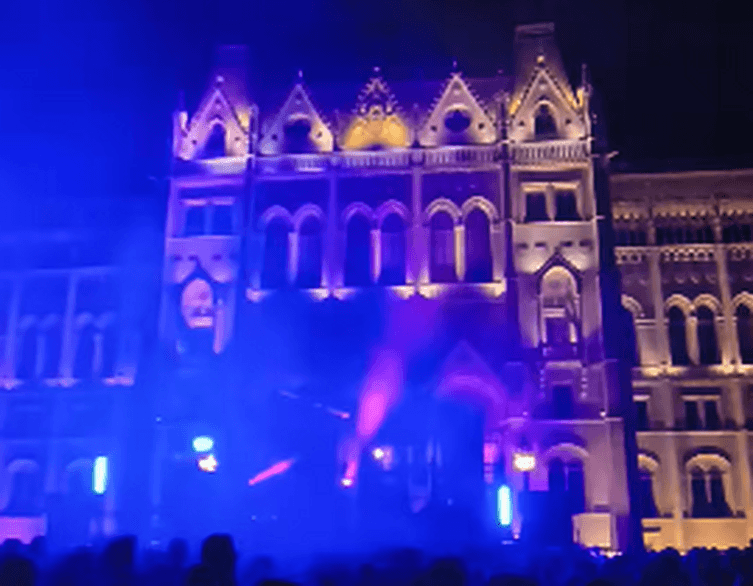
The elections' afterparty
A new beat
But when the numbers finally confirmed what so many had barely dared to dream, the organized festivities gave way to something far more powerful and unscripted — a spontaneous, city-wide eruption of joy that no event organizer could have planned. Thousands upon thousands of supporters flooded the square and the surrounding embankment, waving Hungary’s red, white, and green tricolor alongside the gold-starred blue flag of the European Union.
Budapest celebrates the beginning of a new era
The iconic Chain Bridge, one of Budapest’s most beloved landmarks and a favourite photo stop for tourists, was bathed in Hungary’s national colors as the night unfolded. Below it, along the banks of the Danube, tens of thousands of people toasted with champagne poured into paper cups, strangers embraced, and flares lit up the riverfront in bursts of color and smoke. The air carried a heady mixture of fireworks, smoke, and sheer euphoria — something visitors present that night described as feeling unlike anything they had ever witnessed in the city.
A City United in Celebration
What made last night truly remarkable was that the joy did not stay contained to one square or one riverside. It spilled into every corner of the city, leaping across neighborhoods and finding its way into the most unexpected of places. Underground, on the metro lines that crisscross Budapest beneath its grand boulevards, passengers broke into spontaneous singing and cheering — strangers on their evening commute suddenly united by an overwhelming shared emotion. Carriages that would normally hum along in quiet exhaustion were instead ringing with chants, laughter, and the kind of collective delight that is impossible to manufacture.
Above ground, the same scenes played out on trams, in courtyards, on café terraces, and along side streets far from the main stage. The joy was not directed or organized — it simply overflowed, as if the city itself could not contain what its people were feeling. For any tourist who happened to be out and about in Budapest last night, it was the kind of spontaneous, human moment that stays with you long after you return home.
“I Never Thought This Would Actually Happen”
The emotion on the streets was raw and deeply personal. Many of those celebrating had been waiting for this moment for the entirety of Orbán’s tenure — some for half their adult lives. One Tisza supporter named Szilvia, speaking near the Danube embankment as Péter Magyar delivered his victory speech, put it simply: “I feel amazing. Really amazing. Like, I never thought this would actually happen. I’ve been praying for this for 16 years so I’m super happy.”
Magyar’s speech drew enormous applause from the gathered crowd, and at several points supporters rushed the stage to join in the celebration. Chants of “It’s over!” rippled through the crowds, a phrase that captured 16 years of pent-up frustration finally given a release. For foreign visitors witnessing the scene, it was an immersive, once-in-a-generation glimpse into Hungarian civic life at a turning point in history.
What This Means for Hungary — and for Budapest
Péter Magyar and Tisza have campaigned on a platform of sweeping reforms, a firm commitment to European Union values, and a determined anti-corruption drive. The victory is seen across Europe as a significant geopolitical shift — a blow to Orbán’s traditionally close ties with Moscow and a clear signal that Hungary intends to re-anchor itself within the mainstream of European politics. Magyar was swiftly congratulated by international leaders, who described the outcome as a historic result for the region.
For Budapest itself, the mood this Monday morning is one of cautious, joyful optimism. The city that hosted one of the most dramatic election night celebrations in recent European memory is now waking up to the question of what comes next. Tourists walking along the Danube today may still encounter the remnants of last night’s festivities — flags left on railings, chalk messages on the pavement, and locals who simply cannot stop smiling.
A City Worth Visiting — Now More Than Ever
If this election result and the extraordinary celebrations it unleashed have piqued your curiosity about Budapest, there has never been a better time to visit. The Hungarian capital is a city that wears its soul on its sleeve — its grand Parliament building, its thermal baths, its vibrant ruin bar scene, and now, its capacity for historic, joyous transformation. Whether you are strolling across the Chain Bridge, sipping a coffee on Andrássy Avenue, or simply soaking in the atmosphere of a city at a crossroads, Budapest right now is electric in a way that no guidebook could ever fully prepare you for.
Follow Budappest.com on Facebook